AI Audio Guide
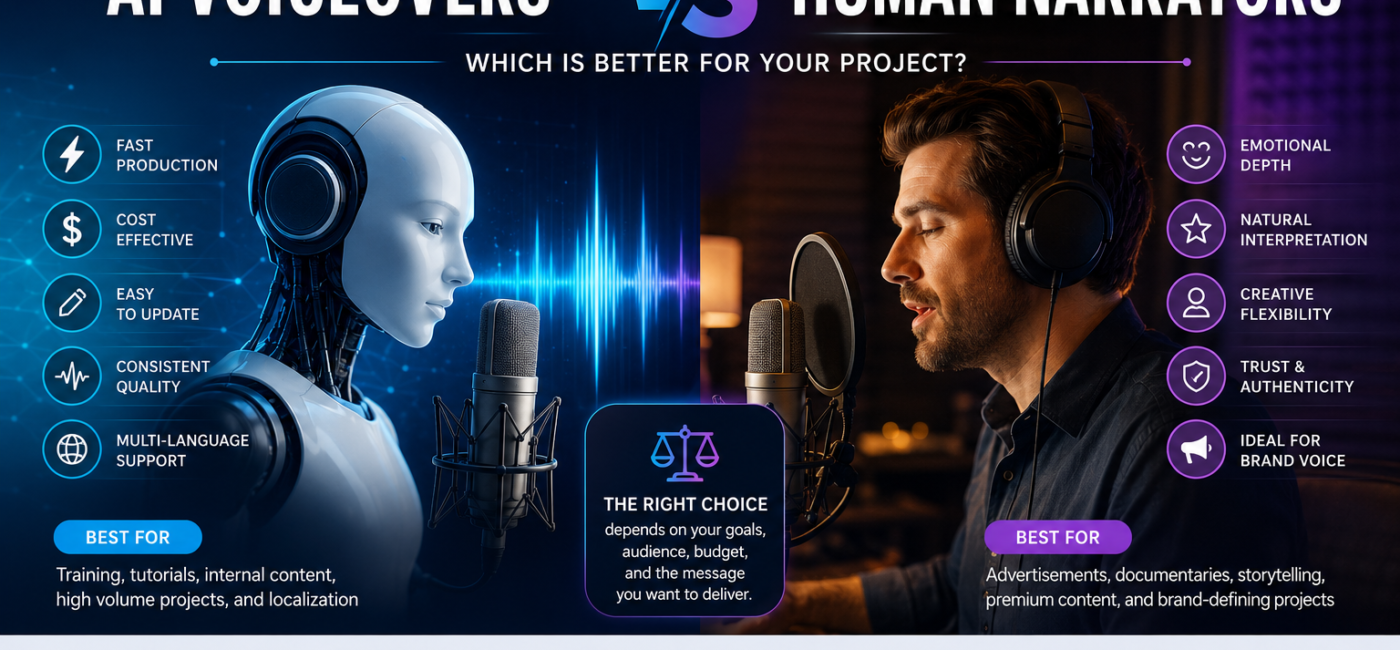
AI Voiceovers vs Human Narrators: Which Is Better for Your Project?
AI voiceovers are not simply replacing human narrators.
They are changing which projects require a professional human performance and which can be produced efficiently with synthetic speech.
AI-generated voices can be fast, consistent, scalable, and easy to update. Human narrators remain stronger when emotional interpretation, originality, trust, character, and creative direction are central to the message.
Editorial approach:
This vendor-neutral guide compares AI voiceovers and human narration based on production speed, editing flexibility, emotional quality, consistency, localization, ethics, and audience expectations.
Oxad.ai does not recommend cloning, imitating, or commercially using a person’s voice without clear permission and appropriate agreements.
Key Takeaways
- AI voiceovers are well suited to frequent updates, internal training, localization, and high-volume content.
- Human narrators remain stronger for emotional storytelling, premium campaigns, fiction, and brand-defining work.
- Voice cloning should only be used with informed permission and clearly defined usage rights.
- AI-generated audio still requires pronunciation, pacing, and quality review.
- A hybrid workflow often provides the best balance of speed, cost, and quality.
What Is an AI Voiceover?
An AI voiceover is audio created by converting written text into synthetic speech.
Modern text-to-speech systems may offer different voices, languages, speaking styles, pronunciation settings, pacing controls, and emotional tones.
Some platforms also allow an authorized user to create a custom synthetic voice based on recorded samples.
This can be useful for maintaining a consistent voice across a large collection of videos, training materials, product demonstrations, or accessibility versions.
However, not every AI-generated voice sounds equally natural.
Quality can vary according to the language, voice model, script, sentence length, punctuation, and emotional demands of the content.
How Do AI Voiceovers Work?
AI voice systems analyze written text and generate speech using models trained on recorded language patterns.
The system attempts to reproduce pronunciation, rhythm, emphasis, pauses, and vocal tone.
A typical workflow includes:
- Writing or importing the script.
- Selecting a voice and language.
- Adjusting speed, pauses, emphasis, and pronunciation.
- Generating the audio.
- Reviewing the result in the context of the final video or presentation.
- Correcting errors before publishing.
Important:
AI-generated narration should be treated as a production draft until names, numbers, locations, abbreviations, technical terms, and emotional delivery have been checked.
Where AI Voiceovers Perform Well
1. Frequently Updated Content
AI voiceovers are useful when scripts change regularly.
Updating one sentence in a software tutorial, product demonstration, onboarding video, or training module usually does not require booking another recording session.
2. High-Volume Production
Organizations that produce many short videos can use synthetic narration to reduce repetitive recording work.
This may include knowledge-base videos, internal announcements, product explainers, social media clips, and educational modules.
3. Localization
AI voice tools can help create versions of the same content in several languages.
This makes them useful for international training, marketing, customer onboarding, and accessibility.
Translation and pronunciation should still be reviewed by a fluent speaker, especially for public or brand-sensitive material.
4. Consistent Delivery
Synthetic speech can maintain similar volume, speed, and tone across a large content library.
This is valuable when several videos must sound like parts of one coordinated series.
5. Prototyping
Producers can generate temporary narration to test timing, scene length, subtitles, and background music before commissioning a final human recording.
6. Internal and Low-Risk Content
AI narration may be practical for internal training, early drafts, temporary demonstrations, accessibility versions, and materials where a distinctive human performance is not the primary value.
Where Human Narrators Remain Stronger
A professional narrator does more than pronounce words.
They interpret the script, understand context, respond to creative direction, and shape the emotional experience of the audience.
Emotional Storytelling
Human narrators can make subtle decisions about warmth, urgency, tension, humor, hesitation, confidence, and vulnerability.
These details are difficult to reproduce consistently with synthetic speech.
Premium Advertising
Brand-defining campaigns often require a distinctive and memorable voice.
A professional narrator can collaborate with directors and producers to develop a performance that supports the identity of the campaign.
Fiction and Character Work
Audiobooks, games, animation, and dramatic content benefit from character interpretation, timing, emotional transitions, and original performance choices.
Documentaries and Sensitive Subjects
Content involving personal testimony, public interest, history, health, loss, or serious social topics may require a clearly accountable human voice.
Complex Creative Direction
Human performers can immediately respond to feedback such as:
- “Make this line warmer.”
- “Reduce the sense of urgency.”
- “Pause as though the speaker is reconsidering the idea.”
- “Sound confident without becoming promotional.”
AI controls may offer similar labels, but the results can be less precise or less emotionally coherent.
AI Voiceovers vs Human Narrators: Side-by-Side Comparison
| Factor | AI Voiceover | Human Narrator |
|---|---|---|
| Production speed | Usually fast | Depends on scheduling and recording |
| Revisions | Easy for text changes | May require another session |
| Emotional nuance | Improving but variable | Strong with skilled performance and direction |
| Consistency | High across repeated scripts | High with professional production |
| Localization | Fast and scalable | Potentially more natural but slower |
| Originality | Depends on the selected model and voice | Distinctive personal performance |
| Creative collaboration | Controlled through settings and prompts | Responsive to detailed direction |
| Ethical risk | Consent, disclosure, and impersonation concerns | Usually addressed through contracts and attribution |
| Best use | Scalable, repeatable, and frequently updated content | Emotionally important and creatively demanding work |
Cost: Which Option Is More Affordable?
AI voiceovers are usually less expensive for large volumes of short or frequently updated content.
Costs may depend on characters, minutes, credits, languages, voice quality, or commercial-use rights.
Human narration may include:
- Recording fees.
- Studio costs.
- Editing and mastering.
- Usage rights.
- Revision fees.
- Broadcast or advertising licenses.
The lowest initial price is not always the lowest final cost.
An inexpensive synthetic voice may require extensive corrections or produce a result that reduces audience trust.
A professional narrator may be more economical when one high-quality recording will be used for a long period.
Ethical and Legal Considerations
Voice technology creates important questions about permission, ownership, impersonation, disclosure, and compensation.
Obtain Clear Permission
Do not clone or imitate a real person’s voice without informed consent.
Permission should define how the voice may be used, where it may appear, how long the agreement lasts, and whether the voice can be used to generate new material.
Define Usage Rights
Commercial agreements should explain whether the voice may be used in advertising, training, entertainment, social media, political content, or other sensitive contexts.
Consider Disclosure
Audiences may reasonably expect to know when a realistic voice is synthetic.
Disclosure can protect trust and may be required by a platform, contract, or applicable rule.
Avoid Deceptive Impersonation
Synthetic speech should not be used to mislead audiences into believing that a person made a statement they did not make.
Legal note:
Laws and contractual requirements vary by country and use case.
Obtain qualified legal advice before using cloned voices for advertising, public figures, sensitive communications, or large commercial projects.
A Responsible Decision Framework
-
Define the audience expectation.
A software tutorial has different requirements from a personal testimony, documentary, or premium advertisement. -
Identify the purpose of the narration.
Decide whether the voice is mainly delivering information, creating emotion, representing the brand, or performing a character. -
Assess reputational risk.
Sensitive or authoritative messages benefit from a clearly accountable human speaker. -
Confirm voice rights.
Never clone or imitate a voice without informed permission and an appropriate agreement. -
Review pronunciation.
Check personal names, locations, numbers, abbreviations, product names, and specialist terminology. -
Test the voice in context.
Listen to it with the final music, visuals, pauses, and subtitles. -
Disclose synthetic media when appropriate.
Transparency supports audience trust. -
Keep a human approval step.
A responsible person should approve the final audio before publication.
The Hybrid Approach: AI and Human Narration Together
Many teams do not need to choose only one option.
A hybrid workflow can provide the speed of AI and the quality of professional performance.
Common hybrid approaches include:
- Using AI voiceovers for script timing and early video drafts.
- Replacing temporary AI narration with a professional narrator before publication.
- Using human narration for flagship content and AI for internal updates.
- Creating translated versions with AI and reviewing them with fluent speakers.
- Licensing a narrator’s custom synthetic voice under agreed conditions.
- Using AI for accessibility versions while preserving the original human performance.
Practical tip:
Use a temporary AI voice while editing the video.
When the timing and script are final, decide whether the project justifies professional human narration.
This avoids paying for repeated recording sessions during early revisions.
Common Mistakes to Avoid
Publishing the First Generated Version
Synthetic narration may contain incorrect emphasis, unnatural pauses, or mispronounced terms.
Always review and revise the audio.
Choosing a Voice Only Because It Sounds Realistic
A realistic voice may still be unsuitable for the audience, brand, language, or emotional purpose of the project.
Ignoring Commercial Rights
Check whether the selected plan permits commercial publication, advertising, client work, or redistribution.
Cloning a Voice Without Permission
This creates serious ethical, reputational, and potentially legal risks.
Using AI for Highly Sensitive Testimony
Synthetic voices may weaken trust when the audience expects a real and accountable speaker.
Failing to Review Localized Versions
A translated script can contain cultural, grammatical, or pronunciation errors even when the original version is accurate.
Which Option Should You Choose?
Choose AI Voiceovers When:
- The script changes frequently.
- You need many short recordings.
- Consistency is more important than performance.
- You need rapid localization.
- The content is internal or low risk.
- You are creating a prototype.
Choose a Human Narrator When:
- Emotional credibility is essential.
- The campaign represents the brand publicly.
- The content includes characters or drama.
- The subject is sensitive or personal.
- Detailed creative direction is required.
- A distinctive voice is part of the project’s value.
Frequently Asked Questions
Do AI Voices Sound Human?
Some AI voices can sound convincing, particularly in short informational passages.
Quality varies according to the language, selected voice, script, pacing, and emotional requirements.
Can AI Voiceovers Replace Professional Narrators?
They can replace human recording in some repetitive, informational, or low-risk workflows.
Professional narrators remain valuable for emotionally demanding, creative, sensitive, and brand-defining projects.
Is Voice Cloning Legal?
Rules differ by country, platform, contract, and use case.
Consent, privacy, publicity rights, copyright, employment agreements, and consumer-protection rules may all be relevant.
Should AI-Generated Voices Be Disclosed?
Disclosure is a strong trust practice and may be required by a platform, agreement, or applicable regulation.
Can AI Voiceovers Improve Accessibility?
They can help create audio versions, alternative languages, and narration for text-based material.
Accessibility quality still requires testing and human review.
Can AI Voiceovers Be Used Commercially?
This depends on the provider, subscription plan, selected voice, training source, and intended use.
Review the current commercial-use terms before publishing.
What Should I Test Before Choosing an AI Voice Tool?
Test pronunciation, language quality, emotional control, export formats, editing options, commercial rights, privacy terms, and total cost using a real script from your project.
Explore AI Voice Tools
Discover text-to-speech platforms, AI voice generators, audio tools, and content-production software in the Oxad.ai directory.
Final Recommendation
Use AI voiceovers when speed, repeatability, scalability, and localization are the main priorities.
Choose a human narrator when emotional interpretation, audience trust, creative direction, and a distinctive performance define the value of the content.
For many organizations, the best solution is a hybrid workflow:
use AI to create drafts, test timing, support accessibility, and produce frequently updated versions, while reserving professional human narration for the projects where voice performance directly affects quality and credibility.
Whatever option you choose, protect voice rights, review the final audio, disclose synthetic media when appropriate, and keep a human responsible for publication.
Last updated: July 12, 2026.