2026 AI Model Review
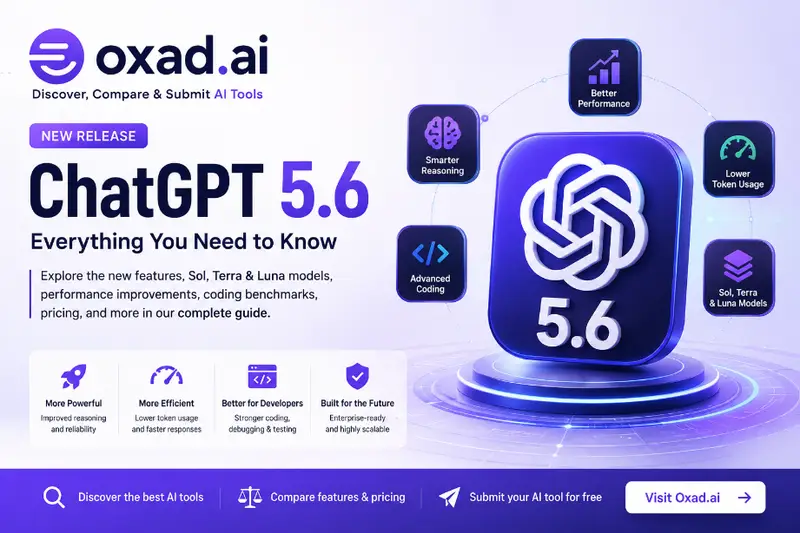
ChatGPT 5.6 introduces OpenAI’s latest improvements in coding, reasoning, efficiency, and model organization.
Rather than focusing only on larger benchmark numbers, GPT-5.6 aims to deliver higher-quality responses, improved reliability, and lower operational costs for both everyday users and enterprise developers.
In this review, we examine the new Sol, Terra, and Luna model lineup, performance improvements, coding capabilities, efficiency gains, pricing, availability, and whether upgrading to ChatGPT 5.6 is worthwhile.
Category
AI Model Review
Focus
Features, Coding, Performance & API Improvements
Reading Time
Approximately 12 Minutes
Editorial Approach
This review was independently prepared by the Oxad.ai editorial team using official product information, technical documentation, benchmark results, and practical developer workflows. Our reviews are not influenced by sponsorships and focus on helping readers understand real-world capabilities instead of marketing claims.
Key Takeaways
- GPT-5.6 introduces three permanent capability tiers: Sol, Terra, and Luna.
- OpenAI focuses on efficiency and lower token usage rather than dramatically increasing model size.
- The model delivers stronger coding performance and more reliable multi-step reasoning.
- Enterprise developers benefit from improved API efficiency and lower operating costs.
- Most everyday users will notice smoother conversations and better consistency rather than revolutionary new abilities.
What Is ChatGPT 5.6?
ChatGPT 5.6 is OpenAI’s latest generation of large language models, designed to improve coding performance, reasoning quality, response efficiency, and long-context understanding while reducing computational costs for developers and businesses.
Instead of introducing a completely new interaction style, GPT-5.6 refines many aspects of the existing ChatGPT experience. Responses are generally more consistent, code generation is more reliable, and complex instructions are handled with greater accuracy across longer conversations.
For API customers, another important goal is efficiency. By producing more complete answers with fewer output tokens, GPT-5.6 can help reduce latency and operational costs without sacrificing response quality.
Why This Release Matters
Rather than competing solely on benchmark scores, GPT-5.6 focuses on practical improvements that benefit real-world workflows, including software development, business automation, technical writing, and AI-powered applications.
What’s New in GPT-5.6?
Compared with previous GPT-5 releases, OpenAI has concentrated on improving reliability, reducing unnecessary output, strengthening coding performance, and simplifying the model lineup.
Many of these changes may appear incremental individually, but together they create a noticeably smoother experience for both casual users and professional developers.
Highlights
- Improved reasoning quality.
- More accurate code generation.
- Better multi-step instruction following.
- Lower token consumption.
- Improved response consistency.
- Expanded enterprise deployment options.
- New permanent model tiers.
Understanding Sol, Terra & Luna
One of the biggest changes introduced with GPT-5.6 is OpenAI’s new capability-based model family.
Instead of shipping one universal model, OpenAI now separates performance into three permanent tiers designed for different workloads.
| Model | Designed For | Typical Users |
|---|---|---|
| Sol | Maximum reasoning and coding performance | Researchers, developers, enterprises |
| Terra | Balanced intelligence and efficiency | Most ChatGPT users |
| Luna | Fast, lightweight, cost-efficient tasks | High-volume applications |
Separating capability tiers from model generations allows OpenAI to improve individual models independently without forcing organizations to redesign existing production workflows every time a new flagship model is released.
Performance Improvements
ChatGPT 5.6 is designed to improve practical performance rather than simply increasing benchmark scores. OpenAI has focused on making the model more dependable across long conversations, complex reasoning tasks, and software development workflows.
Users are likely to notice fewer incomplete responses, better instruction following, and more consistent answers when working through multi-step problems. These improvements are especially valuable for professionals who rely on ChatGPT for research, technical documentation, project planning, or coding assistance.
Another major objective is reducing unnecessary verbosity. GPT-5.6 attempts to produce complete answers using fewer output tokens while preserving context and accuracy. For API customers, this translates into faster responses and potentially lower operating costs.
Performance Highlights
- Improved long-context understanding.
- More reliable multi-step reasoning.
- Better instruction adherence.
- Reduced repetitive output.
- Lower token usage for many tasks.
- Greater consistency across extended conversations.
Coding Improvements
Software development remains one of the strongest areas of GPT-5.6. OpenAI continues to optimize the model for real-world programming workflows instead of simple code generation benchmarks.
Developers can use GPT-5.6 to explain unfamiliar code, generate new functions, debug complex applications, write documentation, create unit tests, and refactor existing projects. The model also performs better when maintaining context across larger codebases and longer programming sessions.
Rather than generating isolated code snippets, GPT-5.6 is increasingly capable of assisting throughout an entire development workflow, making it useful for both experienced engineers and beginners learning new programming languages.
| Coding Task | GPT-5.6 Improvement |
|---|---|
| Code Generation | More accurate and complete implementations |
| Debugging | Better identification of logical and syntax errors |
| Refactoring | Cleaner structure while preserving functionality |
| Documentation | Clearer explanations and API documentation |
| Testing | Improved unit test generation and edge-case coverage |
Developer Insight
While benchmark scores are useful for measuring progress, day-to-day development depends more on consistency, context retention, and reliable debugging. GPT-5.6 focuses heavily on these practical improvements.
Lower Token Usage & Efficiency
One of the most important but less visible upgrades in GPT-5.6 is improved token efficiency.
Every response generated by an AI model consumes tokens, which directly influence API costs and response times. GPT-5.6 aims to produce concise, high-quality answers that require fewer generated tokens while maintaining clarity and usefulness.
For organizations processing thousands or millions of requests every month, even modest reductions in token usage can significantly reduce infrastructure expenses without compromising output quality.
Why Token Efficiency Matters
- Lower API costs.
- Faster response times.
- Reduced latency for AI applications.
- More efficient enterprise deployments.
- Better scalability for production systems.
Availability & Pricing
GPT-5.6 is available through ChatGPT, Codex, and the OpenAI API, although access varies depending on the subscription tier.
| Plan | Access |
|---|---|
| Free | Terra model |
| Go | Terra model |
| Plus | Access to Sol for advanced tasks |
| Pro & Team | Full premium capabilities |
| Enterprise & API | API deployment subject to account permissions |
Availability may continue to expand as OpenAI updates regional access and subscription offerings. Enterprise customers should consult the latest OpenAI documentation for current API pricing and model availability.
ChatGPT 5.6 vs GPT-5.5
| Feature | GPT-5.5 | GPT-5.6 |
|---|---|---|
| Reasoning | Excellent | Improved consistency |
| Coding | Strong | Better debugging and larger project support |
| Token Efficiency | Good | Improved output efficiency |
| Model Structure | Traditional lineup | Sol, Terra & Luna capability tiers |
| Enterprise Flexibility | High | Further improved |
Although GPT-5.6 is an evolutionary update rather than a complete redesign, its cumulative improvements make it a meaningful upgrade for developers, businesses, and organizations using AI in production environments.
Pros & Cons, Who Should Upgrade, FAQ, Final Verdict, Related Guides, and Editorial Note.
Expert Insight
This new structure provides greater flexibility for developers, allowing organizations to balance performance, speed, and operating costs according to their specific workloads rather than relying on a single model for every task.
Performance Improvements, Coding Benchmarks, Token Efficiency, Availability, Pricing, and GPT-5.6 vs GPT-5.5.
Pros & Cons
Like every major AI release, ChatGPT 5.6 brings meaningful improvements while still having limitations. Although it delivers better efficiency, stronger coding performance, and improved reliability, users should continue verifying important information and reviewing AI-generated content before publication or deployment.
Advantages
- More reliable reasoning across long conversations.
- Excellent coding assistance for developers.
- Lower token consumption improves API efficiency.
- Better instruction following.
- Improved consistency in multi-step workflows.
- Flexible Sol, Terra, and Luna model lineup.
- Suitable for enterprise-scale deployments.
Limitations
- Still capable of producing inaccurate or outdated information.
- Complex reasoning tasks may require follow-up prompts.
- Premium capabilities remain tied to paid plans.
- Generated code should always be tested before production use.
- Performance varies depending on prompt quality and workload.
Who Should Upgrade to ChatGPT 5.6?
Whether GPT-5.6 is worth using depends largely on how you interact with AI. For casual users, the improvements may feel gradual. For professionals, however, the efficiency gains and stronger coding capabilities can make a noticeable difference.
| User Type | Recommendation |
|---|---|
| Software Developers | ★★★★★ Highly Recommended |
| Students | ★★★★☆ Excellent Productivity Tool |
| Content Creators | ★★★★☆ Helpful for drafting and research |
| Business Teams | ★★★★★ Strong automation potential |
| Occasional Users | ★★★★☆ Improvements are noticeable but incremental |
Our Verdict
ChatGPT 5.6 is less about introducing groundbreaking capabilities and more about refining what already works well. The improvements in coding, reasoning consistency, efficiency, and enterprise flexibility make it one of OpenAI’s most practical releases to date. While everyday users may notice only incremental changes, developers and businesses are likely to benefit from faster, more reliable, and more cost-effective AI workflows.
Frequently Asked Questions
Is ChatGPT 5.6 free?
Yes. Some GPT-5.6 capabilities are available to Free users through the Terra model, while the most advanced features and higher-capability models are reserved for paid subscription plans.
What is the difference between Sol, Terra, and Luna?
Sol is designed for maximum reasoning and coding performance, Terra balances intelligence and efficiency for most users, and Luna focuses on lightweight, high-speed, cost-efficient workloads.
Is GPT-5.6 better than GPT-5.5?
GPT-5.6 improves consistency, coding assistance, token efficiency, and workflow reliability. Although it is an evolutionary update rather than a complete redesign, it offers meaningful benefits for many professional use cases.
Can developers use GPT-5.6 through the API?
Yes. GPT-5.6 is available through the OpenAI API for eligible accounts, allowing developers to integrate its capabilities into custom applications, products, and enterprise workflows.
Should businesses upgrade immediately?
Organizations already relying on OpenAI models for software development, automation, or content generation may benefit from evaluating GPT-5.6 in staging environments before deploying it across production systems.
Final Verdict
ChatGPT 5.6 represents a thoughtful refinement of OpenAI’s flagship AI platform. Instead of chasing dramatic benchmark gains, the company has focused on the qualities that matter most in everyday use: reliability, efficiency, and practical performance.
The introduction of the Sol, Terra, and Luna model family also signals a shift toward a more structured AI ecosystem, giving users and organizations greater flexibility when selecting the right balance between capability, speed, and cost.
For developers, researchers, businesses, and productivity-focused users, GPT-5.6 offers a well-rounded upgrade that strengthens existing workflows rather than replacing them. While it is not a revolutionary leap over previous versions, it continues OpenAI’s trend of delivering more capable AI systems that are easier and more economical to deploy at scale.
Related Guides on Oxad.ai
Editorial Note
This review was researched and written by the Oxad.ai Editorial Team. Information reflects publicly available documentation, official announcements, and observed product capabilities at the time of publication. As AI platforms evolve rapidly, features, pricing, availability, and performance may change over time. Readers should consult official OpenAI resources for the latest product updates before making business or technical decisions.