AI Threat Detection Tools: What to Compare Before You Buy
AI Cybersecurity Buyer’s Guide
AI Threat Detection Tools: What to Compare Before You Buy
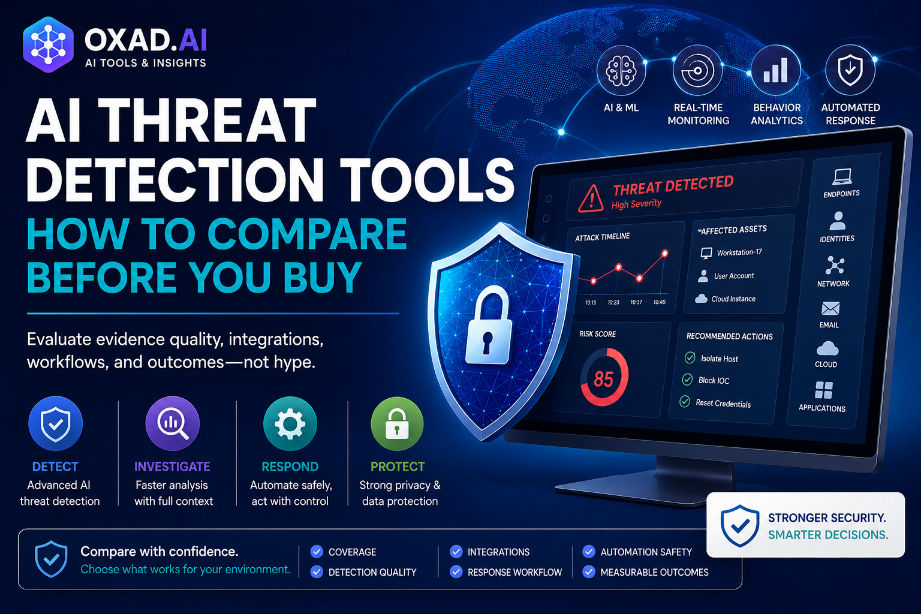
AI threat detection tools should be compared by the quality of their evidence, integrations, investigation workflow, and response controls—not by promises to detect attacks before they happen.
Security teams need measurable information about coverage, alert precision, false positives, investigation time, response safety, privacy, and operational impact. This vendor-neutral guide explains how to evaluate EDR, XDR, SIEM, NDR, and cloud security platforms using a practical framework.
Best for Security leaders, SOC teams, IT managers, and organizations evaluating detection platforms
Main objective Reduce investigation time while improving evidence quality and response safety
Essential safeguard Validate every shortlisted platform in a controlled pilot
Security and editorial note
This vendor-neutral guide was reviewed by the Oxad.ai editorial team in July 2026. Security product features, licensing, integrations, and AI capabilities change frequently. No platform guarantees complete protection. Confirm current details in official documentation and obtain a qualified security assessment before deployment.
Key Takeaways
Begin with the systems and risks you need to cover, not a preferred vendor.
More alerts do not automatically mean better security.
Useful alerts should include evidence, context, confidence, and a clear response path.
Integrations must be tested for depth, reliability, permissions, and data quality.
Automation should begin with low-risk, reversible actions.
The best platform is the one that improves measurable security outcomes without creating unmanageable operational burden.
Why AI Threat Detection Tools Need Careful Comparison
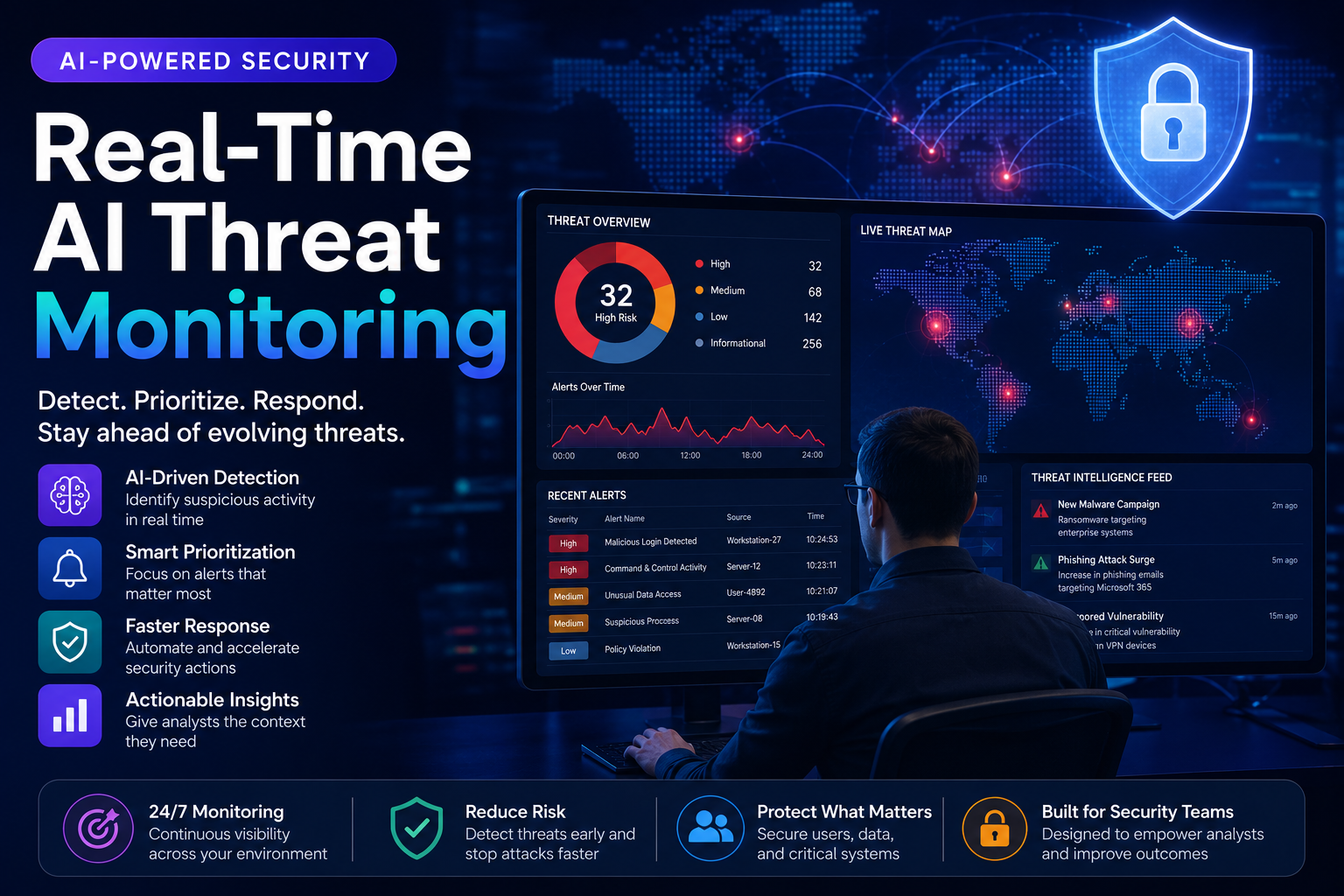
Modern organizations generate large volumes of security telemetry across endpoints, identities, email, cloud services, applications, networks, and business systems. AI-assisted tools can help correlate signals, prioritize incidents, summarize evidence, and automate selected defensive actions.
However, security marketing often emphasizes broad claims such as predictive protection, autonomous defense, or attack prevention before impact. These claims can be difficult to evaluate without clear evidence and a realistic pilot.
Expert insight:
The most valuable detection platform is not the one that generates the most alerts. It is the one that helps analysts reach accurate, defensible conclusions faster.
A strong evaluation should answer practical questions:
Which assets and data sources are monitored?
How accurately are incidents detected?
How are alerts explained?
How much analyst work is required?
Which actions can be automated safely?
How is customer data protected?
What measurable improvement does the platform produce?
Understand the Main Product Categories
AI capabilities are now included across several security product categories. Many vendors combine multiple categories, but the underlying purpose of each one remains different.
Category
Primary focus
Typical data sources
EDR
Endpoint detection and response
Laptops, desktops, servers, processes, files, and endpoint activity
XDR
Cross-domain detection and investigation
Endpoints, identities, email, cloud, applications, and networks
SIEM
Centralized log collection, analytics, search, and compliance
Security logs, applications, infrastructure, cloud services, and identity systems
NDR
Network behavior and traffic analysis
Network flows, packets, DNS activity, protocols, and communications
Cloud security
Cloud posture, workloads, identities, and data protection
Cloud platforms, containers, workloads, configurations, permissions, and storage
Do not begin by asking which category is best. Begin by identifying the assets, users, data flows, and threats the organization needs to monitor.
Practical tip:
A company may need one integrated platform, several specialized tools, or a managed security provider. The correct architecture depends on the environment and the internal team’s ability to operate it.
Examples of Platforms Worth Evaluating
Established providers such as Microsoft, CrowdStrike, SentinelOne, Palo Alto Networks, Darktrace, and others use automation, machine learning, analytics, or generative AI across detection, investigation, and response.
Their products differ in architecture, licensing, ideal customer size, data sources, management model, and integration depth. A platform that performs well in a Microsoft-centered environment may not be the best fit for a highly mixed environment. A specialist endpoint platform may offer deeper endpoint control but require additional products for cloud, identity, or network coverage.
This guide does not name an automatic winner because the best choice depends on:
Existing technology and licenses.
Cloud and on-premises architecture.
Security team size and skills.
Data residency and privacy requirements.
Incident-response procedures.
Budget and expected log volume.
Managed service availability.
Eight Essential Comparison Criteria
1. Coverage
List every endpoint, identity provider, cloud platform, application, network segment, and data source the tool must monitor.
Do not assume that an integration logo represents complete coverage. Confirm:
Which events are collected.
How frequently data is updated.
Whether historical data is supported.
Which permissions are required.
Whether alerts and response actions work in both directions.
Whether the integration is included in the selected plan.
Evaluation rule:
Test the exact integration workflow your analysts will use. A product page is not evidence of operational depth.
2. Detection Quality
Ask vendors for evidence about detection precision, false positives, missed incidents, evaluation methodology, and performance in environments similar to yours.
Useful questions include:
How is detection quality measured?
Which attack techniques are covered?
How often are models and rules updated?
Can customers tune thresholds?
How does the product handle new or rare behavior?
What independent testing is available?
A high alert count is not automatically a sign of strong detection. Excessive low-quality alerts can reduce analyst effectiveness and hide important incidents.
3. Explainability
An alert should provide more than a risk score. Analysts need evidence and context.
A useful alert should identify:
The affected user, device, account, or workload.
The events that contributed to the alert.
The timeline of activity.
The confidence level.
The reason the activity is unusual or harmful.
Recommended investigation or response steps.
Analyst perspective:
If an alert cannot be explained clearly, it is difficult to investigate, defend, audit, or trust.
4. Investigation Workflow
Test how quickly an analyst can move from alert to evidence, search related activity, create a timeline, document findings, and hand the incident to another person.
Evaluate:
Search speed and query flexibility.
Related-event correlation.
Case management.
Collaboration and comments.
Evidence export.
Audit trail quality.
Integration with ticketing and response systems.
A platform may have strong detection but still create operational delays if investigation requires too many separate tools or screens.
5. Response Controls
Review which actions can be automated, which require approval, how changes are logged, and whether the action can be reversed.
Response type
Recommended control
Add context or create a ticket
Suitable for early automation
Block a known malicious indicator
Automate after testing and validation
Disable a user account
Require strong confidence and approval rules
Isolate a critical production server
Human approval strongly recommended
6. Data Protection
Security platforms may collect sensitive logs, identity information, network activity, user behavior, device details, and cloud telemetry.
Review:
Data-processing and storage locations.
Retention periods.
Encryption in transit and at rest.
Administrative access.
Subprocessors.
Cross-border transfers.
Deletion controls.
Whether customer data is used for model improvement.
Privacy warning:
Do not treat a cybersecurity product as automatically privacy-safe. Security telemetry can contain personal, confidential, or regulated information.
7. Operational Burden
A platform can increase workload when it creates excessive alerts, requires constant tuning, lacks useful integrations, or depends on specialist skills the organization does not have.
Include the following in the evaluation:
Deployment time.
Daily administration.
Detection tuning.
Analyst training.
Log-source maintenance.
Incident-response integration.
Vendor support quality.
Required staffing.
Small organizations may gain more value from a managed detection and response service than from purchasing a complex enterprise platform they cannot operate effectively.
8. Measurable Outcomes
Define success before the pilot begins.
Possible measures include:
Reduced alert-triage time.
Fewer duplicate alerts.
Improved asset coverage.
Faster investigation.
Faster containment.
Reduced analyst workload.
Clearer audit evidence.
Better detection of defined scenarios.
The strongest buying decision is based on measurable operational improvement, not the number of AI features in a demonstration.
How to Run a Controlled Pilot
Select a representative but limited environment.
Choose systems that reflect the real environment without creating unnecessary risk.
Connect the required data sources.
Confirm that telemetry is complete, timely, and accurate.
Document a baseline.
Measure current alert volume, investigation time, false positives, and operational workload.
Use authorized defensive simulations.
Follow approved testing procedures and avoid uncontrolled disruption.
Evaluate analyst experience.
Ask actual analysts to investigate alerts and document the effort required.
Test response safety.
Confirm approval workflows, logging, reversibility, and business impact.
Review the results across teams.
Include security, privacy, IT, legal, procurement, and relevant business owners.
Suggested Pilot Scorecard
Criterion
Suggested weight
Detection and evidence quality
25%
Coverage and integrations
20%
Investigation workflow
15%
Data protection
15%
Response safety
15%
Total operational cost
10%
Calculate the Real Operational Cost
Licensing is only one part of the total cost.
Include:
Endpoint or user licenses.
Log ingestion.
Data retention and storage.
Cloud workloads.
Premium integrations.
API usage.
Professional services.
Training.
Internal staffing.
Managed detection services.
Pricing check:
Ask vendors to model your expected data volume, growth, retention period, and integration requirements. Low entry pricing can increase significantly at production scale.
Warning Signs and Risky Claims
Perfect Protection Claims
No security platform detects or prevents every attack.
Unexplained Alerts
A score without evidence gives analysts little to investigate.
Unclear Data Terms
Retention, model training, and subprocessors should be documented clearly.
Irreversible Automation
High-impact actions require controls, approvals, and audit trails.
Incomplete Pricing
Essential ingestion, storage, or integrations may cost extra.
Unrealistic Demonstrations
A curated demo may not reflect your data, users, or operational constraints.
Practical AI Threat Detection Buyer Checklist
The required assets and data sources are documented.
Integration depth has been tested.
Alert evidence is clear and explainable.
False positives and missed detections are measured.
Analysts can investigate incidents efficiently.
Response actions have approval and rollback controls.
Data retention and model-training terms are understood.
The internal team can operate the platform.
Total production cost has been modeled.
Success metrics are defined before purchase.
How Oxad.ai Can Help
Oxad.ai helps users discover and compare AI-enabled security tools, monitoring platforms, automation solutions, and business software.
Use the directory to identify possible tools, then validate every shortlisted product through official documentation, security review, and a controlled pilot.
Explore AI Security Tools
Discover security monitoring, threat detection, automation, compliance, and risk-management tools.
The best option depends on your environment, internal team, existing licenses, data sources, risk profile, privacy requirements, and incident-response process.
Can a Small Business Use AI Threat Detection?
Yes. However, a managed detection and response service or a simpler integrated platform may be more practical than operating a complex enterprise system internally.
Do More Alerts Mean Better Protection?
No. Useful alerts require sufficient confidence, supporting evidence, context, and an actionable response path.
Should AI Be Allowed to Isolate Devices Automatically?
Only after careful testing and clear rules. High-impact actions that may interrupt business operations often benefit from human approval.
What Is the Difference Between EDR and XDR?
EDR focuses primarily on endpoints. XDR combines signals from multiple domains such as endpoints, identities, email, cloud, applications, and networks.
Is SIEM Still Necessary When Using XDR?
It depends on the environment. SIEM may remain important for broad log collection, compliance, custom analytics, and long-term search, while XDR focuses on integrated detection and response.
Can AI Threat Detection Replace Security Analysts?
No. AI can accelerate triage and investigation, but humans remain responsible for context, governance, validation, and high-impact decisions.
How Long Should a Security Pilot Last?
The pilot should be long enough to connect representative data sources, observe normal activity, investigate test scenarios, measure analyst workload, and validate response controls.
Shortlist AI threat detection tools according to coverage, evidence quality, integrations, investigation workflow, response safety, privacy, and operational fit.
Then validate each candidate through a controlled pilot using representative data, real analysts, measurable outcomes, and approved defensive tests.
Prefer transparent evidence, manageable alert volume, strong data controls, reversible automation, and measurable reductions in investigation time over broad claims of autonomous or predictive protection.
The most effective platform is the one your team can understand, operate, trust, and improve over time.
Last reviewed: July 2026 • Prepared by the Oxad.ai Editorial Team