Real-Time AI Threat Monitoring: How It Works and What It Cannot Do
Cybersecurity Guide 2026
Real-Time AI Threat Monitoring: How It Works and What It Cannot Do
Cyber threats evolve faster than ever, making manual monitoring increasingly difficult. Modern organizations generate millions of security events every day across endpoints, cloud services, applications, identities, and networks.
AI-powered threat monitoring helps security teams detect suspicious activity, prioritize alerts, and accelerate investigations. However, artificial intelligence does not replace experienced analysts or guarantee complete protection against cyberattacks.
Key Takeaways
AI analyzes security events much faster than manual processes.
Threat monitoring improves detection and investigation—not prevention alone.
Good data quality is essential for accurate AI analysis.
Automation should begin with low-risk security actions.
Human analysts remain responsible for investigation and final decisions.
Editorial Note
This guide provides vendor-neutral defensive cybersecurity information for educational purposes. Product capabilities, integrations, and AI models evolve rapidly, so always verify current documentation before deployment. This article does not replace a professional security assessment.
Table of Contents
What Is Real-Time AI Threat Monitoring?
How AI Threat Detection Works
Core AI Capabilities
Benefits for Security Teams
Limitations and Risks
Implementation Best Practices
Questions to Ask Vendors
Frequently Asked Questions
Final Recommendation
What Is Real-Time AI Threat Monitoring?
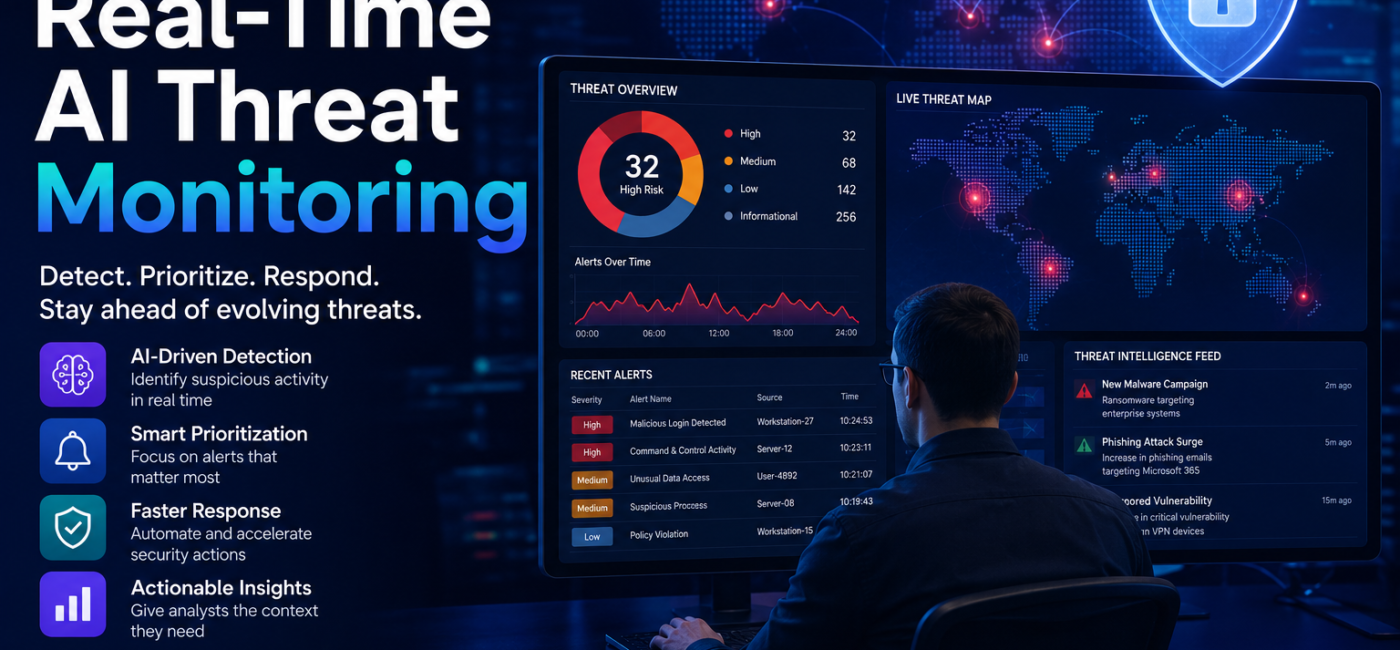
Real-time AI threat monitoring continuously analyzes activity generated by endpoints, cloud platforms, user identities, servers, applications, email systems, firewalls, and networks.
Instead of simply matching known attack signatures, modern AI systems can identify abnormal behavior, correlate multiple security events, prioritize alerts, and assist analysts during investigations.
“Real-time” does not necessarily mean instant certainty. Rather, it refers to continuous or near-continuous analysis that significantly reduces the delay between suspicious activity and analyst awareness.
Expert Insight
The objective of AI monitoring is not to replace human expertise—it is to reduce alert fatigue so analysts can spend more time investigating genuine threats instead of reviewing thousands of repetitive alerts.
How AI Threat Monitoring Works
Modern security platforms collect telemetry from numerous data sources across an organization.
Common Data Sources
Endpoints and workstations
Cloud infrastructure
Email systems
Identity providers
Firewalls
VPN gateways
Network traffic
Security logs
Application activity
Threat intelligence feeds
Machine learning models compare this information against historical behavior, known attack techniques, statistical baselines, and contextual information.
When suspicious activity exceeds predefined confidence thresholds, the system may generate an alert, assign severity, recommend an investigation, or automatically perform approved defensive actions.
Common AI-Assisted Capabilities
Capability
Purpose
Anomaly Detection
Identifies behavior that differs from normal activity.
Alert Correlation
Combines multiple alerts into one security incident.
Prioritization
Ranks alerts according to confidence and business impact.
Behavior Analytics
Evaluates user and device activity over time.
Investigation Assistance
Provides summaries, timelines, and contextual evidence.
Response Automation
Executes predefined defensive actions after validation.
Why AI Helps Security Teams
Modern enterprises generate enormous volumes of security telemetry. Reviewing every event manually is no longer practical.
AI improves operations by filtering repetitive signals, grouping related alerts, identifying unusual combinations of events, and highlighting activity that deserves immediate attention.
Business Benefits
Reduced alert fatigue
Faster incident triage
Improved analyst productivity
Better prioritization
Continuous monitoring 24/7
Improved response consistency
Important Limitations
AI Is Not Perfect
False Positives: Legitimate activity may appear suspicious.
False Negatives: Real attacks may remain undetected.
Poor Data Quality: Missing logs reduce detection accuracy.
Model Drift: Business behavior changes over time.
Automation Risk: Incorrect responses may interrupt business operations.
Limited Context: AI cannot fully understand organizational priorities.
Best Practices for Safe Deployment
Protect your most critical systems first.
Verify complete logging across the environment.
Define alert ownership clearly.
Measure response times before and after deployment.
Automate only low-risk actions initially.
Require human approval for disruptive actions.
Review AI models and detection rules regularly.
Perform routine incident response exercises.
Continuously tune alert thresholds.
Implementation Tip
Successful AI monitoring projects usually improve existing security operations rather than replacing them. Good security processes remain more important than sophisticated AI alone.
Questions to Ask Before Buying
Which security data sources are supported?
How does the platform explain AI decisions?
Can analysts customize detection thresholds?
How is customer data protected?
Which automated actions can be reversed?
How are false positives measured?
Does the platform integrate with our existing SIEM, SOAR, and endpoint tools?
What reporting and audit capabilities are available?
Evaluation Checklist
✓ Continuous monitoring
✓ Explainable AI alerts
✓ High-quality integrations
✓ Secure automation
✓ Human approval workflow
✓ Incident reporting
✓ Privacy controls
✓ Regulatory compliance support
✓ Alert customization
✓ Scalable architecture
Frequently Asked Questions
Can AI replace cybersecurity analysts?
No. AI accelerates investigations but experienced analysts remain responsible for validation, incident response, governance, and strategic decisions.
Can AI stop every cyberattack?
No security technology can guarantee complete prevention. Effective cybersecurity requires multiple defensive layers working together.
Is automated response safe?
Automation is most effective for well-tested, low-risk actions. Critical business decisions should continue to involve human approval.
What matters most for successful AI monitoring?
Reliable telemetry, accurate logging, well-trained analysts, documented response procedures, and continuous improvement are more important than AI alone.
Final Recommendation
Evaluate AI threat monitoring as one component of a broader cybersecurity strategy—not as a complete security solution.
The most effective organizations combine high-quality telemetry, experienced analysts, explainable AI, continuous monitoring, responsible automation, and regular security reviews to reduce cyber risk.
AI can dramatically improve operational efficiency, but people, governance, and well-designed security processes remain the foundation of effective cyber defense.