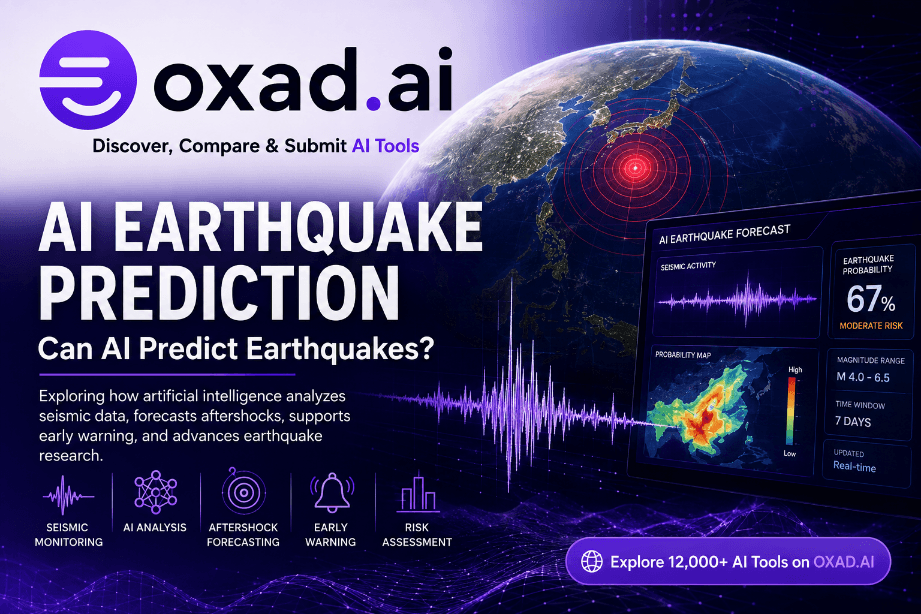
AI Earthquake Prediction: How Artificial Intelligence Is Changing Earthquake Forecasting
Earthquakes remain one of the most difficult natural hazards to anticipate. Scientists can identify active faults, study historical seismic activity, monitor ground deformation, and estimate long-term earthquake probabilities, but knowing exactly when, where, and how large a future earthquake will be remains an unsolved scientific problem.
Artificial intelligence is opening a new direction in this research. Machine learning and deep learning can process enormous amounts of seismic and geophysical data, identify complex patterns, detect subtle signals, and generate forecasts much faster than many traditional analytical approaches.
But there is an important distinction that should not be overlooked: AI has not yet made reliable, exact earthquake prediction possible. Instead, researchers are using AI to improve earthquake monitoring, seismic analysis, probabilistic forecasting, aftershock prediction, and the search for physical signals that may precede fault failure.
Quick answer: AI cannot currently provide a reliable prediction of a major earthquake with its exact time, location, and magnitude. However, research shows that machine learning can detect subtle patterns in seismic data, improve earthquake forecasting, analyze fault behavior, and predict aftershock risk. These capabilities could become increasingly valuable as AI is combined with conventional seismology and geophysical data.
What Does AI Earthquake Prediction Actually Mean?
The phrase AI earthquake prediction is often used broadly, but it can describe several very different scientific tasks.
In the strictest sense, an earthquake prediction would need to specify three essential elements:
When the earthquake will occur.
Where it will occur.
How large it will be.
The U.S. Geological Survey explains that neither the USGS nor other scientists have successfully predicted a major earthquake in this precise sense. Current science can instead estimate the probability of significant earthquakes occurring within particular regions and time periods.
This distinction is particularly important when evaluating claims about artificial intelligence. A model that detects unusual seismic activity or estimates a higher probability of future earthquakes should not automatically be described as an earthquake prediction system.
Prediction vs Forecasting vs Early Warning
Three concepts are frequently confused when discussing AI and earthquakes: prediction, forecasting, and early warning. Understanding the difference makes it much easier to evaluate what current AI systems can realistically accomplish.
Concept
What It Means
Current Role of AI
Earthquake Prediction
Specifying the future time, location, and magnitude of an earthquake.
Not reliably solved.
Earthquake Forecasting
Estimating the probability of future seismic activity over a defined region or period.
Active area of AI research.
Aftershock Forecasting
Estimating the likelihood and distribution of earthquakes following a larger event.
One of the promising practical applications.
Earthquake Early Warning
Detecting an earthquake after it begins and warning locations before stronger shaking arrives.
AI can support rapid seismic analysis.
Earthquake Monitoring
Continuously observing and analyzing seismic activity.
A major application of machine learning.
The USGS describes early warning as a notification issued after an earthquake has started. Depending on the location of the earthquake and the receiving system, an alert can provide seconds to tens of seconds before strong shaking reaches a particular location.
That means an early-warning system is fundamentally different from a system claiming to know that an earthquake will happen tomorrow or next week.
Why Are Earthquakes So Difficult to Predict?
Earthquakes begin deep inside the Earth’s crust, often along faults that cannot be directly observed in their entirety. The physical conditions surrounding a fault can vary considerably over space and time, making the problem far more complicated than simply searching for one universal warning signal.
Scientists have investigated whether faults might undergo measurable changes before rupture. These processes can include microscopic fracturing, slow fault slip, changes in stress, and other physical phenomena. The challenge is determining whether such signals occur consistently before natural earthquakes and whether they can be distinguished from the enormous amount of normal background activity.
Kyoto University researchers recently provided an interesting laboratory demonstration of what AI may contribute to this problem. Using machine learning and data from a meter-scale rock-friction experiment, researchers found that models could detect subtle signals associated with the final stages before laboratory earthquake-like failure. Their analysis indicated that localized changes in shear stress in slowly slipping regions were particularly informative.
The result is scientifically interesting because it suggests that machine learning may uncover relationships within complex fault behavior that are difficult to identify using conventional analysis alone.
Important limitation: The Kyoto University experiment was conducted on a laboratory fault system. It does not demonstrate that an AI model can currently predict natural earthquakes in the real world. The researchers describe the work as an important step toward understanding and potentially improving short-term earthquake forecasting.
Why AI Is Interesting for Earthquake Research
Traditional seismic analysis has produced enormous scientific progress, but modern monitoring systems generate more information than humans can realistically inspect manually.
Seismometers continuously record ground motion. Earthquake catalogs contain information about previous events. Geodetic systems can measure extremely small changes in Earth’s surface. Satellites can provide additional observations of deformation and geological conditions.
This creates a natural opportunity for machine learning.
Rather than asking an AI model to simply “predict an earthquake,” researchers can ask it to solve smaller and more measurable problems:
Can the model identify an earthquake inside a noisy signal?
Can it distinguish different types of seismic events?
Can it identify the arrival of seismic phases?
Can it estimate earthquake magnitude?
Can it identify patterns in earthquake sequences?
Can it estimate the probability of future seismic activity?
Can it forecast aftershock activity?
Can it detect subtle changes in fault behavior?
Machine learning has already become an important part of modern seismology. A comprehensive review in Annual Review of Earth and Planetary Sciences describes machine learning as increasingly important across earthquake monitoring and seismic-data processing, including the creation of more comprehensive earthquake catalogs.
How AI Processes Earthquake Data
A simplified AI-powered earthquake research workflow can be understood as a sequence of stages.
Data collection: Sensors and scientific instruments continuously collect seismic and geophysical observations.
Data preparation: Researchers clean, synchronize, label, and organize the information.
Feature extraction: The system identifies useful characteristics within the data.
Model training: Machine learning algorithms learn relationships from historical or experimental examples.
Validation: Researchers test the model using data that were not used during training.
Real-time analysis: The model can process new observations as they become available.
Forecast generation: Depending on the application, the system can estimate seismic probabilities, classify events, or identify potentially important patterns.
Scientific interpretation: Researchers compare AI results with physical knowledge and established seismic models.
This final step is particularly important. A high-performing AI model is not automatically a scientifically valid earthquake prediction system. Researchers need to determine whether the model has learned a meaningful physical relationship or simply discovered a statistical pattern that works within a particular dataset.
AI Is Becoming a Seismology Tool, Not a Crystal Ball
One useful way to think about AI earthquake research is to imagine AI as an extremely powerful analytical assistant.
It can examine enormous datasets, identify relationships, compare thousands of signals, and continuously update calculations. But the system still operates within the limits of the information available to it and the assumptions built into its training and validation.
A recent cross-disciplinary review argues that the most promising direction is not simply replacing traditional seismology with AI. Instead, researchers should combine artificial intelligence with geophysical knowledge, while accounting for problems such as data imbalance, spatial and temporal clustering, and the physical complexity of earthquakes.
This approach could eventually produce models that are not only statistically powerful but also more scientifically meaningful and easier to evaluate.
What Researchers Are Learning From AI Experiments
Recent research provides both encouraging results and important warnings.
A large review of machine-learning and deep-learning approaches examined thousands of studies and identified commonly used methods including regression models, Random Forest, XGBoost, clustering techniques, PCA, artificial neural networks, LSTM networks, and CNN architectures. The review also emphasizes continuing problems involving data variability, feature selection, model interpretability, and the difficulty of producing reliable earthquake predictions.
Even more importantly, newer research demonstrates why impressive AI accuracy numbers should be treated carefully.
A 2026 study published in Earth Science Informatics re-evaluated a machine-learning earthquake forecasting workflow that had previously reported accuracy above 97%. When tested using stricter time-based validation and walk-forward testing, the apparent performance fell dramatically. The authors identified data leakage as a major reason for the earlier optimistic results. 6
This is a valuable lesson for the entire field: an impressive benchmark score does not necessarily mean that an AI model can predict future earthquakes in real-world conditions.
Why Scientific Validation Matters
Earthquake forecasting is a particularly difficult machine-learning problem because the future is not simply another random sample of the past.
A model may accidentally receive information that would not have been available at the moment a real forecast was made. It may also learn local characteristics that work in one geographic region but fail somewhere else.
For this reason, researchers increasingly need to evaluate AI systems using realistic temporal testing, independent datasets, geographic transfer tests, established scientific baselines, and carefully designed evaluation metrics.
The goal is not to produce the highest possible accuracy number. The goal is to determine whether the model provides genuine predictive information that remains useful when confronted with new seismic conditions.
That distinction will become increasingly important as AI systems become more sophisticated and earthquake forecasting research moves toward larger and more diverse datasets.
How AI Analyzes Earthquake Data
The ability of artificial intelligence to contribute to earthquake research depends heavily on the quality and diversity of the data it receives. Unlike a simple prediction based on one measurement, modern seismic AI can combine information from many sources to identify patterns that may be difficult to recognize manually.
Researchers can train machine-learning models using historical earthquake catalogs, continuous seismic waveforms, satellite observations, GPS measurements, ground-deformation data, and other geophysical information. The goal is not necessarily to find one universal “earthquake signal,” but to understand how different observations relate to seismic activity.
Historical earthquake locations, magnitudes, and times
Seismicity analysis and forecasting
GPS / GNSS
Very small movements of Earth’s surface
Crustal deformation and fault-motion analysis
InSAR
Surface deformation observed by radar satellites
Deformation mapping and fault analysis
Satellite Data
Large-scale observations of Earth’s surface
Geospatial pattern recognition
Distributed Acoustic Sensing
Vibrations detected along fiber-optic cables
High-density seismic monitoring
Combining several data sources can potentially give AI models a broader view of the physical environment surrounding an active fault. However, more data does not automatically mean better predictions. Measurements must be accurately synchronized, validated, and interpreted within their physical context.
Seismic Waveforms: The Core Data Behind Earthquake AI
Seismometers produce continuous measurements of ground motion. These recordings contain the signatures of earthquakes, explosions, human activity, volcanic processes, and background noise.
For a human analyst, reviewing enormous numbers of waveforms manually can be extremely time-consuming. Machine learning can help automate parts of this process by learning characteristics associated with seismic events.
AI systems can be trained to identify:
Potential earthquake signals.
Primary and secondary seismic-wave arrivals.
Small earthquakes that may be difficult to detect automatically.
Noise and non-earthquake signals.
Different types of seismic events.
Patterns within earthquake sequences.
This capability is important because creating more complete earthquake catalogs can improve subsequent scientific research. If thousands of small events that previously went undetected can be identified reliably, researchers gain a much more detailed picture of how faults behave.
Machine Learning for Earthquake Detection
One of the most mature applications of AI in seismology is automated earthquake detection.
Traditional detection methods often rely on predefined signal-processing techniques and thresholds. Machine-learning systems can instead learn from labeled examples and recognize more complex patterns in seismic recordings.
Deep-learning models can be particularly effective because seismic waveforms are time-dependent signals. A model can learn relationships between features that may be difficult to capture using simple threshold-based approaches.
Researchers have developed neural-network approaches for tasks such as earthquake detection, phase picking, magnitude estimation, and seismic-event classification. These systems can process large volumes of waveform data and help scientists build more detailed seismic catalogs.
How Deep Learning Fits Into Seismology
Deep learning is a subset of machine learning based on artificial neural networks with multiple computational layers. It has become particularly useful when the data contain complex patterns.
Different architectures can be useful for different earthquake-related tasks.
AI Method
Potential Earthquake Application
Main Advantage
Random Forest
Classification and feature-based forecasting
Works well with structured features
XGBoost
Forecasting and classification
Powerful gradient-boosting approach
CNN
Waveform and spatial-pattern analysis
Effective at learning local patterns
LSTM
Time-series and seismic-sequence analysis
Designed for sequential information
Transformers
Large-scale sequence and multimodal analysis
Can model long-range relationships
Physics-Informed AI
Combining physical laws with machine learning
Connects statistical learning with geophysical knowledge
These methods should not be viewed as interchangeable “earthquake prediction algorithms.” Their usefulness depends on the specific scientific question, available data, geographical setting, and evaluation method.
Convolutional Neural Networks and Seismic Signals
Convolutional Neural Networks (CNNs) are commonly associated with image recognition, but their ability to identify local patterns can also be applied to time-series and waveform data.
When seismic signals are represented in suitable forms, CNN-based systems can learn features associated with earthquake events. This can help with detection, classification, and other waveform-analysis tasks.
The advantage is that researchers do not necessarily have to manually define every characteristic of a seismic signal. The network can learn useful representations from training examples.
LSTM Models and Earthquake Time Series
Long Short-Term Memory (LSTM) networks were developed for sequential data. This makes them relevant to earthquake research because seismic activity unfolds over time.
An LSTM model can potentially learn relationships between observations separated by different time intervals. Researchers have explored such architectures for seismicity forecasting and time-series analysis.
However, temporal modeling does not automatically solve the fundamental earthquake-prediction problem. A model can learn correlations in historical seismic sequences without discovering a physical mechanism that reliably determines when a future earthquake will occur.
Transformers and the Next Generation of Seismic AI
Transformer architectures have transformed natural-language processing and are increasingly being explored for scientific time-series applications.
Their ability to model relationships across long sequences makes them potentially useful for large seismic datasets. Researchers can investigate whether transformer-based models can integrate long-term temporal information, multiple seismic stations, or different types of geophysical observations.
One particularly interesting direction is the adaptation of foundation models to scientific signals. Research supported by the U.S. Department of Energy demonstrated how a foundation model originally developed for speech-related tasks could be adapted to seismic waveform analysis in the context of volcanic and fault activity. ([energy.gov](https://www.energy.gov/science/bes/articles/can-ai-anticipate-earthquakes?utm_source=chatgpt.com))
This does not mean that a speech model suddenly became an earthquake predictor. Rather, it demonstrates a broader AI principle: models trained to recognize complex patterns in one type of sequential data can sometimes be adapted to other scientific signals.
AI and GPS: Detecting Movement of the Earth’s Crust
Seismic waves are not the only information available to researchers. GPS and GNSS networks can measure extremely small movements of Earth’s surface.
These measurements can help scientists study:
Crustal deformation.
Fault movement.
Tectonic plate motion.
Slow-slip events.
Post-earthquake deformation.
Changes associated with active geological regions.
AI can help identify patterns within these large geospatial datasets and potentially combine them with seismic observations.
This is particularly interesting because earthquakes are not isolated events occurring in a single sensor. They are physical processes involving stress, deformation, fault geometry, and seismic waves.
InSAR and Satellite-Based Earthquake Analysis
Interferometric Synthetic Aperture Radar (InSAR) uses radar observations from satellites to measure changes in Earth’s surface.
After an earthquake, InSAR can reveal patterns of ground deformation across large areas. This information can help scientists understand how a fault moved and how the surrounding crust responded.
Machine learning can potentially assist with the automated interpretation of these complex spatial datasets, particularly when large numbers of satellite observations need to be processed.
The combination of satellite observations and AI is therefore an important research direction for earthquake science, even though it should not be interpreted as proof that satellites can currently provide reliable advance earthquake predictions.
Distributed Acoustic Sensing: Turning Fiber Optics Into Sensors
An especially interesting development is Distributed Acoustic Sensing (DAS).
DAS can use fiber-optic cables to detect vibrations along long stretches of infrastructure. Instead of relying only on conventional seismic stations, researchers can potentially obtain dense measurements distributed along existing fiber networks.
This creates an enormous amount of time-series data, which is difficult to analyze manually and therefore particularly suitable for automated machine-learning methods.
AI could help identify earthquakes and other seismic signals within these high-density measurements, potentially expanding the amount of information available for earthquake monitoring.
Why Multimodal Earthquake AI Could Be Important
The next major development may not come from a model analyzing only seismic waveforms. It could come from models capable of combining several types of information.
Imagine a system that can analyze:
Seismic waveforms.
Historical earthquake catalogs.
GPS measurements.
Satellite deformation maps.
Fault geometry.
Geological information.
Aftershock sequences.
Ground-motion observations.
Such a system would not necessarily “predict earthquakes” in the popular sense. Instead, it could provide a much richer probabilistic picture of changing seismic risk.
This direction resembles the broader evolution of AI in other scientific and professional fields, where models increasingly combine multiple data types rather than relying on one source alone. AI is also becoming useful for specialized decision-support applications in agriculture; for example, our guide to AI-powered agricultural decision-making explores how AI can combine data to support more informed decisions.
Physics-Informed AI: Combining Data With Scientific Knowledge
One of the biggest questions surrounding AI in earthquake science is whether models should rely entirely on statistical patterns.
A purely data-driven system may discover correlations without understanding the physical processes that produced them. This can create problems when the model encounters conditions that differ from its training data.
Physics-informed machine learning offers another approach. Instead of asking AI to learn everything from historical observations, researchers can incorporate known physical relationships and constraints into the modeling process.
The concept is particularly attractive for earthquake research because earthquakes are governed by physical processes involving stress, friction, fault geometry, wave propagation, and crustal deformation.
Combining physical knowledge with machine learning could potentially improve model robustness, interpretability, and generalization.
AI Coding Agents and Scientific Research
The development of AI is also changing how researchers build and analyze scientific software. Modern AI coding tools and intelligent agents can assist researchers with data-processing pipelines, scientific scripts, visualization, testing, documentation, and repetitive programming tasks.
For earthquake research, this could make it easier to experiment with different models, preprocess large datasets, reproduce analytical workflows, and compare forecasting methods.
However, AI-generated scientific code still requires expert review. A programming agent can accelerate research, but it does not remove the need for researchers to verify assumptions, mathematical implementations, data handling, and scientific conclusions.
Key takeaway: The real opportunity is not to replace seismologists with AI. It is to give researchers better tools for processing enormous datasets, testing hypotheses, detecting subtle patterns, and combining observations that would be difficult to analyze manually.
Real-World AI Earthquake Research and Forecasting
The most interesting question is no longer whether artificial intelligence can process earthquake data. It clearly can. The more difficult question is whether AI can turn that ability into reliable, scientifically validated information about future seismic activity.
Recent research provides several encouraging examples. Instead of relying on a single model or a single type of signal, researchers are testing AI across laboratory experiments, real seismic networks, earthquake catalogs, satellite observations, and aftershock sequences.
These studies are important because they show where AI is genuinely useful today—and where significant scientific challenges remain.
Kyoto University: Detecting Signals Before Laboratory Failure
One of the intriguing research directions comes from Kyoto University, where researchers investigated whether machine learning could identify subtle changes occurring before earthquake-like failure in a controlled laboratory experiment.
The experiment used a meter-scale rock-friction system designed to reproduce stick-slip behavior similar to processes associated with earthquakes. Researchers trained machine-learning models using measurements from the experimental fault.
The models were able to identify patterns associated with the final stages before failure. The research highlighted changes in shear stress and slowly slipping regions as potentially informative signals.
This result is interesting because conventional analysis may not always reveal complex relationships hidden within large amounts of experimental data. Machine learning can search through many variables simultaneously and identify combinations that deserve further scientific investigation.
What does this mean? The experiment demonstrates that AI can detect potentially useful precursory patterns under controlled conditions. It does not demonstrate that natural earthquakes can currently be predicted reliably days, weeks, or months in advance.
That distinction is essential when discussing AI earthquake prediction. Laboratory results can reveal physical relationships and guide future research, but natural faults operate at vastly different scales and under much more complicated conditions.
AI and Seismic Waveforms: Learning From Continuous Signals
Another major research direction involves using AI to analyze continuous seismic waveforms.
Seismic stations record ground motion continuously, creating enormous datasets. Much of this information consists of background noise or very small signals that may not be immediately useful to conventional earthquake catalogs.
Machine-learning systems can be trained to identify patterns associated with seismic events and distinguish them from noise.
This can improve several important tasks:
Automatic earthquake detection.
Seismic phase identification.
Earthquake location estimation.
Magnitude estimation.
Event classification.
Creation of more complete earthquake catalogs.
A more complete earthquake catalog is valuable because small earthquakes can provide information about how faults behave. AI therefore has an indirect role in forecasting: by detecting more events and extracting more information from seismic records, it can give scientists better data with which to study seismic processes.
Foundation Models for Seismic Data
AI research is also moving toward foundation models capable of learning from large quantities of sequential data.
Researchers supported by the U.S. Department of Energy adapted a foundation model originally developed for speech-related applications to analyze seismic waveform information associated with activity at Kīlauea.
The work demonstrated that a model trained to recognize complex patterns in one form of sequential data could be adapted to a scientific signal with very different characteristics.
The broader significance is not that a speech model became an earthquake predictor. Rather, it demonstrates how modern AI architectures may provide researchers with new ways to analyze seismic time series and detect patterns associated with geological processes.
Such approaches could become increasingly valuable as seismic networks produce larger and more diverse datasets.
AI Earthquake Forecasting in California
Another important research direction involves forecasting future seismicity rather than attempting to predict one specific earthquake.
Researchers have explored deep neural networks for forecasting earthquake activity in California. One study evaluated a fully convolutional neural-network approach against established statistical earthquake-forecasting methods.
The research showed that machine learning could provide competitive forecasting performance while potentially making some computational processes much faster.
This distinction is important:
Forecasting does not mean predicting an exact earthquake. A forecasting model can estimate how seismic activity is likely to be distributed across space and time without specifying the exact event that will occur.
This probabilistic approach is much closer to how earthquake risk is handled scientifically.
AI for Aftershock Forecasting
One of the clearest practical applications of AI in earthquake science is aftershock forecasting.
After a major earthquake, emergency managers and scientists need to understand whether additional earthquakes are likely and where they may occur. This information can influence building inspections, emergency operations, infrastructure decisions, and public-safety planning.
Researchers from the British Geological Survey, the University of Edinburgh, and the University of Padua developed machine-learning approaches for forecasting aftershock risk.
The models were trained using earthquake data from multiple regions, including California, New Zealand, Italy, Japan, and Greece. The researchers reported that their AI system could produce aftershock forecasts in seconds and achieved performance comparable to the established Epidemic-Type Aftershock Sequence (ETAS) approach in their evaluation.
The ability to generate forecasts quickly is particularly valuable immediately after a major earthquake, when scientists and emergency authorities may need updated information rapidly.
However, aftershock forecasting remains probabilistic. The system does not determine exactly which aftershock will happen, at precisely what time, or exactly how large it will be.
Why Aftershock Forecasting May Be More Practical Than Earthquake Prediction
There is a fundamental difference between forecasting aftershocks and predicting an earthquake before it happens.
Once a major earthquake has occurred, scientists already know that the crust has undergone a significant change. The resulting aftershock sequence provides new information that can be analyzed immediately.
This gives AI a much more defined starting point.
Task
Available Information
AI Potential
Pre-earthquake prediction
Highly uncertain future conditions
Unsolved scientific challenge
Long-term forecasting
Historical seismicity and geological information
Established research application
Aftershock forecasting
Known mainshock and developing sequence
Promising practical application
Earthquake detection
Real-time seismic signals
Highly useful AI application
AstroTeq: An Example of an AI Earthquake Forecasting Tool
The growing interest in AI-powered earthquake analysis has also led to platforms that aim to combine multiple data sources for earthquake forecasting and early-warning applications.
One example listed in the OXAD.AI directory is AstroTeq, an AI-powered earthquake forecasting and early-warning platform.
AstroTeq and AI-Based Earthquake Forecasting
AstroTeq represents an emerging approach to earthquake-related AI applications. The platform is designed to analyze multiple sources of information and provide earthquake forecasting and early-warning capabilities.
This type of platform illustrates how AI development is moving beyond simple earthquake detection toward broader systems designed to analyze seismic risk and support forecasting.
At the same time, it is important to distinguish an AI forecasting platform from scientifically established earthquake prediction. The existence of an AI-based system does not by itself establish that earthquakes can be predicted with reliable exact timing, location, and magnitude.
Independent validation, transparent methodology, uncertainty estimates, reproducible results, and real-world testing remain essential when evaluating any earthquake forecasting technology.
Another important application is the creation of more detailed earthquake-risk maps.
Instead of asking whether an earthquake will occur at one exact location, AI can help analyze the factors that influence seismic risk across a wider geographic area.
These factors may include:
Historical earthquake activity.
Fault locations.
Earthquake magnitude distributions.
Ground-motion characteristics.
Geological conditions.
Population exposure.
Building characteristics.
Infrastructure vulnerability.
Combining these datasets can help move earthquake AI from simple event detection toward broader risk assessment and decision support.
This distinction is valuable for governments, infrastructure operators, insurers, emergency planners, and researchers because reducing earthquake losses does not depend exclusively on predicting the exact moment of an earthquake.
AI and Earthquake Early Warning
Earthquake early-warning systems represent another important area where rapid computation can make a practical difference.
When an earthquake begins, seismic sensors can detect the initial waves and rapidly estimate characteristics of the event. Because some seismic waves travel faster than the strongest shaking arrives, warning systems can sometimes provide a short window for people and automated systems to respond.
AI can potentially improve parts of this process by helping identify seismic events faster, estimate their characteristics, and reduce the time required to make an alert decision.
The key point remains that early warning happens after the earthquake has started. It is therefore not the same as predicting an earthquake before rupture.
What Would a Future AI Earthquake System Look Like?
The most promising future systems may combine several technologies instead of relying on one algorithm.
A possible architecture could integrate:
Dense seismic sensor networks.
GPS and GNSS measurements.
Satellite-based deformation observations.
Earthquake catalogs.
Geological and fault information.
Aftershock sequences.
Ground-motion measurements.
Machine-learning models.
Physics-based simulations.
Real-time uncertainty estimation.
Such a system would not necessarily announce that “an earthquake will occur tomorrow.” A more realistic goal would be to continuously update probabilistic assessments as new information becomes available.
This could make AI a powerful layer between enormous scientific datasets and the scientists, engineers, emergency managers, and organizations responsible for interpreting that information.
Why Human Expertise Still Matters
Earthquake AI should not be treated as an autonomous authority.
Seismologists understand the geological context, limitations of sensors, uncertainty in earthquake catalogs, physical models of fault behavior, and the consequences of incorrect forecasts.
AI can process information at enormous scale, but human experts remain essential for determining whether a detected pattern is physically meaningful and whether it should influence a real-world decision.
The strongest future workflow is therefore likely to combine AI automation with human scientific judgment.
AI Should Assist Earthquake Science, Not Replace It
The value of AI lies in its ability to process more information, detect complex patterns, accelerate analysis, and support better decisions. Scientific validation remains the foundation for determining whether those predictions are genuinely useful.
How Accurate Is AI Earthquake Forecasting?
Accuracy is one of the most important questions when evaluating an AI system designed for earthquake forecasting. A model may produce impressive results on historical data, but that does not necessarily mean it can reliably forecast future earthquakes in real-world conditions.
Earthquake forecasting is particularly challenging because major earthquakes are relatively rare events, seismic patterns vary between regions, and the available datasets may contain substantial noise and uncertainty.
For this reason, researchers need to evaluate AI models using more than a single accuracy percentage.
Accuracy Is Not the Same as Reliability
Suppose an AI system correctly classifies thousands of small earthquakes. That would demonstrate useful detection capability, but it would not prove that the same system can predict a major earthquake before it happens.
Similarly, a model may achieve a very high score when tested on historical data but perform poorly when presented with genuinely new observations.
This is why earthquake AI research needs carefully designed validation procedures.
Evaluation Factor
Why It Matters
Precision
Measures how often positive forecasts are actually useful.
Recall
Measures how effectively the system identifies relevant events.
False Positives
Shows how frequently the system raises an incorrect alarm.
False Negatives
Shows how often important events are missed.
Calibration
Determines whether predicted probabilities correspond to observed outcomes.
Generalization
Tests whether the model works on new regions, periods, and datasets.
Uncertainty
Shows how confident the model should be in its forecasts.
The Problem of Data Leakage
One of the most important technical problems in machine-learning research is data leakage.
Data leakage occurs when information that would not realistically be available at prediction time accidentally influences the training or evaluation process.
This can make a model appear much more accurate than it actually is.
The problem is particularly serious in earthquake forecasting because seismic catalogs contain events that are connected in time. Aftershocks, foreshocks, revisions to earthquake locations, and later information can unintentionally introduce information about the future into a model’s evaluation.
A recent study examining machine-learning earthquake forecasting illustrates why this matters. A previously reported high-performing approach showed substantially weaker performance when evaluated using stricter temporal validation and walk-forward testing. The researchers identified data leakage as an important factor behind the earlier optimistic results. ([link.springer.com](https://link.springer.com/article/10.1007/s12145-026-02078-x?utm_source=chatgpt.com))
Why this matters: A model should be evaluated as if it were operating in the real world. If future information accidentally enters the training process, an impressive historical score may give a misleading impression of predictive ability.
Why Earthquake Data Is Difficult for AI
Machine learning usually benefits from large quantities of high-quality examples. Earthquake research presents a complicated situation because the most important events are relatively rare.
There may be millions of small seismic events, but only a limited number of major earthquakes suitable for studying extreme outcomes.
This creates a significant class imbalance problem.
If an AI model is trained primarily on small events, it may become very good at recognizing common patterns while having insufficient information about rare, large events.
Researchers therefore need specialized methods for handling rare events and evaluating whether a model has genuinely learned useful information rather than simply learning the statistical characteristics of the most common observations.
Regional Differences Can Break an AI Model
Another major challenge is geographical generalization.
A machine-learning model trained using earthquake data from one region may perform very differently when applied somewhere else.
Earthquake environments vary because of differences in:
Fault geometry.
Rock and geological properties.
Tectonic setting.
Earthquake frequency.
Magnitude distribution.
Seismic-network density.
Sensor quality.
Historical earthquake records.
A model trained in California, for example, should not automatically be assumed to work equally well in Japan, Chile, Greece, Türkiye, Morocco, or Indonesia.
This is one reason why independent regional validation is so important.
Can AI Learn a Universal Earthquake Signal?
This is one of the biggest unanswered questions.
If a universal physical signal reliably appeared before every major earthquake, identifying it would potentially transform earthquake science.
However, earthquakes do not all occur under identical conditions. Different faults can behave differently, and the physical processes involved can vary significantly.
AI may discover useful patterns within particular datasets without those patterns representing a universal precursor.
Therefore, researchers need to distinguish between:
Correlation: Two observations appear related.
Prediction: The relationship provides useful information about future events.
Causation: There is a scientifically supported physical mechanism explaining the relationship.
An AI model can discover correlations, but scientists still need to investigate whether those correlations represent meaningful physical processes.
Explainable AI and Earthquake Forecasting
Another challenge is interpretability.
Some deep-learning systems can identify highly complex patterns but provide limited insight into why a particular forecast was produced.
For earthquake research, this can be problematic.
If a system reports a higher probability of seismic activity, scientists may want to know what contributed to that assessment.
Was the forecast influenced by:
An increase in local seismicity?
A specific waveform pattern?
Changes in ground deformation?
A developing aftershock sequence?
Historical activity around a fault?
A combination of several independent signals?
Understanding these factors can help researchers determine whether the model is learning scientifically meaningful information or exploiting an unexpected feature of the training data.
Physics-Informed Machine Learning
This challenge has encouraged interest in physics-informed machine learning.
Instead of allowing a model to learn entirely from statistical correlations, researchers can incorporate known physical relationships into the modeling process.
For earthquake science, this could involve information related to:
Fault mechanics.
Stress and strain.
Friction.
Seismic-wave propagation.
Geological structures.
Crustal deformation.
The objective is not necessarily to constrain AI so strongly that it cannot discover new patterns. Rather, physics-informed approaches attempt to combine the flexibility of machine learning with established scientific knowledge.
This may become particularly important when models are applied to regions with limited historical data.
AI Forecasts Need Uncertainty Estimates
One of the most important characteristics of a responsible earthquake forecasting system is its ability to communicate uncertainty.
A statement such as:
“There is a 70% chance of an earthquake.”
is meaningless without additional information.
Seventy percent over what time period? In what geographical area? For what magnitude threshold? How was the probability calibrated?
A scientifically useful forecast needs to define its:
Time window.
Geographical region.
Magnitude threshold.
Probability estimate.
Confidence or uncertainty.
Reference model or baseline.
This is why probabilistic forecasting can be much more useful than presenting an AI system as an all-or-nothing prediction machine.
False Alarms and Missed Earthquakes
Earthquake warning systems face a difficult balance.
If a system is extremely sensitive, it may identify more potentially dangerous events but also generate more false alarms. If the system is too conservative, it may avoid false alarms while missing events that matter.
Both outcomes have consequences.
Outcome
Potential Consequence
False Alarm
Unnecessary warnings, disruption, economic costs, and loss of public trust.
Missed Event
A potentially important earthquake may receive insufficient warning or attention.
Well-Calibrated Forecast
Provides probabilistic information that can support better decisions.
For this reason, an AI earthquake system should be evaluated not simply by asking whether it is “accurate,” but whether its forecasts are reliable, calibrated, reproducible, and useful for real decisions.
Why Reproducibility Matters
Scientific progress depends on independent researchers being able to reproduce important findings.
For AI earthquake research, reproducibility can involve:
Clearly documented datasets.
Transparent preprocessing methods.
Defined training and testing periods.
Published evaluation criteria.
Independent test datasets.
Clear descriptions of model architecture.
Comparison with established scientific baselines.
Without these safeguards, it can be difficult to determine whether a reported AI breakthrough represents a genuine improvement or a result that depends heavily on a particular dataset or experimental setup.
AI Should Be Tested Against Established Models
A new AI model should not automatically be considered successful simply because it produces plausible forecasts.
Researchers can compare it with established statistical and physical approaches.
For example, the British Geological Survey aftershock research compared machine-learning forecasts with the established ETAS framework. Such comparisons are valuable because they answer a more meaningful question:
Does AI provide useful information beyond what established forecasting methods already provide?
This is a much stronger scientific test than simply measuring how well an AI model reproduces historical data.
AI Earthquake Forecasting and Human Decision-Making
Even a scientifically strong AI forecast does not automatically determine what people should do.
Consider an emergency-management agency receiving a probabilistic forecast. The agency may need to combine it with:
Building vulnerability.
Population density.
Infrastructure conditions.
Existing emergency plans.
Weather and environmental conditions.
Hospital capacity.
Transportation availability.
Official seismic assessments.
This means earthquake AI is best understood as a decision-support technology rather than an autonomous authority.
The same principle applies to other AI applications. AI can organize information and accelerate analysis, but responsible human oversight remains essential when decisions have significant consequences.
Transparency Is Becoming More Important as AI Expands
As AI systems increasingly influence information and decision-making, users also need to understand when AI has been involved and what its limitations are.
This broader issue of AI transparency and labeling is relevant beyond social-media content. In scientific and safety-related applications, transparency about data sources, model limitations, uncertainty, and validation can be even more important.
An earthquake forecasting platform should therefore communicate clearly what it measures, what its model actually predicts, how the forecast is validated, and where uncertainty remains.
What Would Make an AI Earthquake Forecast Trustworthy?
A trustworthy system would ideally satisfy several requirements.
Independent validation: Performance should be tested by researchers who were not involved in developing the model.
Real-time testing: The model should be evaluated using information available only before each forecast.
Regional validation: Performance should be tested across different geological environments.
Transparent methodology: The major data sources and evaluation procedures should be documented.
Uncertainty reporting: Forecasts should communicate confidence and limitations.
Baseline comparison: AI should be compared with established forecasting methods.
Long-term monitoring: Performance should be evaluated continuously rather than through one historical experiment.
Human oversight: Important decisions should not depend exclusively on an opaque AI output.
The Most Important Question
It is not enough for AI to find patterns. Researchers need to prove that those patterns remain useful when the model encounters genuinely new earthquakes and new geological conditions.
What AI Can Realistically Do Today
Based on current research, it is useful to divide AI earthquake applications into different levels of maturity.
Application
Current Scientific Position
Earthquake detection
A well-established and active AI application.
Seismic phase picking
AI can significantly automate waveform analysis.
Earthquake classification
A practical machine-learning application.
Aftershock forecasting
Promising research and practical application.
Seismicity forecasting
Active research with encouraging results.
Fault-behavior analysis
Important research area, including laboratory experiments.
Exact earthquake prediction
Not reliably solved.
This distinction is essential for anyone evaluating commercial or research-oriented AI earthquake platforms. A system may provide useful forecasting or risk information without being capable of exact earthquake prediction.
The Future of AI Earthquake Forecasting
The future of earthquake forecasting is unlikely to depend on a single AI model or one breakthrough algorithm. A more realistic path is the gradual combination of artificial intelligence with seismology, geophysics, satellite observations, dense sensor networks, physics-based simulations, and human scientific expertise.
As computing power and scientific datasets continue to grow, AI may become increasingly useful for identifying patterns, updating probabilistic forecasts, and helping researchers understand how faults behave before, during, and after earthquakes.
AI and Geophysics: A Combined Approach
One of the most promising directions is the integration of AI with established geophysical knowledge.
Traditional earthquake science provides information about fault mechanics, tectonic movement, stress accumulation, seismic-wave propagation, and crustal deformation. AI can complement these methods by analyzing relationships within datasets that may be difficult to model explicitly.
Instead of treating AI and traditional seismology as competing approaches, future systems could combine both:
Traditional Science
AI Contribution
Potential Result
Fault mechanics
Pattern recognition
Better understanding of fault behavior
Seismic catalogs
Large-scale data analysis
More detailed seismicity forecasts
Geophysical models
Nonlinear relationship detection
Improved model development
Satellite observations
Automated image and spatial analysis
Faster deformation assessment
Physical simulations
Fast approximation and optimization
Faster scientific computation
This hybrid approach could be more robust than relying exclusively on either statistical AI or conventional physical models.
Physics-Informed AI Could Become More Important
Purely data-driven models have an obvious limitation: they can only learn from the information available in their training datasets.
Physics-informed approaches attempt to incorporate known scientific relationships into the learning process. This could help prevent models from producing physically unrealistic results and may improve performance when data are limited.
For earthquake research, physics-informed AI could potentially incorporate constraints related to:
Stress and strain.
Fault geometry.
Friction and fault mechanics.
Seismic-wave propagation.
Crustal deformation.
Plate movement.
Geological structures.
The objective is not to make AI replace physics. It is to allow machine learning to work within a framework informed by established physical knowledge.
Multimodal AI for Earthquake Science
Another major opportunity is multimodal earthquake AI.
Today’s AI systems are increasingly capable of processing different types of information together. The same principle could be applied to earthquake research.
A future model might simultaneously analyze:
Seismic waveforms.
Earthquake catalogs.
GPS and GNSS measurements.
InSAR deformation maps.
Satellite imagery.
Geological maps.
Fault models.
Ground-motion observations.
Aftershock sequences.
Instead of relying on a single indicator, the system could estimate how multiple observations collectively change the probability of different seismic scenarios.
This could be particularly valuable because earthquakes are complex physical processes rather than isolated signals appearing in one sensor.
Satellite Data and AI
Satellites provide researchers with an increasingly detailed view of Earth’s surface.
Technologies such as InSAR can detect subtle changes in ground elevation and deformation across large areas. AI can potentially automate parts of the process of identifying unusual spatial patterns and comparing observations collected at different times.
In the future, AI systems could help researchers process satellite observations alongside seismic and geodetic measurements to build continuously updated maps of geological activity.
However, surface deformation alone should not be interpreted as a reliable universal precursor to an earthquake. The scientific challenge is determining which changes are meaningful and whether they provide reproducible predictive information.
Dense Sensor Networks and Real-Time AI
The expansion of seismic monitoring networks could provide another major advantage.
More sensors mean more observations, potentially allowing AI systems to detect smaller changes and locate seismic activity more precisely.
Distributed Acoustic Sensing could expand this concept further by using fiber-optic infrastructure as a dense network of vibration sensors.
Combined with real-time machine learning, such networks could support:
Faster earthquake detection.
More accurate event localization.
Improved seismic catalogs.
Faster early-warning decisions.
Detailed monitoring of aftershock sequences.
Better understanding of local ground motion.
The value of these systems may therefore come from improving the entire earthquake-monitoring pipeline rather than producing a single dramatic prediction.
From Earthquake Detection to Continuous Risk Assessment
A future earthquake AI platform could potentially operate continuously rather than waiting for a single event.
Instead of producing a simple message such as “earthquake predicted”, a more sophisticated system could continuously update a probabilistic assessment as new observations arrive.
For example:
Seismic sensors detect changes in local activity.
GPS and satellite systems provide updated deformation measurements.
The AI system analyzes the new information.
Historical and physical models provide additional context.
The system calculates updated probabilities.
Uncertainty is communicated alongside the forecast.
Scientists and authorities evaluate whether the change is significant.
This approach would resemble a continuously updated earthquake risk intelligence system rather than a conventional prediction machine.
Digital Twins and Earthquake Simulation
Another emerging possibility is the use of AI together with digital twins.
A digital twin is a computational representation of a physical system that can be updated using real-world observations.
For earthquake science, researchers could potentially develop increasingly detailed digital representations of faults, geological structures, cities, or infrastructure networks.
AI could then help analyze simulations and compare them with real observations.
Potential applications could include:
Testing earthquake scenarios.
Estimating ground-motion impacts.
Studying fault behavior.
Assessing infrastructure vulnerability.
Testing emergency-response strategies.
Exploring possible aftershock scenarios.
Digital twins would not necessarily solve earthquake prediction, but they could improve preparedness and risk management.
AI for Earthquake Risk and Disaster Preparedness
Earthquake preparedness does not depend entirely on knowing exactly when an earthquake will happen.
AI can also contribute to reducing potential damage by helping organizations understand where vulnerability is greatest.
AI-assisted risk systems could combine seismic hazard information with:
Building data.
Population density.
Infrastructure maps.
Transportation networks.
Hospital locations.
Emergency resources.
Historical damage information.
Ground-motion models.
This could help emergency planners prioritize resources and prepare for different earthquake scenarios.
The broader lesson is important: even without exact earthquake prediction, AI can still contribute significantly to earthquake resilience.
AI and Earthquake Early Warning
AI could also make early-warning systems faster and more sophisticated.
When sensors detect the first signals of an earthquake, algorithms need to rapidly determine whether the event is genuine and estimate its characteristics.
Every second can matter.
Future AI systems could potentially improve:
Event detection speed.
Magnitude estimation.
Location estimation.
Shaking intensity prediction.
Alert prioritization.
False-alarm reduction.
But the fundamental limitation remains: early warning does not mean the earthquake was predicted before it began. The system is responding to an earthquake that has already started.
Can AI Eventually Predict Earthquakes Days or Weeks in Advance?
This remains one of the biggest unanswered questions in earthquake science.
It is possible that future research will uncover useful physical signals that can improve short-term forecasting. AI may be particularly valuable because it can examine combinations of variables that would be difficult for humans to analyze simultaneously.
However, there is currently no scientific basis for claiming that AI can reliably predict every major earthquake days or weeks before it happens.
A responsible future system would need to demonstrate:
Consistent performance across different regions.
Independent validation.
Long-term real-world testing.
Reliable uncertainty estimates.
Low and well-characterized false-alarm rates.
Performance beyond established forecasting baselines.
A scientifically understandable mechanism behind important predictive signals.
The Role of Human Scientists Will Remain Important
Even highly advanced AI systems will not eliminate the need for seismologists and geophysicists.
Human experts provide essential context when interpreting unusual patterns, evaluating data quality, investigating unexpected model behavior, and deciding whether a forecast should influence real-world decisions.
AI can process information at extraordinary scale, but scientific judgment remains necessary to determine what the information actually means.
The most useful future model is therefore likely to be human-guided AI, where algorithms perform large-scale analysis while experts remain responsible for interpretation and critical decisions.
What the Future Could Look Like
Today
Potential Future Development
AI detects seismic events
Continuous intelligent seismic monitoring
AI forecasts aftershocks
Rapidly updated aftershock-risk maps
Separate data sources
Multimodal seismic and geophysical AI
Statistical models
AI combined with physics-based models
Regional models
More transferable and globally validated systems
Event-based analysis
Continuous earthquake-risk intelligence
AI Earthquake Forecasting Is About More Than Prediction
The most valuable contribution of AI may ultimately be broader than predicting the next earthquake.
AI can help scientists detect more seismic events, process enormous datasets, identify complex relationships, forecast aftershocks, improve early-warning systems, map risk, analyze deformation, and accelerate scientific research.
These capabilities can have practical value even if the exact prediction of major earthquakes remains impossible.
For anyone exploring AI-based earthquake forecasting platforms, including AstroTeq, the most important questions should therefore be about methodology, data sources, validation, uncertainty, independent testing, and the precise meaning of the forecasts being provided.
The Future of Earthquake AI
The strongest opportunity may not be a machine that claims to know exactly when an earthquake will happen. It may be an intelligent scientific system that continuously analyzes the Earth, learns from new observations, quantifies uncertainty, and helps people make better decisions about seismic risk.
How to Evaluate an AI Earthquake Forecasting Tool
As AI becomes more visible in earthquake research and forecasting, it is becoming increasingly important to distinguish between a genuinely useful scientific system and a platform that simply uses impressive AI terminology.
For researchers, organizations, emergency planners, and curious users, the most useful question is not simply “Does this tool use AI?” but rather:
“What does the AI actually forecast, how is it validated, and how much uncertainty is involved?”
This distinction is particularly important because earthquake forecasting involves scientific uncertainty, rare events, incomplete observations, and complex geological processes.
What Should You Look for in an AI Earthquake Tool?
A credible platform should provide enough information for users to understand what the system does and what it does not do.
Evaluation Area
Important Question
Why It Matters
Data
What data sources does the system use?
Data quality strongly influences model performance.
Forecast Type
Does it forecast probability, aftershocks, risk, or exact events?
Different tasks require different scientific standards.
Validation
Has the system been independently tested?
Independent testing helps reveal overfitting.
Uncertainty
Does the platform communicate uncertainty?
Earthquake forecasting is inherently probabilistic.
Testing Period
Was the model tested on genuinely future data?
Prevents misleading results caused by data leakage.
Baseline
Is AI compared with established forecasting methods?
Shows whether AI provides additional value.
Transparency
Are the methodology and limitations explained?
Users need enough context to interpret forecasts responsibly.
Does the Tool Predict or Forecast Earthquakes?
This may be the first question users should ask.
The word prediction is sometimes used broadly in technology marketing, while scientists use it much more carefully.
A strict earthquake prediction would need to provide a future earthquake’s location, timing, and magnitude with sufficient reliability. Current earthquake science has not achieved this capability consistently.
A forecasting system may instead estimate the probability of earthquakes within a particular region and time window.
These are fundamentally different claims.
Claim
How to Interpret It
“Predicts an earthquake”
Ask exactly what is being predicted and how the claim was validated.
“Forecasts earthquake probability”
Generally refers to a probabilistic assessment over a defined area and time.
“Forecasts aftershocks”
Analyzes seismic activity after a known earthquake.
“Provides early warning”
Detects an earthquake after it begins and can provide warning before stronger shaking arrives.
What Data Sources Should an AI Forecasting Platform Explain?
Transparency about data is one of the most important characteristics of a serious scientific platform.
Users should ideally be able to understand whether a system relies on:
Seismic stations.
Historical earthquake catalogs.
GPS or GNSS measurements.
Satellite observations.
InSAR deformation data.
Geological information.
Fault models.
Ground-motion measurements.
Aftershock sequences.
Environmental or other supplementary datasets.
It is also useful to know whether the information is processed in real time, periodically updated, or based primarily on historical datasets.
Why Multiple Data Sources Can Be Valuable
No single measurement provides a complete picture of earthquake behavior.
Seismic sensors provide information about ground motion. GPS can reveal crustal movement. Satellites can detect surface deformation. Geological information provides context about faults and tectonic structures.
AI can potentially combine these different observations and search for relationships between them.
However, combining data also introduces additional challenges. Different datasets may have different spatial resolution, time resolution, noise levels, and measurement uncertainties.
A sophisticated AI system therefore needs more than a large number of inputs. It needs a scientifically sound method for integrating them.
How to Read an AI Forecast
Users should avoid interpreting an AI forecast as a guaranteed event.
A responsible forecast should ideally specify:
Location: The geographic region covered.
Time: The period during which the forecast applies.
Magnitude: The earthquake size or threshold being considered.
Probability: The estimated likelihood.
Confidence: How certain the system is.
Method: How the forecast was generated.
Update frequency: How often the forecast changes.
Without these details, a numerical prediction can easily be misunderstood.
Why Probability Is More Useful Than a Simple Yes-or-No Prediction
Earthquake forecasting is inherently uncertain. A probabilistic forecast can communicate this uncertainty more honestly than a binary prediction.
For example, a system might identify an elevated probability of seismic activity in a specific region during a defined period. This does not mean an earthquake is guaranteed to occur.
Instead, the forecast can be interpreted alongside historical probabilities, geological information, and other scientific models.
This approach is particularly useful for organizations that need to make decisions under uncertainty.
Evaluating AI Earthquake Tools Like AstroTeq
Emerging platforms such as AstroTeq illustrate the growing interest in using AI for earthquake forecasting and early-warning applications.
When evaluating a platform of this type, users should focus on the actual capabilities and methodology rather than assuming that the use of AI automatically means exact earthquake prediction.
Explore the platform’s listed capabilities and information while keeping the distinction between AI-assisted forecasting and scientifically established exact earthquake prediction in mind.
How to Avoid Misleading Earthquake AI Claims
AI terminology can sometimes make a technology sound more capable than the underlying evidence supports.
Words such as deep learning, neural networks, predictive analytics, multimodal AI, real-time intelligence, and machine learning describe technologies or approaches. They do not automatically establish that a system can predict earthquakes accurately.
A responsible evaluation should always connect the technology to measurable outcomes.
Marketing Statement
Question to Ask
“AI-powered prediction”
What exactly does the model predict?
“High accuracy”
What dataset and validation method produced that accuracy?
“Real-time forecasting”
How quickly does the system update and what information does it use?
“Early warning”
Does the system detect an earthquake after it begins?
“Predictive AI”
Has the predictive performance been independently validated?
The Importance of Independent Validation
One of the strongest indicators of scientific credibility is independent testing.
A company or research group may report excellent performance using its own dataset, but independent researchers should ideally be able to test the model using separate data.
Independent validation can reveal:
Overfitting.
Data leakage.
Regional limitations.
Unexpected false-alarm rates.
Weak performance on rare events.
Problems with model calibration.
For a technology intended to influence earthquake preparedness, these checks are especially important.
Why Long-Term Testing Matters
A short period of successful forecasts does not necessarily prove that a model works reliably.
Earthquake activity changes over time, and rare major events may occur only occasionally. A forecasting system therefore needs to be evaluated over sufficiently long periods and across diverse seismic conditions.
Long-term monitoring can reveal whether model performance remains stable or deteriorates when the underlying data distribution changes.
Can AI Replace Traditional Earthquake Models?
There is currently no strong reason to assume that AI should completely replace conventional earthquake models.
Traditional approaches provide decades of scientific knowledge and physical understanding. AI can complement these methods by finding patterns, accelerating calculations, and processing data at much larger scales.
The strongest approach may therefore be an ensemble of AI and conventional models.
For example, several models could independently estimate seismic probability, aftershock activity, and ground-motion risk. Their results could then be compared or combined to provide a more robust assessment.
AI Earthquake Forecasting and Public Safety
Public communication is another critical consideration.
An inaccurate earthquake warning can create unnecessary fear, while an incorrect reassurance can create a false sense of security.
For this reason, AI-generated earthquake information should be communicated carefully, particularly when it reaches the general public.
Users should be encouraged to treat AI forecasts as additional information rather than as a replacement for official emergency-management instructions or established earthquake-warning systems.
AI Is Also Changing the Tools Researchers Use
AI is not only being used to analyze earthquake data. It is also changing how scientists and developers build the software used for scientific research.
Modern AI productivity tools can assist with documentation, data organization, research workflows, analysis, and repetitive tasks.
Combined with AI coding agents, these tools can help researchers build data pipelines, test algorithms, visualize results, and automate portions of scientific workflows.
This does not eliminate the need for scientific expertise. Instead, it can allow researchers to spend more time on interpretation, experimentation, and hypothesis development.
A Practical Checklist for Evaluating an AI Earthquake Tool
Before relying on an AI earthquake forecasting platform, consider the following checklist:
Identify the exact claim. Is it prediction, forecasting, early warning, or risk analysis?
Check the data. What information is actually being analyzed?
Check the geography. Where has the system been tested?
Check the time window. What period does each forecast cover?
Check the magnitude threshold. What earthquake sizes are included?
Check the validation. Has the system been tested on genuinely future data?
Look for independent research. Are results available outside the platform’s own materials?
Check uncertainty. Does the system communicate confidence and limitations?
Compare baselines. Does AI outperform established approaches?
Understand the limitations. No AI model should be treated as infallible.
A Better Way to Think About AI Earthquake Forecasting
The goal should not be to find an AI system that sounds the most impressive. The goal is to identify systems that provide useful, measurable, transparent, and independently testable information about seismic activity and risk.
What AI Could Mean for Earthquake Preparedness
Even if exact earthquake prediction remains beyond current scientific capabilities, AI can still make a meaningful contribution to preparedness.
Better detection can improve earthquake catalogs. Better aftershock forecasts can support emergency response. Faster early-warning systems can provide valuable seconds. Improved risk maps can help identify vulnerable areas. More powerful simulations can help organizations prepare for possible scenarios.
In this sense, the future of earthquake AI does not depend on one spectacular prediction breakthrough.
It may instead emerge through dozens of smaller improvements that collectively make earthquake monitoring and preparedness more effective.
Key Takeaway
AI earthquake forecasting should be evaluated as a scientific and probabilistic technology, not as a guaranteed prediction machine.
The strongest systems will likely be those that combine high-quality data, machine learning, physical knowledge, transparent methodology, uncertainty estimation, independent validation, and human expertise.
As research continues, platforms such as AstroTeq represent the growing interest in applying AI to earthquake forecasting and early-warning challenges. Their real-world value should ultimately be judged by measurable performance, transparent methodology, and independent scientific validation.
Conclusion: Can AI Really Predict Earthquakes?
The idea of using artificial intelligence to predict earthquakes is both fascinating and scientifically challenging. AI has already demonstrated that it can process enormous quantities of seismic and geophysical data, detect subtle patterns, improve earthquake catalogs, forecast aftershocks, support early-warning systems, and assist researchers in studying fault behavior.
However, there is an important line between AI-assisted earthquake forecasting and the exact prediction of a future earthquake.
At present, science cannot reliably determine the precise time, location, and magnitude of a major earthquake before it occurs. Artificial intelligence has not eliminated this fundamental limitation.
What AI Can Do Today
Current research shows that AI can already contribute to several areas of earthquake science.
AI Application
Potential Value
Scientific Status
Earthquake Detection
Identify seismic events within large waveform datasets.
Established research application.
Seismic Analysis
Extract patterns from complex seismic signals.
Active and rapidly developing.
Aftershock Forecasting
Estimate the probability and distribution of subsequent earthquakes.
Promising practical application.
Earthquake Early Warning
Accelerate analysis after an earthquake begins.
Useful operational application.
Seismic Risk Assessment
Analyze geographic and infrastructure-related earthquake risk.
Growing application.
Exact Earthquake Prediction
Determine the precise future time, location, and magnitude.
Not reliably achieved.
The Most Promising Direction: AI + Science
The future is unlikely to be about artificial intelligence replacing seismologists. A more realistic and potentially more powerful approach is to combine AI with established scientific knowledge.
Future earthquake forecasting systems could integrate seismic networks, GPS measurements, satellite observations, geological information, fault models, historical earthquake catalogs, physics-based simulations, and machine-learning algorithms.
This combination could help researchers detect changes faster, analyze more information, test scientific hypotheses, and continuously update probabilistic assessments.
From Prediction to Earthquake Risk Intelligence
The phrase “earthquake prediction” can make people imagine a system that simply announces when the next earthquake will happen.
A more realistic future may look very different.
Instead of producing a binary prediction, an AI system could continuously evaluate seismic conditions and provide updated information about changing risk.
Such a platform could answer questions such as:
Has seismic activity changed significantly?
Which areas currently show increased activity?
How does the latest activity compare with historical patterns?
What is the probability of aftershocks?
How has the estimated risk changed?
How confident is the model?
What additional information could change the assessment?
This approach would be much closer to AI-powered earthquake risk intelligence than to perfect earthquake prediction.
AstroTeq and the Emerging AI Earthquake Ecosystem
The development of AI earthquake forecasting platforms illustrates how this field is expanding beyond academic research.
AstroTeq, listed in the OXAD.AI directory, is an example of an emerging platform focused on AI-powered earthquake forecasting and early-warning applications.
AstroTeq
AstroTeq represents the broader effort to apply artificial intelligence and multiple data sources to earthquake forecasting and risk-related analysis.
As with any emerging earthquake AI technology, its capabilities should be evaluated according to transparent methodology, measurable performance, independent validation, uncertainty estimates, and real-world testing.
How Should Users Interpret AI Earthquake Forecasts?
AI-generated earthquake information should never be interpreted as an absolute guarantee.
If an AI platform reports an increased probability of seismic activity, users should understand the geographical area, time window, magnitude threshold, confidence level, and methodology behind that assessment.
For safety-critical decisions, AI information should also be considered alongside official earthquake monitoring and emergency-management guidance.
The responsible approach is to use AI as an additional source of scientific information rather than assuming that an algorithm can eliminate the uncertainty inherent in earthquake science.
Frequently Asked Questions About AI Earthquake Prediction
Can AI predict earthquakes?
AI can analyze seismic data and support forecasting, but it cannot currently predict major earthquakes reliably with exact time, location, and magnitude.
What is AI earthquake forecasting?
AI earthquake forecasting uses machine learning to analyze seismic and geophysical data and estimate future earthquake probabilities or related risks.
Can AI predict earthquakes days in advance?
Reliable prediction of major earthquakes days in advance has not been scientifically demonstrated. Research continues to investigate possible precursory patterns.
Can AI predict aftershocks?
Yes. Machine-learning systems have demonstrated promising capabilities for estimating aftershock risk following a known earthquake.
What is the difference between earthquake prediction and forecasting?
Prediction implies identifying a specific future event, while forecasting generally estimates probabilities across a defined region and time period.
Can AI improve earthquake early warning?
AI can potentially accelerate earthquake detection, event characterization, shaking estimation, and other components of early-warning systems.
Does earthquake early warning predict an earthquake?
No. Early-warning systems detect an earthquake after it begins and can provide warning before stronger shaking reaches some locations.
What data does earthquake AI use?
Depending on the system, AI can analyze seismic waveforms, earthquake catalogs, GPS, satellite observations, InSAR, geological information, and other datasets.
Why is earthquake prediction so difficult?
Earthquakes involve complex fault processes, incomplete observations, rare major events, geological differences, and substantial uncertainty.
Can AI replace seismologists?
No. AI can accelerate analysis and identify patterns, but scientific interpretation, validation, and critical decision-making still require human expertise.
Is AstroTeq an earthquake prediction system?
AstroTeq is an emerging AI-powered platform focused on earthquake forecasting and early-warning applications. Its capabilities should be evaluated through its methodology, evidence, validation, and stated limitations.
Should people rely only on an AI earthquake forecast?
No. AI forecasts should be treated as additional information and not as a replacement for official warnings or emergency guidance.
How to Evaluate Claims About AI Earthquake Prediction
Whenever you encounter a claim that an AI system can predict earthquakes, consider these questions:
What exactly is being predicted?
What geographical area is covered?
What time window is being forecast?
What earthquake magnitude is considered?
What data does the model use?
Was the model tested on genuinely future data?
Has independent research evaluated it?
How are false alarms measured?
Does the system provide uncertainty estimates?
Does it outperform established scientific forecasting methods?
These questions help separate meaningful scientific progress from claims that may be difficult to verify.
Related AI Topics on OXAD.AI
AI earthquake forecasting is part of a much larger movement toward using artificial intelligence for complex scientific and professional decision-making.
— Discover how AI is being integrated into everyday professional and research workflows.
Final Takeaway
AI is changing earthquake science, but it has not eliminated the fundamental uncertainty of earthquake prediction.
The most credible progress is happening in areas such as seismic-event detection, waveform analysis, earthquake catalogs, aftershock forecasting, early warning, risk assessment, satellite-data interpretation, and scientific research.
The next generation of earthquake AI may become more powerful as researchers combine machine learning with physics-based models, multimodal data, satellite observations, dense sensor networks, and continuously updated forecasting systems.
Rather than expecting AI to become a perfect crystal ball, it is more useful to view it as a powerful analytical technology that can help scientists understand an extraordinarily complex natural system.
Platforms such as AstroTeq illustrate the growing interest in applying AI to earthquake forecasting and early-warning challenges. The long-term value of these technologies will ultimately depend on transparent methodologies, rigorous validation, reproducibility, and demonstrated performance under real-world conditions.
AI May Not Predict Every Earthquake — But It Can Help Us Prepare Better
The most meaningful future for earthquake AI may be a combination of better monitoring, faster analysis, improved forecasting, stronger early-warning systems, and smarter disaster preparedness.