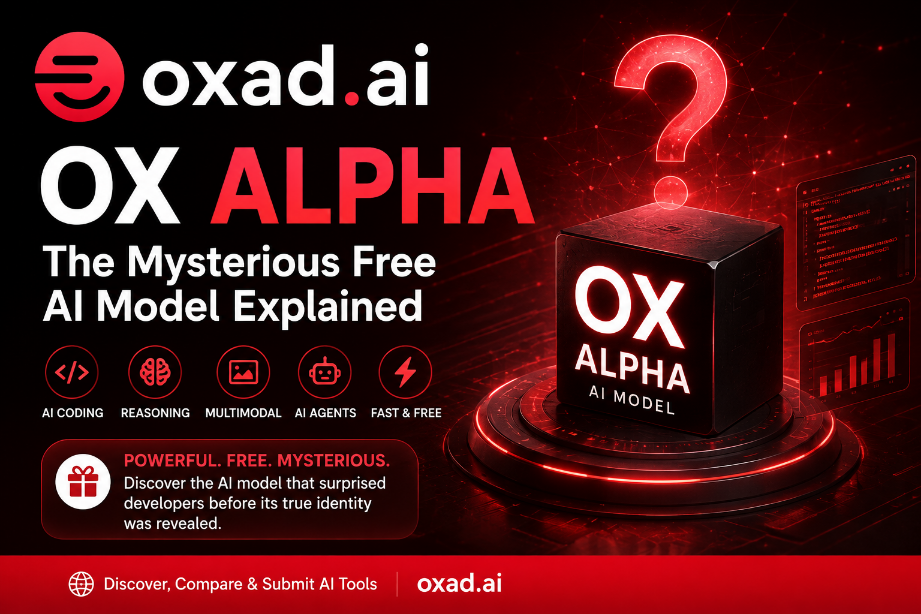
Ox Alpha: The Mysterious Free AI Model That Suddenly Took the AI World by Surprise
Every now and then, a new AI model appears and immediately raises more questions than answers. There is no familiar brand behind it, no massive advertising campaign, and sometimes not even a clear explanation of where it came from. That is exactly what happened with Ox Alpha, an AI model that appeared almost out of nowhere and quickly attracted the attention of developers and AI enthusiasts.
At first, Ox Alpha looked like an entirely unknown project. It was presented as a stealth model, its creator was not publicly identified, and yet it was available for people to test. The model was described as being capable of advanced reasoning, coding, long-running software engineering tasks, and agentic workflows. The combination was unusual enough to make people curious.
But there was another reason the story spread so quickly: Ox Alpha was available for free during its anonymous testing period.
For developers, that created a very simple invitation. Instead of reading a carefully prepared marketing announcement, they could simply try the model and decide for themselves whether it was any good.
Then the mystery became even more interesting.
The identity behind Ox Alpha was eventually revealed. It was not a mysterious startup after all. Ox Alpha had been an anonymous preview of GLM-5.3-Flash, a new model from Z.ai, the company behind the GLM family of AI models.
The unusual journey from an anonymous model to an officially revealed AI system makes Ox Alpha more than just another model release. It offers an interesting look at how AI companies are experimenting with real-world testing, developer feedback, open models, and increasingly capable coding agents.
What Is Ox Alpha?
Ox Alpha is an AI reasoning model designed with demanding technical workflows in mind. Rather than focusing only on casual conversations or simple text generation, the model was positioned around coding, complex reasoning, long-running software engineering tasks, AI agents, tool use, and large-context workloads.
That distinction is important because the role of AI assistants is changing. Developers are increasingly asking AI systems to do more than generate a short piece of code. They want models that can understand an entire project, follow a complex objective, reason through problems, use tools, modify files, review their own work, and continue working through several stages of a task.
Ox Alpha appeared to be designed for exactly this kind of environment.
Its original positioning emphasized sustained agentic work and long-horizon software engineering. In practical terms, that means the model was intended for tasks that may require multiple reasoning steps rather than a single response.
This makes Ox Alpha particularly interesting to developers building or experimenting with modern AI coding agents.
The Mystery Behind Ox Alpha
When Ox Alpha first appeared, one question dominated the conversation: Who created it?
The model was presented without a recognizable company identity. Its provider was intentionally hidden, turning what could have been an ordinary model launch into a small mystery within the AI community.
That approach was unusual. Most major AI companies want their names attached to new models because the reputation of the company itself can help generate interest and trust. Ox Alpha followed the opposite strategy.
The model appeared first. The identity came later.
Developers began trying to understand the system based on its behavior rather than its brand. Some users compared its responses with familiar AI models, while others tried to identify its technical origins from its capabilities, performance, and behavior.
Speculation naturally followed. Could it be a new model from a Chinese AI laboratory? Could it be connected to another major technology company? Was it an unreleased frontier model being tested quietly?
For a short period, there was no definitive answer.
Why Did Ox Alpha Attract So Much Attention?
The mystery alone would probably not have been enough to sustain interest. What made Ox Alpha stand out was the combination of anonymity, accessibility, and ambitious capabilities.
AI developers are constantly exposed to new models. Every week brings another announcement, another benchmark, and another claim about improved reasoning or coding performance. Most of those releases quickly become part of the background noise.
Ox Alpha was different because users could actually experiment with it before knowing exactly who was behind it.
That changed the psychology of the launch.
Instead of starting with a company’s reputation and then evaluating its model, developers were effectively evaluating the model first and asking about the company afterward.
It became a kind of real-world blind test.
The question was simple: if you remove the brand name, does the model still impress people?
The Mystery Was Eventually Solved
The mystery did not remain unsolved for long. Z.ai eventually confirmed that Ox Alpha had been used as an anonymous testing identity for GLM-5.3-Flash.
According to Z.ai, the company deliberately deployed the model under the Ox Alpha identity through OpenCode and OpenRouter before its official announcement. The purpose was to expose the system to real-world users and collect feedback from genuine usage rather than relying entirely on internal testing and controlled benchmarks.
This revelation changed the way the entire story could be understood.
Ox Alpha was not an unknown team suddenly appearing on the AI scene. It was a carefully planned experiment from an established AI laboratory.
The company had effectively placed its model in front of developers and allowed the model’s performance to speak before revealing its identity.
What Is Z.ai?
Z.ai is the AI company behind the GLM family of models. Its work has increasingly focused on advanced reasoning, coding, multimodal capabilities, AI agents, and open or open-weight AI systems.
The company’s decision to use an anonymous identity for GLM-5.3-Flash demonstrates how AI model development is becoming more experimental. Traditional product launches often depend heavily on benchmarks and marketing. Real-world testing introduces a different kind of evidence.
Real users do not behave like benchmark datasets.
They make unusual requests, use incomplete instructions, work with messy codebases, change direction halfway through a task, and encounter problems that developers inside a laboratory may not have anticipated.
For a company building an AI model intended for developers, this type of feedback can be extremely valuable.
Why Hide the Model’s Identity?
Z.ai’s anonymous testing strategy raises an interesting question. Why would a company deliberately hide the identity of its own model?
One possible advantage is that anonymity reduces the influence of brand expectations. When developers know they are using a model from a famous company, they may approach it with certain assumptions. They may expect a particular level of quality, compare it with previous products from the same company, or judge it according to the reputation of the brand.
Ox Alpha removed much of that context.
Users had to interact with the system itself.
That makes the experiment particularly interesting because the feedback was generated around actual usage rather than simply around a public announcement.
In a rapidly changing AI market, that kind of direct feedback can reveal strengths and weaknesses that conventional benchmark testing may not capture.
The Free Access Made Ox Alpha Even More Interesting
There was another major factor behind the attention surrounding Ox Alpha: its free access during the anonymous testing period.
For developers, free access removes one of the biggest barriers to experimenting with a new AI model. Instead of deciding whether a new system is worth paying for before testing it, users can simply try it with their own coding tasks, questions, projects, and workflows.
Reports about the Ox Alpha experiment described extremely high serving capacity during the test. That made it possible for a large number of users to interact with the model and generate real-world usage data.
The result was a powerful combination: a mysterious AI model, free access, and developers trying to discover whether the system was genuinely capable.
That is a much more compelling story than another conventional product announcement.
A Context Window Built for Large Projects
One of the most notable technical characteristics associated with Ox Alpha is its enormous context window.
OpenRouter listed the model with a context capacity of approximately 1,048,576 tokens, or around one million tokens. That is particularly relevant for developers and researchers working with large amounts of information.
A large context window can allow an AI system to work with much more material in a single interaction. Instead of repeatedly supplying small sections of a project, users may be able to provide much larger collections of files, documentation, specifications, or other information.
This can be useful when working with:
Large software repositories.
Long technical documents.
Multiple source files.
Extensive project documentation.
Large research collections.
Detailed software specifications.
Long-running conversations.
However, context size should not be confused with intelligence. A model having a million-token context window does not automatically mean that it will understand every piece of information perfectly.
The more important question is how effectively the model can identify relevant information, maintain relationships between different parts of a project, and reason over that information.
Ox Alpha and AI Coding
Coding is one of the areas where Ox Alpha becomes particularly interesting.
The modern AI coding assistant is evolving beyond simple autocomplete. Developers increasingly want an AI system that can act as a collaborator capable of understanding a broader software project.
Consider the difference between asking an AI to write a small function and asking it to investigate a problem across an entire application.
The second task might require the model to inspect multiple files, understand how different components interact, identify the likely source of a problem, propose a solution, modify the code, run tests, interpret the results, and make additional changes if something fails.
That is closer to software engineering than traditional text generation.
Ox Alpha was designed with this kind of long-running, agentic workflow in mind.
From Code Generation to AI Software Engineering
This transition is one of the most important developments happening in AI coding.
A traditional coding assistant might help a developer complete a function or explain an error. An AI software engineering agent is expected to operate at a much broader level.
It may receive a goal rather than a specific coding instruction.
For example, a developer might ask an agent to investigate why a dashboard is slow, identify the problem, implement a fix, run the relevant tests, and verify that the change did not introduce another issue.
That workflow requires reasoning, planning, memory, context management, tool use, code generation, and verification.
These are precisely the capabilities that make reasoning models such as Ox Alpha worth watching.
What Is GLM-5.3-Flash?
After the Ox Alpha mystery was solved, the model could finally be understood in the context of Z.ai’s broader GLM strategy.
GLM-5.3-Flash is described by Z.ai as a natively multimodal model in the GLM-5 family. The model is designed to combine reasoning, coding, visual understanding, and agentic capabilities while placing considerable emphasis on inference efficiency.
Z.ai reports that the model contains 320 billion total parameters, with approximately 18 billion active parameters.
The difference between total and active parameters is significant when thinking about model efficiency. A model can contain a very large number of parameters while using only a portion of them during a particular computation. This type of architecture can help deliver substantial model capacity while reducing the amount of computation required for individual tasks.
For developers, that can potentially translate into a more practical balance between capability, speed, and cost.
Why the “Flash” Approach Matters
The AI industry has spent years competing over increasingly large models. But size alone is no longer enough.
As AI becomes part of everyday software development, businesses and developers need models that are not only capable but also affordable and responsive.
Z.ai says GLM-5.3-Flash uses a hybrid approach involving sparse and linear attention mechanisms to improve the efficiency of long-context inference.
This is particularly relevant for agentic applications, where a model may need to process large amounts of information repeatedly while continuing to reason through a task.
The broader trend is clear: the next generation of AI competition will involve not only intelligence, but also efficiency.
Multimodal Capabilities Add Another Layer
Another important aspect of GLM-5.3-Flash is its multimodal design.
Modern software development increasingly involves more than source code. Developers work with screenshots, interfaces, diagrams, dashboards, documents, visual bugs, and other forms of information.
An AI system that can understand both code and visual information can therefore become much more useful.
Imagine a developer debugging a web application. The problem may not be obvious from the source code alone. The developer might also need to examine how the interface is actually rendered.
Visual reasoning can become part of that feedback loop.
Instead of asking an AI only whether the code looks correct, developers can increasingly ask whether the resulting interface behaves or appears as expected.
How Good Is GLM-5.3-Flash?
Z.ai has published strong results for GLM-5.3-Flash across coding, agentic, and visual reasoning benchmarks.
The company reports a score of 84.3 on Terminal-Bench 2.1, 63.4 on DeepSWE v1.1, and 48.8 on AutomationBench v1.0.6, alongside results across several vision-oriented evaluations.
These results are certainly interesting, particularly because they focus on areas that matter to developers and AI agent builders.
Still, benchmarks should be treated as indicators rather than guarantees.
A model can perform extremely well on a benchmark and still behave differently when exposed to a particular company’s codebase, development environment, programming style, or production requirements.
For that reason, hands-on testing remains one of the best ways to determine whether Ox Alpha or GLM-5.3-Flash is actually useful for a particular workflow.
What Can You Use Ox Alpha For?
Developers can experiment with Ox Alpha on a wide range of technical tasks. The model’s positioning makes it particularly suitable for situations where simple text generation is not enough and deeper reasoning is required.
For example, you might use it to analyze unfamiliar code, investigate bugs, refactor existing components, design software architecture, create automated tests, review changes, or reason through a complicated technical problem.
Its large context capability can also be useful when the task involves several related files or a substantial amount of documentation.
The most interesting experiments are often the ones that resemble real work rather than artificial benchmark questions.
Try Ox Alpha on OXAD.AI
If you have followed the story this far, the natural next step is to experience the model yourself.
Curious About Ox Alpha?
Explore the Ox Alpha listing on OXAD.AI and discover the model that started as a mystery before its connection to Z.ai was revealed.
Ox Alpha is especially interesting for people who want to explore advanced AI reasoning, coding, and agentic workflows. Developers are an obvious audience, but they are not the only ones who may find the model useful.
Who
Why It May Be Useful
Developers
Coding, debugging, refactoring and understanding large projects.
AI Agent Builders
Experimenting with reasoning, tools and multi-step workflows.
Researchers
Analyzing large amounts of technical information and documentation.
Students
Learning programming, researching topics and solving complex problems.
AI Enthusiasts
Testing an unusual model with a fascinating development story.
Is Ox Alpha Still Free?
This is an important distinction.
The original Ox Alpha experiment was offered with free access during its anonymous testing period. That does not necessarily mean that every future version or access route will remain permanently free.
AI companies frequently change pricing, access limits, infrastructure, and availability as models move from testing to broader commercial deployment.
If you are considering Ox Alpha for an ongoing project, always check the current availability and usage conditions before making it part of a production workflow.
Open Weights Make the Story More Interesting
The story of Ox Alpha also connects to the growing importance of open and open-weight AI models.
Z.ai has made GLM-5.3-Flash weights publicly available, giving developers and researchers opportunities to explore the model beyond a simple hosted chatbot experience.
This can be particularly valuable for technical users who want more control over how an AI model is deployed and integrated.
Open-weight models can also encourage experimentation, independent evaluation, research, and integration into different AI development environments.
That makes the transition from Ox Alpha to GLM-5.3-Flash more significant than a simple name change.
Should You Trust an AI Model Just Because It Performs Well?
Probably not.
The excitement surrounding Ox Alpha is understandable, but developers should separate curiosity from production readiness.
Benchmark results, online discussions, and impressive demonstrations can all be useful signals, but none of them replaces testing the model against real requirements.
Before using any unfamiliar AI model for an important project, consider its accuracy, reliability, latency, context handling, coding quality, tool use, privacy implications, and data-handling policies.
You should also consider what happens when the free testing period ends or when the provider changes its access policy.
A model that performs exceptionally well on one task may not be the best option for another.
The Real Lesson Behind Ox Alpha
Perhaps the most fascinating part of the Ox Alpha story is not its parameter count or benchmark scores.
It is the experiment itself.
Z.ai essentially allowed a new model to enter the developer community without the usual identity and branding attached to it. Users had to judge the system based on what they experienced.
Developers tested the model.
They discussed its capabilities.
They tried to determine where it came from.
And eventually, the answer arrived.
Behind the mysterious Ox Alpha name was Z.ai’s GLM-5.3-Flash.
That makes the story a fascinating example of how AI companies can use real-world developer communities as part of the model evaluation process.
From Mystery to Official AI Model
Ox Alpha began as an anonymous experiment, but its story eventually led to an official model release.
The transition from Ox Alpha to GLM-5.3-Flash also illustrates a broader shift in the AI industry. Models are increasingly being designed around practical workflows rather than simple conversation.
Coding, research, automation, visual understanding, tool use, and autonomous agents are becoming increasingly connected.
As these systems become more capable, the difference between an AI chatbot and an AI software agent will become increasingly important.
Ox Alpha was interesting precisely because it appeared to sit on that boundary.
Could Ox Alpha Become a Serious Coding Alternative?
That depends on the developer and the project.
There is no universal AI coding model that is best for everyone. Programming languages, repository size, development environment, context requirements, latency, budget, privacy expectations, and preferred tools can all influence the choice.
However, Ox Alpha deserves attention because its combination of reasoning, coding, large context, multimodal capabilities, and agentic positioning makes it different from a basic coding assistant.
The best way to judge it is not to ask whether it beats every other AI model.
The better question is whether it can solve your particular problem effectively.
Final Verdict: Is Ox Alpha Worth Trying?
Yes, especially if you are interested in AI coding, reasoning models, AI agents, or emerging AI technology.
Ox Alpha has an unusual story that immediately separates it from ordinary AI releases. It appeared anonymously, attracted developers through free access, generated speculation about its creator, and eventually turned out to be an experiment involving Z.ai’s GLM-5.3-Flash.
But the story is more than an entertaining mystery.
It demonstrates how the AI industry is moving toward models that can reason over large amounts of information, work with multiple modalities, interact with tools, and participate in longer software engineering workflows.
For developers, that evolution could be extremely important.
The Mystery Is Solved. The Experiment Is Still Worth Exploring.
Ox Alpha may have started as an anonymous AI model, but its unusual journey into GLM-5.3-Flash offers a fascinating glimpse at how the next generation of AI coding and reasoning systems is being developed.
Try Ox Alpha
If you want to see what made this mysterious AI model so interesting to developers, you can explore its listing on OXAD.AI.
Ox Alpha was a reasoning-focused AI model positioned for coding, complex reasoning, long-running software engineering, and agentic workflows.
Who created Ox Alpha?
Ox Alpha was an anonymous preview of GLM-5.3-Flash created by Z.ai.
Why was Ox Alpha anonymous?
Z.ai used the anonymous identity to test the model with real users and collect practical feedback before its official release.
Was Ox Alpha free?
The original anonymous preview provided free access for a limited testing period, although availability and usage conditions can change.
What is GLM-5.3-Flash?
GLM-5.3-Flash is a natively multimodal AI model from Z.ai designed for reasoning, coding, visual understanding, and agentic workflows.
Is Ox Alpha good for coding?
Yes. Coding and long-horizon software engineering were among the main use cases associated with the model.
Does Ox Alpha support a large context window?
OpenRouter listed the original Ox Alpha model with a context window of approximately 1.05 million tokens.
Does GLM-5.3-Flash support multimodal tasks?
Yes. Z.ai describes GLM-5.3-Flash as a natively multimodal model capable of working with visual information alongside text.
Is GLM-5.3-Flash open weight?
Z.ai has made GLM-5.3-Flash weights publicly available, giving developers and researchers more opportunities for experimentation and deployment.
Should I use Ox Alpha for production?
Test the model carefully against your own workloads, security requirements, reliability expectations, privacy needs, and operational constraints before using it in production.
Where can I try Ox Alpha?
You can explore the Ox Alpha listing on OXAD.AI and learn more about its capabilities and intended use cases.