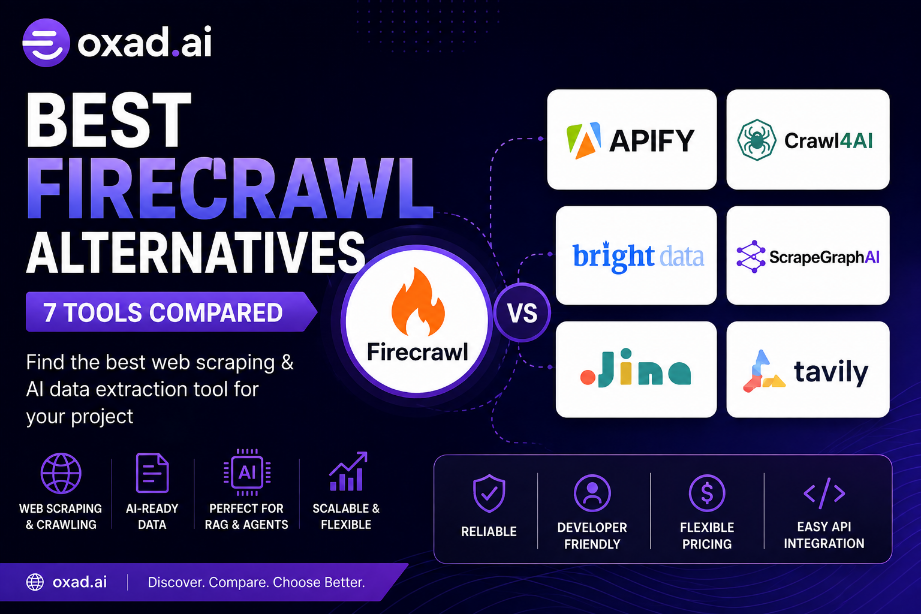
Best Firecrawl Alternatives: 7 Web Scraping Tools Compared
If you are building an AI application, RAG system, research agent, or automated data pipeline, you have probably discovered how quickly a simple web scraping task can become complicated.You may need to collect information from websites, deal with JavaScript-rendered pages, convert web content into clean Markdown, extract structured data, or make the resulting information usable by an AI model. This is exactly the problem that Firecrawl was designed to solve.
Firecrawl has become a popular choice for developers who want to turn web pages into clean, AI-ready content without building an entire crawling and extraction infrastructure from scratch. It supports scraping, crawling, mapping, search, interaction, and structured extraction, making it particularly attractive for AI and developer workflows.
But Firecrawl is not automatically the best choice for every project.
Your requirements may be different. You might need a completely open-source solution, more control over infrastructure, pre-built scrapers, enterprise-grade proxy infrastructure, structured extraction, or a tool designed specifically for AI search and agents.
That is why looking at the best Firecrawl alternatives can make sense before committing to a particular platform.
Quick answer: Firecrawl remains a strong choice for developers who want an AI-focused web crawling and scraping API with clean outputs and a straightforward developer experience. However, Apify, Crawl4AI, Bright Data, ScrapeGraphAI, Jina Reader, Tavily, and other platforms can be better suited to specific workflows.
Firecrawl is a web data API built around a simple idea: give an application access to website content in a form that AI systems can actually use.
Instead of manually downloading HTML and writing custom parsing logic for every website, developers can use Firecrawl to scrape pages, crawl websites, map site structures, search the web, interact with pages, and extract information into formats suitable for downstream applications.
This makes Firecrawl particularly relevant to the growing number of applications that need fresh web information.
Examples include:
Retrieval-augmented generation systems.
AI research assistants.
Web search agents.
Knowledge bases.
AI coding assistants.
Market research systems.
Competitive intelligence platforms.
Automated content pipelines.
Website monitoring systems.
Firecrawl’s current pricing page offers a free plan with 1,000 credits per month. Paid self-serve plans include Hobby, Standard, and Growth tiers, while larger Scale and Enterprise options are available for higher-volume requirements.
Because pricing and usage policies can change, developers should always verify the current plan before estimating the long-term cost of a production pipeline.
Why Are Developers Looking for Firecrawl Alternatives?
Firecrawl is capable, but different projects have different requirements.
One developer may want a simple URL-to-Markdown API. Another may need thousands of pre-built scrapers. A third may want to run everything on their own infrastructure. An enterprise team may care more about proxy infrastructure and difficult websites than Markdown quality.
This is why the phrase Firecrawl alternatives covers several very different categories of tools.
Some alternatives compete directly with Firecrawl. Others solve a related problem from a completely different angle.
What Should You Look for in a Firecrawl Alternative?
Before comparing specific tools, it is worth defining the criteria that actually matter.
Output Quality
If the scraped information is going directly into an LLM or RAG system, clean and well-structured output is extremely important. Removing unnecessary navigation elements, advertisements, duplicated content, and irrelevant HTML can make downstream processing much easier.
JavaScript Rendering
Many modern websites do not deliver all of their content in the initial HTML response. If your targets rely heavily on JavaScript, browser rendering can become essential.
Scale
A tool that works perfectly for a few hundred pages may not be suitable for millions of pages. Consider concurrency, rate limits, infrastructure requirements, and how pricing changes as your usage grows.
Structured Extraction
If you need specific fields rather than an entire page, structured extraction can save considerable development time.
Anti-Bot and Proxy Capabilities
Some websites are relatively easy to access, while others use sophisticated anti-bot systems. The harder your target websites are, the more important proxy infrastructure, browser automation, and request management become.
Developer Experience
Documentation, SDKs, APIs, examples, integrations, and debugging tools can make a major difference when a product becomes part of your development workflow.
Self-Hosting
Some developers prefer complete control over their infrastructure. In that situation, an open-source framework may be more attractive than a managed API.
Apify takes a different approach from Firecrawl. Instead of focusing primarily on a single AI-oriented crawling workflow, Apify provides a broad platform built around reusable web automation programs known as Actors.
This can be particularly useful when you need to collect structured information from a specific website or platform and do not want to build the scraper entirely from scratch.
Apify’s ecosystem includes pre-built scrapers and automation tools for many different websites and use cases. That can be a significant advantage for teams that need practical data collection rather than simply converting arbitrary websites into Markdown.
Best for: Developers and teams looking for pre-built scrapers, automation workflows, structured datasets, and an extensible scraping platform.
Apify Pros
Large ecosystem of ready-made Actors.
Useful for structured web data collection.
Supports automation workflows.
Suitable for a wide range of websites.
Useful for teams that want more than basic scraping.
Apify Cons
The platform can feel more complex than a simple scraping API.
Choosing between different Actors may require research.
Costs can vary significantly depending on the Actor and workload.
Not every Actor provides the same level of quality or maintenance.
Choose Apify instead of Firecrawl if: your priority is a large ecosystem of reusable scraping and automation components rather than a streamlined AI crawling workflow.
Crawl4AI: Best Open-Source Alternative
If your biggest reason for looking beyond Firecrawl is control, Crawl4AI deserves serious consideration.
Crawl4AI is an open-source framework designed specifically for AI-friendly web crawling and extraction. It is particularly attractive to developers who want to run their own infrastructure and customize how crawling and extraction work.
The major advantage is flexibility.
You are not limited to a hosted API. You can inspect the project, modify your implementation, and build the crawling pipeline around your own infrastructure and requirements.
Best for: Developers who prefer open-source software, self-hosting, Python-based workflows, and greater infrastructure control.
You may need to manage browsers and infrastructure yourself.
Scaling requires engineering work.
It may be less convenient than a fully managed API.
Choose Crawl4AI instead of Firecrawl if: you value control and open-source flexibility more than having a managed service handle the infrastructure for you.
Bright Data: Best for Large-Scale and Difficult Web Data
Bright Data sits in a different part of the market. Its strength is large-scale web data infrastructure, including proxy networks, scraping APIs, datasets, and tools designed for accessing challenging websites.
This can make it attractive to organizations that operate at a much larger scale or regularly encounter websites with sophisticated anti-bot protections.
For a small AI prototype, Bright Data may be more infrastructure than you need. For a large data operation, however, its broader ecosystem can become a major advantage.
Best for: Enterprises and data-intensive teams that need extensive web data infrastructure and large-scale collection capabilities.
Bright Data Pros
Large-scale web data infrastructure.
Broad proxy capabilities.
Designed for demanding data collection workloads.
Suitable for enterprise use cases.
Multiple products beyond basic scraping.
Bright Data Cons
Can be more complex than developers need for simple projects.
Pricing can be harder to compare with simple per-page APIs.
Enterprise-oriented features may be unnecessary for small projects.
Choose Bright Data instead of Firecrawl if: your biggest challenge is accessing large volumes of difficult web data rather than simply converting pages into AI-ready content.
ScrapeGraphAI: Best for AI-Powered Structured Extraction
ScrapeGraphAI takes a more AI-native approach to web extraction. Instead of requiring developers to manually define every parsing rule, the platform is designed to use AI to extract information according to the user’s instructions or desired structure.
This can be useful when the goal is not simply to obtain a webpage in Markdown, but to answer a question such as: “Extract the product name, price, rating, availability, and description from these pages.”
That makes it particularly interesting for applications where the final result needs to be structured data rather than raw page content.
Best for: Developers who want AI-assisted extraction of structured information from web pages.
ScrapeGraphAI Pros
AI-driven extraction approach.
Useful for structured data workflows.
Can reduce the need for manually written extraction rules.
Interesting option for AI-native applications.
Open-source components are available.
ScrapeGraphAI Cons
AI-based extraction can introduce additional variability.
Complex extraction requirements may still need engineering oversight.
Costs can increase as workloads become larger.
Choose ScrapeGraphAI instead of Firecrawl if: your primary objective is extracting specific structured fields rather than simply retrieving clean website content.
Jina Reader: Best for Simple URL-to-Content Workflows
Jina Reader is an interesting alternative when your requirements are relatively straightforward.
Its core idea is simple: provide a URL and receive content in a format that is easier for AI systems to process.
This simplicity can be an advantage. Not every application needs a complete crawling platform with extensive configuration. Sometimes developers simply want a reliable way to turn a webpage into clean content that can be passed to an LLM.
Best for: Developers building simple AI applications that primarily need clean webpage content.
Jina Reader Pros
Simple concept.
Well suited to URL-to-content workflows.
Useful for AI and RAG applications.
Lower complexity for straightforward use cases.
Jina Reader Cons
Not a full replacement for every Firecrawl workflow.
Advanced crawling requirements may require another solution.
Complex extraction and automation needs can exceed its core use case.
Choose Jina Reader instead of Firecrawl if: you mainly need clean content from individual URLs and do not require the broader functionality of a full crawling platform.
Tavily approaches the problem from the perspective of AI search rather than traditional web crawling.
That distinction matters.
If your application needs an AI agent to search the web, discover relevant sources, and retrieve information as part of a research workflow, a search-focused platform may be more appropriate than a crawler designed primarily to ingest known websites.
Tavily is therefore worth considering when your application needs to answer questions using fresh web information rather than simply crawl a predefined website.
Best for: AI agents, research assistants, and applications that need web search combined with retrieval.
Tavily Pros
Designed around AI search.
Strong fit for research agents.
Useful for discovering information dynamically.
Can complement LLM-based applications.
Tavily Cons
Search is not the same as full website crawling.
May not be the right choice for large site ingestion.
Developers with deterministic crawling requirements may need a different architecture.
Choose Tavily instead of Firecrawl if: your application needs an AI-powered web search layer rather than a dedicated crawler for ingesting known websites.
The biggest mistake when choosing a scraping platform is comparing features without considering the actual job.
Firecrawl may be excellent for one workflow while Crawl4AI is better for another. Apify may win for pre-built scrapers, while Bright Data may be more appropriate for enterprise-scale web data.
Requirement
Recommended Option
Why
AI-ready crawling
Firecrawl
Strong focus on AI-ready web content.
Pre-built scrapers
Apify
Large Actor ecosystem.
Self-hosting
Crawl4AI
Open-source and customizable.
Enterprise web data
Bright Data
Broad web data infrastructure.
Structured extraction
ScrapeGraphAI
AI-oriented extraction workflows.
Simple URL extraction
Jina Reader
Simple URL-to-content workflow.
AI web search
Tavily
Designed for search and research agents.
Firecrawl vs Apify
This is one of the most useful comparisons for developers who are undecided between the two.
Firecrawl is particularly attractive when the workflow starts with websites and ends with AI-ready content. Its API-oriented design makes it straightforward to incorporate crawling and extraction into an AI application.
Apify is more like a broad web automation ecosystem. Its Actor model gives developers access to many specialized scraping and automation solutions.
If you know exactly which websites you need to scrape and a suitable Actor already exists, Apify can be extremely convenient.
If you are building an AI application that needs a consistent crawling and content-extraction layer, Firecrawl may feel more direct.
Verdict: Firecrawl for streamlined AI crawling; Apify for broader scraping automation and pre-built solutions.
Firecrawl vs Crawl4AI
This comparison comes down largely to convenience versus control.
Firecrawl provides a managed experience, while Crawl4AI is attractive to developers who want to build and control their own crawling environment.
If you do not want to manage infrastructure, a hosted service can save substantial engineering time.
If you want maximum customization and are comfortable maintaining the system yourself, an open-source framework may be more appealing.
Verdict: Firecrawl for convenience; Crawl4AI for self-hosted control.
Firecrawl vs Bright Data
These platforms are not identical competitors.
Firecrawl is highly focused on making web content usable for AI applications. Bright Data operates at a much broader web data infrastructure level.
If your project requires large-scale data collection and sophisticated proxy infrastructure, Bright Data deserves consideration.
If your objective is to turn web pages into clean content for an AI application, Firecrawl may be the more straightforward option.
Verdict: Firecrawl for AI-native crawling; Bright Data for broader large-scale web data infrastructure.
Firecrawl Pricing: Is It Expensive?
Firecrawl currently provides a free tier with 1,000 credits per month. Its published self-serve plans include Hobby at $16 per month when billed annually, Standard at $83 per month when billed annually, and Growth at $333 per month when billed annually. Larger Scale and Enterprise options are also available.
The important point is that Firecrawl uses a credit-based model. Scrape, Crawl, and Map operations consume credits based on pages, while other capabilities such as Search and browser interaction have different credit rules.
This makes it important to estimate your actual workload rather than comparing only the headline monthly price.
For a small project, the free tier may be enough to evaluate the service. For a large production pipeline, you should calculate expected page volume, concurrency requirements, and the cost of additional usage before choosing a plan.
Is Firecrawl Free?
Yes, Firecrawl currently offers a free plan.
The free plan provides 1,000 credits per month and does not require a payment card according to the published pricing information.
However, free access should be viewed primarily as an opportunity to evaluate the platform rather than a guarantee that a large production workload can remain free.
If your application grows significantly, you should expect to move to a paid plan or consider whether a self-hosted alternative makes better economic sense.
Firecrawl Pros and Cons
Advantages
Limitations
Strong AI-focused crawling workflow
Not necessarily the cheapest option at every scale
Clean outputs for AI applications
Credit-based usage requires careful planning
Supports crawling and mapping
Very difficult websites may require specialized infrastructure
Useful for RAG and AI agents
Large-scale workloads can become expensive
Developer-friendly API
Self-hosting requires additional infrastructure work
Free tier available
Pricing and limits can change over time
Which Firecrawl Alternative Should You Choose?
The answer depends less on which product has the longest feature list and more on what your application actually needs.
Choose Firecrawl if you want a developer-friendly platform focused on turning websites into AI-ready content and building crawling workflows into AI applications.
Choose Apify if you want access to a broad ecosystem of pre-built scrapers and automation tools.
Choose Crawl4AI if open-source software and self-hosting are important to you.
Choose Bright Data if you operate at large scale or need extensive web data and proxy infrastructure.
Choose ScrapeGraphAI if your primary requirement is AI-powered extraction of structured information.
Choose Jina Reader if your application mainly needs a straightforward way to turn URLs into clean content.
Choose Tavily if your real requirement is AI-powered web search and research rather than conventional site crawling.
When Firecrawl Is Still the Better Choice
Looking for alternatives does not mean that Firecrawl is a poor choice.
In fact, Firecrawl remains one of the more compelling options when your application needs a dedicated web data layer for AI.
Its biggest strength is the combination of crawling, scraping, mapping, search, interaction, and extraction capabilities within a platform designed specifically around modern AI workflows.
For developers building RAG systems, research agents, AI assistants, or applications that need to ingest website content, this integrated approach can reduce the amount of infrastructure that needs to be assembled independently.
In many cases, paying for a managed service is not simply about the scraping itself. It is about saving development time.
When You Should Consider an Alternative
An alternative becomes more attractive when Firecrawl’s strengths are not aligned with your requirements.
For example, a developer who wants to self-host everything may prefer Crawl4AI. A team that needs hundreds of specialized website scrapers may find Apify more practical. An enterprise organization with extensive proxy and data requirements may prefer Bright Data.
Similarly, an AI research agent may benefit more from a search-oriented service such as Tavily, while a structured extraction project may be better suited to an AI extraction platform.
The important lesson is that there is no universally superior web scraping API.
The best tool is the one that matches the architecture of your application.
How We Evaluated These Firecrawl Alternatives
This comparison focuses on product positioning, documented capabilities, pricing information, developer use cases, and the type of workflow each platform is designed to support.
It is not presented as a claim that OXAD.AI independently benchmarked every provider under identical laboratory conditions. Performance can vary significantly depending on the target websites, geographic location, JavaScript requirements, concurrency, anti-bot systems, and extraction workload.
For that reason, developers evaluating a tool for production should run their own tests using representative URLs and realistic workloads.
This approach is particularly important for scraping because a platform that performs well on ordinary websites may behave differently when faced with dynamic pages, protected sites, large crawls, or unusual content structures.
Important Considerations Before Web Scraping
Technical capability is only one part of choosing a scraping platform.
Before collecting website data at scale, you should also consider the legal and contractual conditions that apply to the websites and information involved. Website terms, robots directives, copyright, privacy requirements, and applicable laws can vary by jurisdiction and use case.
Developers should therefore make sure that their intended data collection is appropriate and compliant with the relevant rules.
No scraping platform removes the responsibility of the person or organization collecting and using the data.
Our Overall Take
Firecrawl remains a compelling option for developers who want an AI-oriented web crawling platform without building every part of the infrastructure themselves.
Its biggest advantage is the way it connects web data collection with modern AI workflows. Instead of treating scraping as an isolated task, Firecrawl is designed around the needs of applications that need to search, crawl, extract, and process web information with AI.
But that does not make it the right choice for everyone.
Apify is compelling when pre-built scrapers and automation matter most. Crawl4AI is attractive for self-hosted and open-source workflows. Bright Data is better suited to organizations with large-scale web data requirements. ScrapeGraphAI stands out for AI-powered structured extraction, while Jina Reader can be a simpler choice for URL-to-content workflows. Tavily, meanwhile, makes more sense when the application is fundamentally about AI search and research.
In other words, the best Firecrawl alternative is not necessarily the tool with the most features.
It is the one that solves your particular problem with the least unnecessary complexity.
Frequently Asked Questions About Firecrawl Alternatives
What is the best Firecrawl alternative?
There is no universal winner. Apify, Crawl4AI, Bright Data, ScrapeGraphAI, Jina Reader, and Tavily each target different web data and AI workflows.
Is Firecrawl free?
Firecrawl currently offers a free plan with 1,000 credits per month, while paid plans provide higher limits and additional capacity.
Is Crawl4AI better than Firecrawl?
Crawl4AI may be better for developers who want open-source, self-hosted control, while Firecrawl is generally more convenient for managed AI crawling.
Is Apify better than Firecrawl?
Apify can be a better choice when you need pre-built scrapers and broader automation capabilities. Firecrawl may be more convenient for AI-focused crawling workflows.
What is the best open-source Firecrawl alternative?
Crawl4AI is one of the most relevant open-source alternatives for developers who want to build and operate their own AI-friendly crawling infrastructure.
What is the best Firecrawl alternative for AI agents?
The answer depends on the agent. Firecrawl is strong for web content ingestion, while Tavily is more focused on AI search and research workflows and Apify can provide specialized scraping Actors.
Is Firecrawl good for RAG?
Yes. Firecrawl is designed to make website content easier to ingest into AI and RAG applications by providing machine-friendly outputs.
What should I use instead of Firecrawl?
Choose based on your requirement: Apify for pre-built scrapers, Crawl4AI for self-hosting, Bright Data for large-scale infrastructure, ScrapeGraphAI for structured extraction, Jina Reader for simple URL extraction, and Tavily for AI search.
Does Firecrawl support large websites?
Firecrawl supports crawling workflows and offers higher-capacity plans for larger workloads, but developers should evaluate concurrency, credits, and target-site behavior before scaling.
Are Firecrawl alternatives cheaper?
Some can be cheaper for particular workloads, especially self-hosted open-source options. However, total cost should include infrastructure, maintenance, proxy services, engineering time, and scaling requirements.
Explore Firecrawl on OXAD.AI
If you are still deciding whether Firecrawl is the right choice for your project, you can explore its dedicated OXAD.AI listing for a concise overview of the tool, its category, platform, pricing, and capabilities.
Still Considering Firecrawl?
Compare its capabilities with your project requirements before choosing a web scraping and AI data platform.
Firecrawl has earned its place among the tools developers consider when they need to bring web data into AI applications. Its combination of crawling, scraping, search, mapping, interaction, and AI-friendly output makes it particularly relevant to RAG systems, research tools, AI agents, and modern data pipelines.
Still, choosing a web scraping platform should never be reduced to a simple “best tool” ranking.
If you want convenience and an AI-focused workflow, Firecrawl is a strong candidate. If you want a huge ecosystem of ready-made scrapers, look at Apify. If self-hosting and open-source control matter most, Crawl4AI deserves attention. For enterprise-scale web data infrastructure, Bright Data may be more appropriate. For structured AI extraction, consider ScrapeGraphAI. For straightforward URL-to-content tasks, Jina Reader can be attractive. And for AI-powered web research, Tavily may be the better fit.
The smartest approach is to start with your actual workload, test a small representative sample, calculate the real cost, and only then commit to a production platform.
That is ultimately what makes a good Firecrawl alternative: not simply being cheaper or having more features, but being better suited to the job you actually need to accomplish.
The Best Firecrawl Alternative Depends on Your Workflow
Compare the tools by crawling needs, extraction requirements, scale, infrastructure, AI integration, and total cost before making your decision.