Multi-Agent Coding: How AI Engineering Teams Are Changing Software
AI coding is moving beyond the idea of a single assistant sitting beside a developer.
For years, developers used AI mainly to generate code, explain errors, suggest improvements, and answer programming questions. Modern coding agents can go further: they can inspect repositories, plan changes, edit multiple files, run commands, execute tests, investigate failures, and revise their work.
The next step is to coordinate multiple AI agents, with different agents responsible for different parts of the software development workflow.
What happens when an AI coding system starts behaving more like an engineering team than a single coding assistant?
This is the idea behind multi-agent coding.
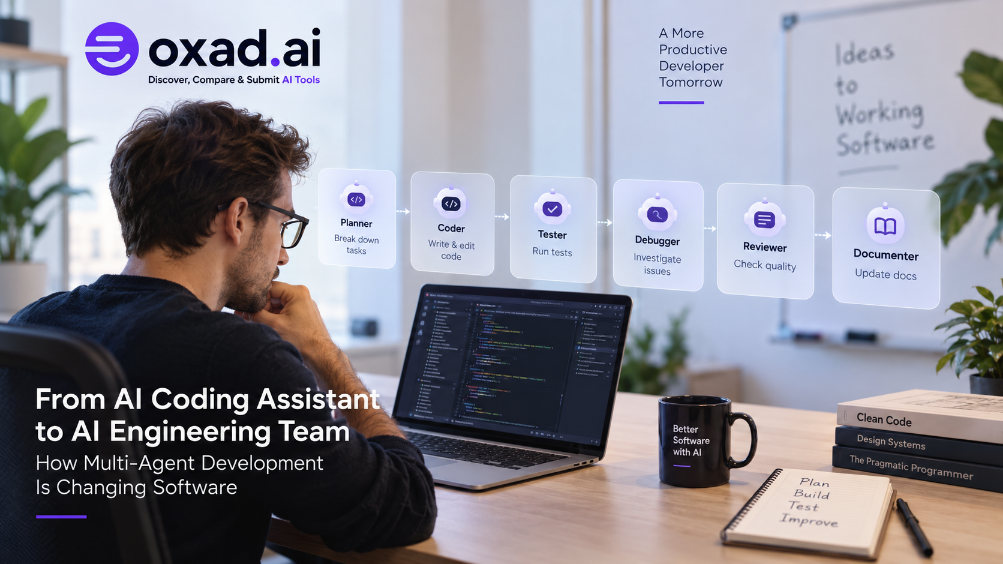
Instead of asking one AI system to perform every development task, a coordinated workflow can distribute work across planning, coding, testing, debugging, code review, research, and documentation.
The important shift is not simply the number of agents. It is the move from AI-assisted coding to AI-coordinated software development.
What Is Multi-Agent Coding?
Multi-agent coding is a software development approach in which multiple AI agents collaborate on different parts of a programming task or development workflow.
An agent can be assigned a specific role, objective, set of tools, context, or permissions. An orchestration system then determines how those agents interact and how their outputs move through the workflow.
AI Agent
Primary Role
Typical Output
Planning Agent
Understand requirements and repository structure
Implementation plan
Coding Agent
Implement software changes
Source code
Testing Agent
Create and execute tests
Tests and results
Debugging Agent
Investigate failures and errors
Diagnosis and fixes
Review Agent
Inspect code quality and potential issues
Review findings
Research Agent
Investigate libraries, APIs, and technical options
Research findings
Documentation Agent
Maintain technical documentation
Documentation updates
These agents do not have to operate independently. They can share context, pass results between stages, work in parallel, or be controlled by an orchestration layer.
From AI Assistant to AI Engineering Team
The evolution of AI coding can be understood as a gradual expansion of what AI is responsible for.
Development Stage
AI Responsibility
Developer Responsibility
AI Autocomplete
Suggest code
Write and control most of the implementation
AI Coding Assistant
Answer questions and generate code
Direct individual interactions
AI Coding Agent
Execute multi-step development tasks
Define goals and supervise execution
Multi-Agent Development
Coordinate specialized development activities
Design workflows, evaluate results, and make key decisions
With autocomplete, AI can automate a few lines of code.
With an assistant, AI can help solve a programming problem.
With an agent, AI can potentially handle an entire development task.
With multiple agents, the system can coordinate several connected tasks as a workflow.
That changes the unit of automation from code generation to software development processes.
How Does a Multi-Agent Coding Workflow Work?
Consider a developer who wants to add authentication to an existing application.
A multi-agent workflow could divide the task into several stages:
Developer Goal
Define the authentication requirement and constraints.
↓
Planning Agent
Analyzes the repository and creates an implementation plan.
↓
Coding Agent
Implements the required changes.
↓
Testing Agent
Creates and runs relevant tests.
↓
Debugging Agent
Investigates failures and proposes corrections.
↓
Review Agent
Checks the resulting implementation.
↓
Human Developer
Reviews the result and decides whether it should be accepted or merged.
The exact architecture can vary. Some agents may run sequentially, while others can work in parallel.
The important concept is that the workflow defines who does what, what information they receive, and how their work is evaluated.
Why Use Multiple AI Agents?
Specialization
Different agents can focus on different objectives.
A testing agent can concentrate on edge cases and coverage, while a review agent can focus on maintainability, security considerations, and architectural consistency.
Specialization can make complex workflows easier to structure.
Parallel Work
Some development activities can happen at the same time.
For example, one agent could investigate the backend while another analyzes frontend requirements and another prepares test cases.
Parallel execution can reduce waiting time when the tasks are genuinely independent.
Generation and Verification
A coding agent can produce an implementation while another agent evaluates it.
This creates a useful separation between generation and verification.
However, an AI review is not automatically independent or correct. Verification is strongest when it is supported by objective checks such as automated tests, static analysis, type checking, security scanning, or clearly defined acceptance criteria.
Different Models for Different Tasks
A multi-agent workflow does not necessarily need to use the same AI model for every task.
A fast model may handle routine transformations, while a more capable model may be reserved for difficult debugging or architecture decisions.
This connects multi-agent development with model routing and AI cost management.
Multi-Agent Coding and Model Routing
As development workflows become more complex, choosing the appropriate model for each task can become part of system design.
Task
Possible Strategy
Simple refactoring
Fast and efficient model
Documentation
Efficient general-purpose model
Test generation
Coding-focused model
Complex debugging
Higher-capability reasoning model
Architecture analysis
High-capability reasoning model
Code review
Reasoning-focused or specialized model
This changes the question from “Which AI model is the best?” to:
Which model is appropriate for this particular task?
That distinction can matter for both performance and cost.
The Orchestrator: The Control Layer Behind Multiple Agents
Once several agents are involved, coordination becomes a major part of the architecture.
An orchestrator can determine:
Which agent starts the workflow
What information each agent receives
Which tasks can run in parallel
When an agent should stop
When another agent should take over
How results are passed between agents
How failed tasks are retried
How conflicting outputs are handled
When human approval is required
The orchestrator can therefore be viewed as the coordination layer of an AI engineering workflow.
Component
Main Responsibility
Human
Defines goals, constraints, priorities, and important decisions
Orchestrator
Coordinates agents and workflow state
Specialized Agents
Perform individual development activities
Tools
Provide access to repositories, terminals, tests, APIs, and other systems
Evaluation
Determines whether the output satisfies requirements
Without effective orchestration, adding more agents can create additional complexity rather than reducing it.
The Biggest Risk: AI Agents Can Multiply Mistakes
Multi-agent development is not automatically more reliable simply because more agents are involved.
Imagine that one agent makes an incorrect assumption about the application architecture. A second agent receives that assumption as context and builds on it. A third agent tests the resulting implementation without questioning the original premise.
The workflow can then produce a chain of increasingly confident mistakes.
More agents do not automatically mean better software.
The quality of a multi-agent system depends on communication, context quality, evaluation, error handling, and the ability to detect incorrect assumptions.
Why Verification Becomes More Important as AI Autonomy Increases
The more responsibility an AI system receives, the more important verification becomes.
A robust development workflow should therefore include multiple opportunities to detect problems before they reach production.
A useful pattern is:
Plan → Build → Test → Verify → Review → Human Approval
Each stage can provide feedback to the workflow.
Automated tests are particularly valuable because they provide a measurable feedback mechanism. Static analysis, type checking, linting, security checks, integration tests, and deployment safeguards can add additional layers of validation.
This is one reason multi-agent coding should be viewed as a workflow engineering problem, not simply a prompt engineering problem.
Where Multi-Agent Coding Can Be Useful
Not every programming project requires multiple AI agents.
A simple coding task may be easier and faster with one capable agent. Multi-agent architectures become more interesting when a workflow contains several distinct activities that can be separated, evaluated, or performed in parallel.
Use Case
Potential Role for Multiple Agents
Large feature development
Divide planning, implementation, testing, and review
Legacy codebases
Investigate different areas of the repository
Large refactoring
Plan changes and verify them in stages
Testing
Separate test creation, execution, and analysis
Code review
Use independent checks for different quality dimensions
Research-heavy development
Investigate APIs, libraries, and implementation options
Documentation
Update documentation alongside software changes
Multi-Agent Coding Is Not the Same as Fully Autonomous Coding
One common misconception is that multi-agent development means developers can simply start several agents and leave them unsupervised.
That is not necessarily the goal.
Software engineering contains decisions that cannot always be evaluated through code execution alone.
Is the architecture appropriate for the product?
Does the feature solve the actual user problem?
Is the implementation maintainable?
Are security and privacy trade-offs acceptable?
Does the behavior match the business requirements?
Should the feature exist in the first place?
These decisions can require human judgment.
A more useful model is therefore:
Human direction → AI execution → Automated evaluation → Human verification
The human does not necessarily need to write every line of code, but remains responsible for important technical and product decisions.
How Multi-Agent Development Could Change the Developer’s Role
As AI handles more implementation tasks, the developer’s work can shift toward system design, supervision, evaluation, and architecture.
Traditional Focus
Potentially Emerging Focus
Writing individual components
Designing systems and development workflows
Manual debugging
Supervising automated debugging and validating fixes
Writing every test manually
Designing testing and evaluation strategies
Reviewing every change manually
Focusing human review on important decisions and risks
Managing one coding assistant
Managing AI development workflows
This does not make programming knowledge less relevant.
In some workflows, deeper technical knowledge may become even more valuable because developers need to understand the system well enough to evaluate AI-produced changes and recognize when an agent has made an incorrect assumption.
The Economics of Multi-Agent Coding
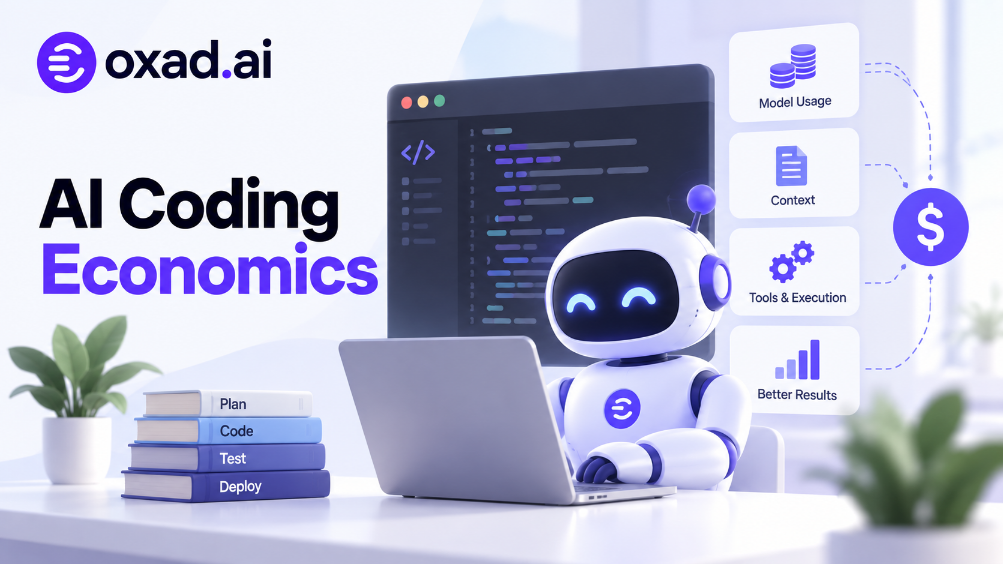
Multiple agents can increase the amount of work that AI performs, but they can also increase AI usage.
Each agent may consume model tokens, process context, call tools, execute commands, and generate additional inference.
That can result in substantially more model calls and compute.
For this reason, the objective should not be to maximize the number of agents.
The more useful metric is useful, validated work per unit of cost.
For a deeper discussion of the economics behind AI-assisted development, see the OXAD.AI guide to AI coding economics.
Multi-Agent Coding vs. One Large AI Agent
There is no universal requirement to use multiple agents.
The right architecture depends on the complexity, dependencies, risk, and evaluation requirements of the task.
Approach
Potential Strength
Potential Challenge
Single Agent
Simpler coordination and context flow
One system handles many responsibilities
Multi-Agent
Specialization, parallelism, and separated responsibilities
More orchestration, communication, and failure modes
A single agent may be appropriate for a small and clearly defined task.
A multi-agent workflow can become more useful when a project contains several independent or specialized activities.
The practical question is therefore:
Which architecture produces the most reliable and efficient workflow for the task?
When AI Agents Review Other AI Agents
One particularly interesting possibility is machine-to-machine quality control.
A coding agent can produce an implementation, while another agent evaluates it:
Coding Agent → Review Agent → Testing Agent
The review agent does not necessarily need to write new code. Its purpose can be to challenge assumptions, identify risks, and inspect the implementation against defined requirements.
However, there is an important limitation.
If all agents share the same incorrect assumptions, a review process may appear independent without actually providing strong independent verification.
For this reason, multi-agent systems benefit from diverse checks and objective evaluation rather than simply increasing the number of AI participants.
Could AI Agents Replace Parts of a Software Team?
AI agents can automate individual software development activities, but software engineering involves much more than implementation.
Engineering teams also deal with:
Product requirements
Architecture
Security
Operations
Prioritization
Communication
Maintenance
Risk management
Accountability
A more realistic use of multi-agent development is therefore to extend the capacity of software teams.
A small team could potentially supervise more implementation and testing activity without manually performing every intermediate step.
This also changes the metrics organizations may care about.
Validated features shipped
Time from requirement to production
Defect rates
Developer review time
Successful task completion
Cost per completed task
The AI Engineering Team Architecture
The concept can be summarized as a layered workflow:
This resembles a software engineering organization, but the specialized workers are software agents rather than separate human employees.
The potential advantage is that software agents can operate rapidly, repeat structured tasks, and in some architectures work on independent tasks in parallel.
The challenge is ensuring that speed does not come at the expense of reliability.
What Skills Will Developers Need for Multi-Agent Development?
If multi-agent development continues to expand, developers may need to learn more than prompt engineering.
Important areas include:
Agent orchestration
Task decomposition
Context engineering
Automated testing
Evaluation design
Model selection and routing
AI workflow cost management
Repository architecture
Human-in-the-loop design
Security and permissions
The skill is increasingly about designing systems of AI workers, rather than simply asking an AI to generate code.
Where AI Coding Tools Fit Into Multi-Agent Development
The AI coding ecosystem already includes tools focused on different stages of software development, from code generation and context management to code review and agentic workflows.
CodeRabbit, for example, is relevant to the growing role of AI-assisted code review, while Context.dev illustrates why providing useful repository context is becoming an important part of AI-assisted development.
In a mature multi-agent architecture, specialized capabilities like these could become components inside larger development workflows.
The Future May Be About AI Workflows, Not Individual AI Tools
The AI coding market has traditionally encouraged developers to compare individual products.
Which coding assistant is better?
Which model produces better code?
Which editor has the best AI features?
Multi-agent development introduces another layer of competition.
The important product may increasingly be the workflow connecting multiple AI capabilities.
A development pipeline could eventually look like:
Different AI systems can potentially contribute at different stages.
This means that the competitive advantage may shift from an individual model or coding assistant toward the quality of the entire development system.
What Could Make Multi-Agent Coding Successful?
A multi-agent coding system needs more than capable models.
It needs a reliable operating structure.
Requirement
Why It Matters
Clear task boundaries
Prevents agents from duplicating or conflicting with each other
Good context
Helps agents make decisions based on relevant project information
Objective tests
Provides measurable feedback
Error handling
Prevents one failed step from silently contaminating the workflow
Human approval
Keeps important architectural and product decisions under human control
Cost controls
Prevents unnecessary model calls and runaway workflows
The strongest multi-agent systems are therefore likely to be designed around controlled autonomy rather than unlimited autonomy.
Frequently Asked Questions
What is multi-agent coding?
Multi-agent coding is a software development approach in which multiple AI agents collaborate on different tasks such as planning, coding, testing, debugging, research, and code review.
Is multi-agent coding better than using one AI coding agent?
Not universally. Multiple agents can provide specialization and parallel execution, but they also introduce additional coordination, communication, and verification requirements.
Can multiple AI agents work on the same codebase?
Yes. With suitable orchestration and repository controls, multiple agents can inspect and modify the same software project. Workflows need safeguards to prevent conflicting changes, duplicated work, and incorrect assumptions.
Does multi-agent coding mean fully autonomous software development?
No. A multi-agent workflow can automate substantial parts of development while still requiring human oversight for architecture, requirements, security, product decisions, and final approval.
Does multi-agent coding cost more?
It can. Multiple agents may generate additional model calls, context processing, tool usage, and compute. The relevant measurement is therefore the cost of successfully completed and validated work, not simply the number of agents.
What is an AI engineering team?
An AI engineering team is a conceptual model in which multiple specialized AI agents perform different software development activities under an orchestration and evaluation layer, with humans retaining responsibility for important decisions.
What skills are useful for multi-agent development?
Useful skills include agent orchestration, task decomposition, context engineering, automated testing, evaluation, model routing, software architecture, cost management, and human-in-the-loop workflow design.
Conclusion
AI coding is moving beyond the simple model of a developer asking an assistant to generate code.
Modern coding agents can potentially handle larger development tasks, interact with repositories and tools, run tests, investigate failures, and revise their work.
Multi-agent development takes this idea further by distributing responsibilities across specialized AI systems.
The result is a new way to think about software development:
Human direction → AI planning → AI implementation → Automated testing → AI review → Human verification
This does not mean every project needs a collection of agents. In many cases, a single capable coding agent may remain simpler and more efficient.
The important change is architectural.
Developers can increasingly think not only about which AI tool to use, but about how several AI capabilities should work together.
If these workflows become sufficiently reliable, the AI coding market could gradually move from the era of the AI coding assistant toward a model in which AI systems operate as specialized members of an AI engineering workflow.
The central question is no longer simply whether AI can write code.
It is whether coordinated AI agents can reliably turn a software requirement into tested, maintainable, and validated software.