AI Coding Economics: How Much Does AI Coding Really Cost?
AI coding has changed from simple autocomplete into a much broader form of software development automation. Modern coding agents can inspect repositories, plan implementation steps, write and modify code, run tests, analyze failures, and continue working through multiple iterations.
That evolution creates a new economic question for developers and companies.
How much does it actually cost to complete a software task successfully with AI?
The answer is more complicated than the monthly price of an AI coding tool or the cost of individual model tokens. An agentic coding workflow can consume model inference, context, tool calls, compute, retries, and human review before a task is actually finished.
This is why AI coding economics is becoming an increasingly important part of software development. As coding agents move from occasional assistants to systems capable of performing longer and more autonomous workflows, developers and engineering leaders need to understand not only how much AI costs, but how much useful software it produces for that cost.
The key idea
The real cost of AI coding is not simply the price of tokens or a monthly subscription. A more useful measure is the total cost of completing a software task successfully, including model usage, context, retries, tool execution, compute, and human review.
What Is AI Coding Economics?
AI coding economics is the study of the costs, productivity gains, efficiency, and return on investment associated with using AI systems to build and maintain software.
For a simple coding assistant, the calculation can appear straightforward: pay for a subscription and use the tool while developing software.
Agentic coding makes the calculation more complex.
An AI coding agent may perform many actions before a task is complete. It can inspect files, search a repository, generate code, execute commands, run tests, inspect errors, modify its implementation, and repeat the process.
As a result, the useful economic unit is increasingly not the individual AI response. It is the completed software task.
Why AI Coding Costs Are Changing
Traditional coding assistants mainly helped developers write code faster. Agentic coding systems can participate in a much larger portion of the software development lifecycle.
The difference can be summarized simply:
Traditional AI Coding
Agentic AI Coding
Code suggestions
Multi-step task execution
Developer controls most actions
Agent can execute multiple actions
Short interactions
Longer-running workflows
Relatively predictable usage
Variable consumption
Generation is the main activity
Reasoning, context, tools, tests and retries also matter
This creates an important economic shift. A low-cost interaction can become an expensive workflow when the agent performs many iterations or uses large amounts of context.
What Actually Makes AI Coding Expensive?
The cost of an AI coding workflow comes from several components rather than one number.
A practical model is:
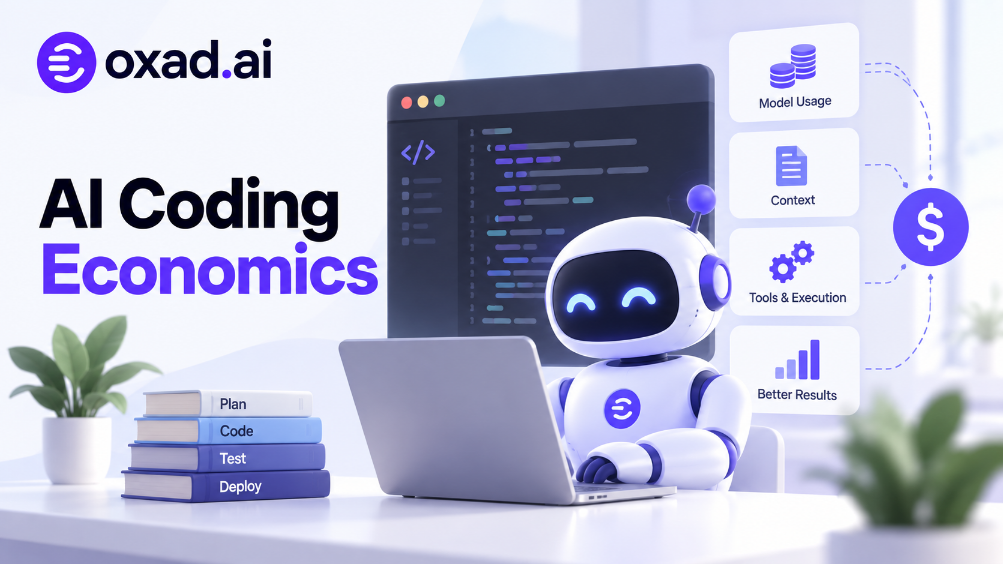
Total AI Coding Cost = Model Usage + Context + Tool Execution + Retries + Compute + Human Review
Not every workflow exposes all of these costs directly to the developer, but each can affect the total economic value of AI-assisted development.
Model usage
AI models process information as tokens. Coding agents can consume tokens not only when generating code, but also when interpreting requirements, reading project information, analyzing tool results, and reasoning about errors.
More capable reasoning models can also require more inference resources for complex tasks.
Context
An agent needs enough information to understand the software project.
That context can include source files, documentation, configuration files, dependency information, test results, error logs, previous interactions, and architectural requirements.
The larger the context, the more information the system may need to process.
Tool execution
Coding agents can use tools to search files, execute commands, run tests, inspect logs, interact with version control, and perform other development operations.
A task that requires many tool interactions can therefore consume substantially more resources than a simple code-generation request.
Retries
Retries are particularly important because an agent can appear inexpensive during its first attempt while becoming costly through repeated failures.
A workflow might look like:
Task → Code → Test → Error → Analysis → Fix → Test → New error → Fix → Final result
Every additional iteration can increase consumption.
Human review
AI-generated code still needs validation. Developers may need to inspect changes, correct mistakes, review security implications, run additional tests, or redesign parts of an implementation.
Human time is therefore an important part of AI coding economics.
Cost Per Successful Task Is a Better Metric
One of the most useful ways to evaluate AI coding is to move beyond the question of how much a model call costs.
Instead, ask:
How much does it cost to produce a working result that actually satisfies the requirements?
Consider two hypothetical coding systems:
Metric
System A
System B
Cost per attempt
Lower
Higher
First-pass success
Lower
Higher
Retries
Frequent
Less frequent
Human correction
Higher
Lower
Cost per completed task
Potentially higher
Potentially lower
System A may have cheaper individual model calls, yet still cost more to operate if it fails frequently or requires substantial developer intervention.
This is why organizations should consider metrics such as:
Cost per completed task
First-pass success rate
Average retries per task
Tokens consumed per successful task
Human review time
Development cycle time
Defect rate
Useful work produced per dollar
Why the Cheapest Model Is Not Always the Cheapest Option
It is tempting to select the model with the lowest token price when trying to control AI coding costs.
That can be misleading.
A less expensive model may require more attempts to understand a complex architecture or resolve a difficult bug. A more capable model may cost more per interaction but complete the task with fewer iterations.
The relevant question is therefore not simply:
How cheap is the model?
It is:
How much useful work does the model produce for the money spent?
This distinction becomes increasingly important as coding agents take on more complex tasks.
The Rise of Model Routing
One way to improve AI coding economics is to stop treating every development task as equally difficult.
A simple formatting change does not necessarily require the same model as a complex architectural investigation.
Task Type
Potential Strategy
Simple transformations
Use an efficient model
Documentation
Use a fast general-purpose model
Routine bug fixes
Use a capable but cost-efficient model
Complex debugging
Escalate to a stronger reasoning model
Architecture and difficult autonomous work
Use high-capability models selectively
This approach is known as model routing or inference tiering.
Matching model selection to task complexity can help teams route simpler, high-frequency work toward efficient models while reserving more capable models for complex and high-value tasks.
For AI-native software teams, this can become an important cost-control mechanism.
Context Engineering Is Also Cost Engineering
Context quality affects both coding performance and cost.
Providing an agent with an entire repository may appear safer because it gives the model more information. However, unnecessary information can increase processing requirements and make it harder for the agent to identify what actually matters.
Better context can include:
The files directly relevant to the task
Clear acceptance criteria
Relevant architecture information
Important dependencies
Specific error messages
Relevant test results
Concise project instructions
The goal is not to provide the maximum amount of information.
The goal is to provide the right information.
Bloated context and poorly controlled usage can contribute to rising AI coding costs, particularly when agents repeatedly process large amounts of project information.
Autonomous Coding Can Increase Productivity and Spending
Agentic coding creates another economic effect: developers can run more work in parallel.
A developer might have one agent investigating a bug while another writes tests and another explores an implementation approach.
This can increase the amount of useful work completed in a given period.
It can also increase AI consumption.
OpenAI has reported that, by mid-August 2026, the median researcher in its research organization using coding agents was consuming more than $600 per day of inference at API prices, while the 90th-percentile user exceeded $7,000 per day. OpenAI also reported that its research organization was using the equivalent of 3.1 agent-workdays for every human workday.
These figures should not be treated as a typical developer’s expected bill. They illustrate a different point: when AI agents become capable of performing substantially more work, usage can expand rapidly alongside capability.
The AI Coding Cost Paradox
AI models can become cheaper on a per-token basis while total AI spending still increases.
This may sound contradictory, but the underlying mechanism is straightforward.
Lower unit costs can make it economical to use AI for more tasks. At the same time, more capable agents can perform longer and more complex workflows that consume more tokens.
This dynamic can be described as an inference paradox: model economics can improve while the overall cost of AI workflows increases because more sophisticated systems use substantially more inference.
For software development, this means falling token prices do not automatically guarantee falling engineering AI budgets.
What AI Coding Cost Forecasts Mean
Industry forecasts increasingly point toward higher AI coding consumption as organizations move from simple coding assistance toward autonomous, multi-step software development workflows.
Some forecasts suggest that AI coding costs could become comparable to or exceed traditional developer software costs at significant organizational scale as token consumption and agent usage increase.
This should not be interpreted as a prediction that every developer will personally spend an amount comparable to a developer salary on AI tools.
The broader issue is organizational scale.
When companies move from occasional AI assistance to continuous agentic development, the number of AI operations can grow rapidly. Without measurement and governance, productivity gains can therefore be accompanied by unexpected spending.
Does AI Coding Actually Save Money?
AI coding can create substantial economic value, but productivity and cost savings are not the same thing.
A company may spend more on AI and still achieve a strong return if developers can deliver significantly more useful software, shorten development cycles, reduce bottlenecks, or experiment more quickly.
The relevant calculation is therefore closer to:
AI Coding ROI = Value of Additional Useful Work − Total AI-Related Cost
The value side can include faster product delivery, increased engineering capacity, shorter debugging cycles, better test coverage, faster experimentation, or reduced repetitive work.
The cost side includes AI consumption as well as the human effort required to supervise and validate the output.
How Companies Should Measure AI Coding Costs
For an individual developer, the monthly subscription may be enough to understand basic spending.
For an engineering organization, a broader measurement system is more useful.
Metric
Why It Matters
AI spend per developer
Shows overall consumption
AI spend per completed task
Connects cost to actual output
Tokens per successful task
Shows workflow efficiency
Retry rate
Highlights inefficient workflows
Human review time
Captures hidden labor costs
Development cycle time
Measures delivery impact
Defect rate
Measures quality alongside speed
This approach turns AI coding from a software subscription decision into an engineering economics decision.
How Developers Can Reduce AI Coding Costs
Choose the model according to the task
Do not automatically use the most powerful model for every request. Match capability to complexity and escalate when necessary.
Define tasks clearly
Clear requirements, acceptance criteria, and constraints can reduce unnecessary exploration and repeated attempts.
Control the context
Provide relevant project information without automatically sending everything available.
Monitor retries
A high retry rate can indicate that the task is poorly defined, the context is inadequate, or the selected model is not appropriate.
Measure human intervention
A workflow that produces code quickly but requires extensive manual correction may not be economically efficient.
Set usage limits
Teams can establish token thresholds, budgets, escalation rules, and monitoring for high-consumption workflows.
Review expensive workflows
Repeatedly expensive tasks should be analyzed to determine whether context, model selection, task decomposition, or automation design can be improved.
AI Coding Tools Are Becoming Part of Infrastructure
As coding agents become integrated into everyday engineering workflows, they increasingly resemble infrastructure rather than optional productivity software.
That changes how companies should manage them.
Engineering teams may eventually need:
Usage monitoring
Cost budgets
Model-routing policies
Permission controls
Security policies
Task-level observability
Quality measurement
Human approval for sensitive actions
The objective is not to minimize AI spending at all costs.
The objective is to make AI spending predictable and connected to useful engineering outcomes.
What This Means for AI Coding Tools
The economics of AI coding could also change competition between coding platforms.
Early competition focused heavily on autocomplete quality, developer experience, and model intelligence.
As agents become more autonomous, other factors become increasingly important:
Task completion reliability
Token efficiency
Context management
Model selection
Tool orchestration
Long-running task performance
Cost visibility
Security and governance
Enterprise controls
The enterprise AI coding market is moving from AI-assisted development toward agentic software development across more stages of the software development lifecycle.
That means the best AI coding platform may not necessarily be the one with the lowest subscription price or the most powerful model.
It may be the platform that produces the best balance between capability, reliability, speed, cost, and human effort.
The Future of AI Coding Economics
The economics of software development are likely to become increasingly tied to AI inference and agent performance.
As models become more efficient, developers may use them for more tasks. As agents become more autonomous, each task can also become more complex.
This creates a new optimization problem:
How much intelligence should a software task receive?
A simple documentation change may need very little reasoning. A security-sensitive architectural change may justify a much more capable model and additional human review.
The future of AI coding will therefore likely involve a mixture of models, workflows, permissions, automation levels, and human oversight rather than one model handling everything.
AI Coding Economics vs Traditional Developer Economics
AI does not eliminate the economic value of software engineers. Instead, it changes how engineering capacity can be allocated.
A developer using AI may spend less time writing repetitive code and more time defining requirements, reviewing architecture, validating results, debugging difficult problems, and deciding what should be built.
This means the economic question is not simply whether AI can replace a certain amount of coding labor.
It is whether AI can increase the amount of valuable engineering work that a team can complete while maintaining acceptable quality, security, and cost.
Frequently Asked Questions
What is AI coding economics?
AI coding economics examines the cost, productivity, efficiency, and return on investment associated with using AI systems to develop and maintain software.
What is the biggest hidden cost of AI coding?
There is no single hidden cost. Context consumption, retries, tool execution, compute, and human review can all increase the total cost of an AI coding workflow.
Is a cheaper AI coding model always better?
No. A cheaper model can become more expensive overall if it requires more retries, produces lower-quality results, or requires substantial human correction.
What is cost per successful task?
Cost per successful task measures the resources required to produce a working result that satisfies the task requirements rather than measuring only the cost of an individual AI interaction.
How can developers reduce AI coding costs?
Developers can reduce costs by matching models to task complexity, controlling context, defining tasks clearly, reducing unnecessary retries, monitoring usage, and measuring human review effort.
Why does context affect AI coding costs?
Large or unnecessary context can increase the amount of information an AI system must process. Relevant, focused context can improve efficiency while also helping the agent understand the task.
Will AI coding become more expensive?
Individual model inference can become more efficient while total spending still increases if developers and companies use AI for substantially more tasks. The growth of complex agentic workflows can increase total inference consumption even when the underlying cost per token falls.
How should companies measure AI coding ROI?
Companies should compare AI-related costs with measurable outcomes such as completed work, development cycle time, engineering capacity, defect rates, human review time, and the business value created by faster software delivery.
The Bottom Line
AI coding is moving from a simple productivity tool toward an increasingly autonomous software development system.
That shift creates a new economic reality.
The price of an AI coding tool tells only part of the story. The real cost depends on how much inference, context, tool usage, retrying, compute, and human review are required to produce a successful result.
For that reason, one of the most useful metrics for the next generation of AI-assisted development may be:
Cost per successful software task.
Developers and companies that learn to measure this metric can make better decisions about model selection, context engineering, automation, and AI coding tools.
The goal is not to spend as little as possible on AI.
The goal is to generate the greatest amount of useful software development value per dollar.
As coding agents become more capable and more autonomous, that distinction will become increasingly important.
Affiliate disclosure: Some tools listed on OXAD.AI may use affiliate links. If you purchase through an affiliate link, OXAD.AI may earn a commission at no additional cost to you.