What Is an AI Agent Harness and How Does It Turn an AI Model Into a Working Agent?
An AI model can generate text, analyze information, and make decisions, but an AI agent needs more than a model. To complete real-world tasks, it may need access to tools, files, APIs, memory, context, permissions, and an execution loop.
This surrounding software layer is known as an AI agent harness.
Quick answer: An AI agent harness is the software environment around an AI model that manages context, tools, execution, permissions, memory, errors, and workflow so the model can operate as an agent and work toward a goal.
What Is an AI Agent Harness?
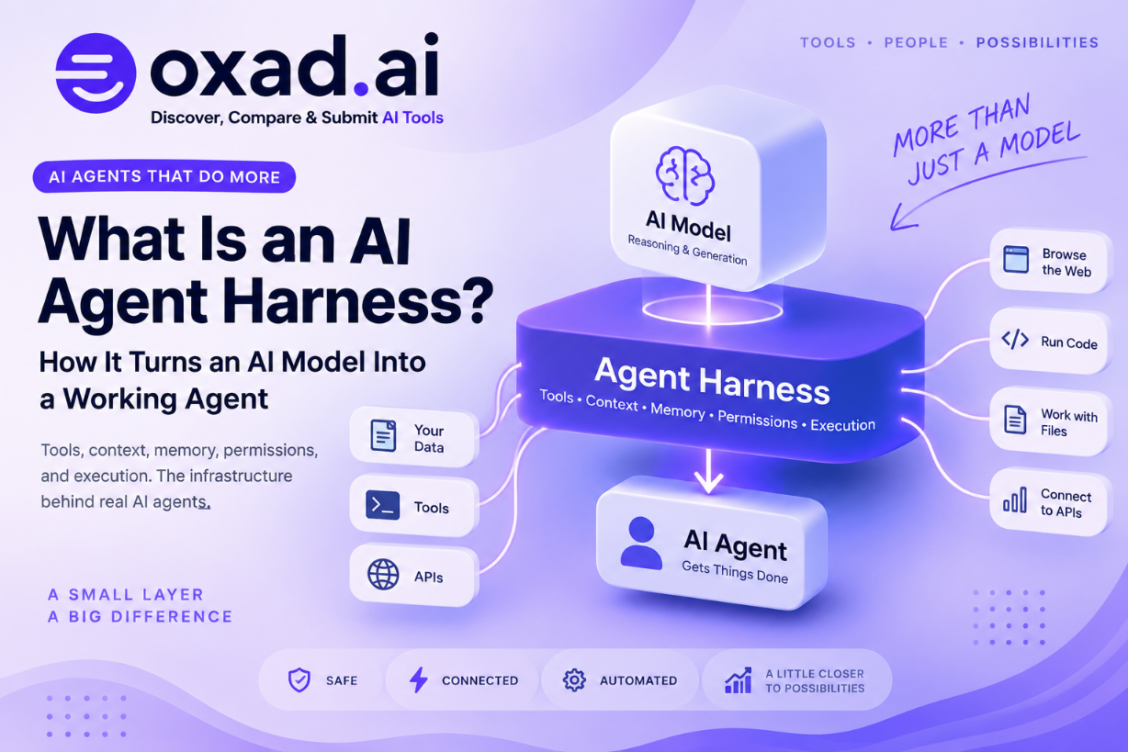
An AI agent harness is the software layer that surrounds an AI model and provides the infrastructure required to perform tasks beyond generating a single response.
The model provides capabilities such as language understanding, reasoning, and generation. The harness provides the environment through which those capabilities can interact with external systems.
Layer
Primary role
AI Model
Understands information and generates responses or decisions.
Agent Harness
Provides context, tools, execution, permissions, memory, and control.
AI Agent
Uses the model and surrounding infrastructure to accomplish a defined goal.
For example, a user might ask an agent to research several competitors, compare their pricing, and prepare a report. The model can determine what information is needed, while the harness provides the mechanisms for searching, collecting results, maintaining context, and continuing the workflow.
Why Does an AI Agent Need a Harness?
A conventional AI interaction can follow a simple pattern: input → model → response.
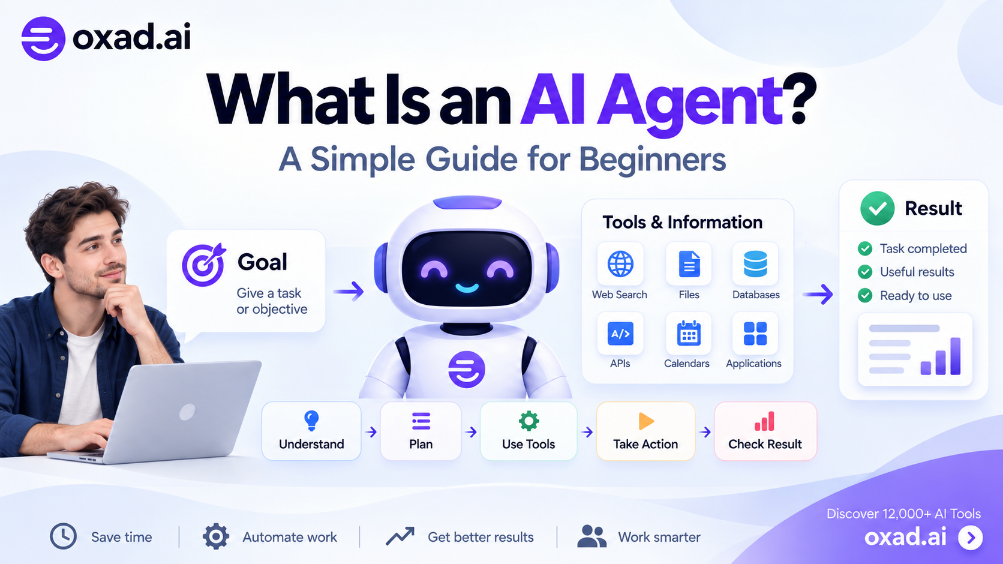
An agent performing a complex task may instead need to follow a much longer cycle:
Stage
What happens
Goal
The user provides an objective.
Context
The harness supplies relevant information and available capabilities.
Decision
The model determines what action may be useful.
Action
A connected tool performs the requested operation.
Observation
The result is returned to the agent.
Iteration
The agent decides whether another step is required.
The harness coordinates this process so that the model is not limited to producing a single response.
What Does an AI Agent Harness Actually Do?
There is no single universal architecture for an AI agent harness. Different systems combine these capabilities in different ways, but several functions are common.
Context Management
The harness determines which information should be available to the model at each stage. This can include the original request, previous actions, tool results, files, project information, and retrieved documents.
Tool Access
The harness can connect the model to browsers, APIs, databases, code execution environments, file systems, and business applications.
Execution Loops
Instead of stopping after one response, an agent can continue through multiple cycles of action and observation until a defined stopping condition is reached.
Memory
Some agent systems maintain short-term state or longer-lived information that can be reused across steps or sessions.
Permissions
The harness can determine which operations are permitted and whether a human must approve sensitive actions before they are executed.
Error Handling
Tools can fail, APIs can time out, and generated actions can produce unexpected results. A harness can detect failures, return useful information to the model, and support retries or alternative approaches.
AI Model vs AI Agent vs AI Agent Harness
Component
Role
Example
AI Model
Reasoning and generation
Language model analyzing a coding request
Agent Harness
Coordinates context, tools, execution, and controls
Runtime connecting a model to a repository and terminal
AI Agent
Works toward an objective
Agent investigating and fixing a software bug
Tool
Performs a specific operation
Browser, API, database, or code executor
How Does an AI Agent Harness Work?
A typical workflow can be simplified into the following sequence:
Step
Process
Goal
The user defines what needs to be accomplished.
Interpretation
The model interprets the objective and available context.
Tool selection
The system determines which available capability can help.
Execution
The selected tool performs an operation.
Observation
The result becomes new information available to the model.
Iteration
The agent decides whether another action is necessary.
This loop can continue until the task is completed, a limit is reached, an error cannot be recovered from, or human intervention is required.
Agent Harness vs AI Agent Framework
The terms agent harness and agent framework are sometimes used interchangeably, but they emphasize different aspects of an AI system.
Concept
Typical focus
AI Model
Reasoning, generation, perception, and prediction
Agent Framework
Reusable components for building agent applications
Agent Harness
The environment that coordinates the model, tools, context, and execution
Agent Runtime
Infrastructure for executing agent processes
AI Agent
The system performing a defined task or objective
The boundaries are not always strict. A platform can provide both framework components and the runtime environment used to operate agents.
What Tools Can an AI Agent Harness Connect To?
The tools available depend on the system and its permissions. Common categories include:
Tool category
Possible use
Web browsers
Search, navigation, information gathering, and web interactions
Code execution
Run code, tests, scripts, and development workflows
APIs
Connect with external services and business systems
Files
Read or modify documents, source code, spreadsheets, and other permitted files
Databases
Retrieve, analyze, or update structured information when authorized
What Role Does MCP Play in an Agent Harness?
Model Context Protocol (MCP) provides a standardized way for AI applications to connect with external tools and data sources.
MCP can therefore help organize the tool layer of an agent system. Instead of implementing every connection as a completely separate integration, developers can expose capabilities through a common protocol.
However, MCP is not the same thing as an agent harness. MCP focuses on how capabilities and context can be exposed to AI applications, while the harness can manage the broader workflow, including execution, permissions, state, and control.
Why Are Agent Harnesses Important for Coding?
Coding demonstrates the difference between generating code and actually completing a software-development task.
A coding agent may need to inspect a repository, locate relevant files, edit code, run tests, analyze failures, make corrections, and repeat the process.
Tools such as CodeRabbit illustrate the broader movement toward integrating AI into real software-development workflows.
A coding-oriented harness may provide access to:
Repositories and project files
File editing
Terminal execution
Test environments
Version-control operations
Error output
Documentation
Approval workflows
How Do Agent Harnesses Support Web Research?
Research is another strong example because useful research often requires several actions rather than a single model response.
An agent may need to search multiple sources, retrieve pages, extract information, compare findings, resolve inconsistencies, and produce a structured report.
Firecrawl is an example of a web-focused capability that can provide structured web information to AI workflows.
The harness determines how and when such capabilities are made available to the agent and how their results become part of the ongoing context.
Why Is Context Management Important?
Long-running agents can accumulate large amounts of information. Sending every previous action and tool result to the model at every step can be inefficient and may eventually exceed the model’s context limits.
A harness can therefore help determine:
Which information is relevant to the current task
Which previous results should be retained
Which information can be summarized or removed
Which files should be retrieved
Which tool results should remain available
This makes context management an important part of agent reliability. Systems such as Context.dev are relevant to this broader area of AI context management and agent infrastructure.
Are AI Agent Harnesses Secure?
Security becomes more important when an AI system can take actions instead of simply generating text.
An agent with access to files, a computer, APIs, email, or business applications may have meaningful permissions. The harness therefore needs appropriate controls for the environment in which it operates.
Security control
Purpose
Permission boundaries
Limit what the agent can access or change.
Human approval
Require confirmation for sensitive operations.
Sandboxing
Restrict where actions can be executed.
Credential isolation
Reduce unnecessary exposure of credentials and secrets.
Logging
Provide visibility into actions and events.
What Is a Sandbox in an AI Agent Harness?
A sandbox is a controlled environment that limits what an agent can access or execute.
For example, a coding agent might be allowed to modify files inside a specific project directory and execute approved commands while being prevented from accessing unrelated files.
Sandboxing can reduce the potential impact of unintended actions, but it is not a complete security solution. Its effectiveness depends on how the environment and permissions are designed.
AI Agent Harness vs Traditional Automation
Traditional automation
AI agent harness
Usually follows predefined rules.
Can allow the model to determine the next step.
Workflow is usually designed in advance.
Workflow can adapt to observations and tool results.
Generally more predictable.
Can be more flexible but introduces additional uncertainty.
Decision-making is largely predefined.
The model can influence decisions within defined boundaries.
Failures often use predefined recovery rules.
The agent may attempt alternative actions or recovery strategies.
What Makes a Good AI Agent Harness?
The right design depends on the task, but useful agent harnesses generally need several capabilities.
Capability
Why it matters
Tool reliability
The agent needs dependable operations and clear results.
Context management
Relevant information should be available without unnecessary context.
Permissions
Actions should be limited according to risk.
Observability
Developers should be able to understand what happened.
Error recovery
The system should handle failures without unnecessarily stopping the workflow.
Clear stopping conditions
The agent needs defined limits and completion criteria.
Why May Agent Harnesses Become More Important?
Real-world AI tasks are rarely just reasoning problems. They often require a combination of:
The harness connects these elements into an operating environment.
This becomes particularly important when agents are expected to work for longer periods, interact with external systems, recover from errors, or perform actions with real consequences.
Will Every AI Agent Need a Harness?
Not every AI application requires a sophisticated harness.
A simple chatbot answering a single question may need only limited orchestration. A system that must use tools, maintain state, interact with files, execute code, or perform multiple actions generally needs more infrastructure.
In general, the more complex the agent’s responsibilities become, the more important its surrounding execution environment becomes.
What Is the Future of AI Agent Harnesses?
As AI agents become more capable, agent infrastructure is likely to place greater emphasis on areas such as:
Context management
Tool discovery
Agent memory
Permissions
Human approval
Sandboxing
Long-running execution
Monitoring and auditing
Multi-agent coordination
This points toward a useful architectural distinction:
Layer
Primary responsibility
Models
Provide intelligence and generation capabilities.
Harnesses
Connect intelligence to context, tools, execution, and controls.
Agents
Use these capabilities to work toward defined objectives.
Key Takeaways
An AI agent harness is the software environment surrounding an AI model.
It can manage context, tools, memory, permissions, execution, and errors.
The model provides intelligence, while the harness connects that intelligence to actions.
Agent harnesses are especially relevant to coding, research, automation, and other multi-step tasks.
MCP can provide a standardized way to expose tools and external capabilities to AI applications.
Security controls become increasingly important when agents can interact with real-world systems.
A capable model is only one part of a reliable agent system.
Frequently Asked Questions
What is an AI agent harness?
An AI agent harness is the software layer around an AI model that manages context, tools, execution, permissions, memory, and other capabilities required for agentic workflows.
What is the difference between an AI model and an agent harness?
An AI model provides capabilities such as reasoning and generation. The harness provides the environment through which those capabilities can interact with tools, data, and external systems.
Is an AI agent harness the same as an AI agent?
No. The harness is the surrounding infrastructure that helps an agent operate. The agent is the system using that infrastructure to pursue a particular objective.
Why do coding agents need a harness?
Coding agents may need access to repositories, files, terminals, tests, documentation, and version-control systems. A harness coordinates these capabilities.
Does MCP replace an AI agent harness?
No. MCP can provide a standardized mechanism for connecting AI applications with tools and data. A harness can manage the broader execution workflow around those connections.
Can an agent harness access my computer?
It can when the system has been designed and authorized to access local files, applications, terminals, or other computer resources.
Are AI agent harnesses secure?
Security depends on the implementation. Permissions, sandboxing, credential isolation, tool restrictions, logging, validation, and human approval can all affect the security of an agent system.
What is a sandbox in an AI agent system?
A sandbox is a controlled environment that limits what an AI agent can access or execute.
Do simple AI assistants need an agent harness?
Simple assistants may require only limited orchestration. More complex systems that use multiple tools, maintain state, or perform multi-step actions generally require more infrastructure.
Why are AI agent harnesses becoming important?
They connect increasingly capable AI models with the context, tools, execution environments, and controls needed to perform real-world tasks.
Will agent harnesses become part of AI development infrastructure?
Agent harnesses are becoming an important architectural concept as developers build AI systems that operate across tools, data sources, software environments, and longer-running workflows.



3 Replies to “What Is an AI Agent Harness and How Does It Turn an AI Model Into a Working Agent?”
The agent harness explanation makes it much easier to see how models, tools, memory, and execution work together.
La partie sur l’architecture est particulièrement utile pour comprendre où se situe le modèle dans un système d’agent.
Separating the model from the surrounding execution layer is a useful way to understand modern AI agents.