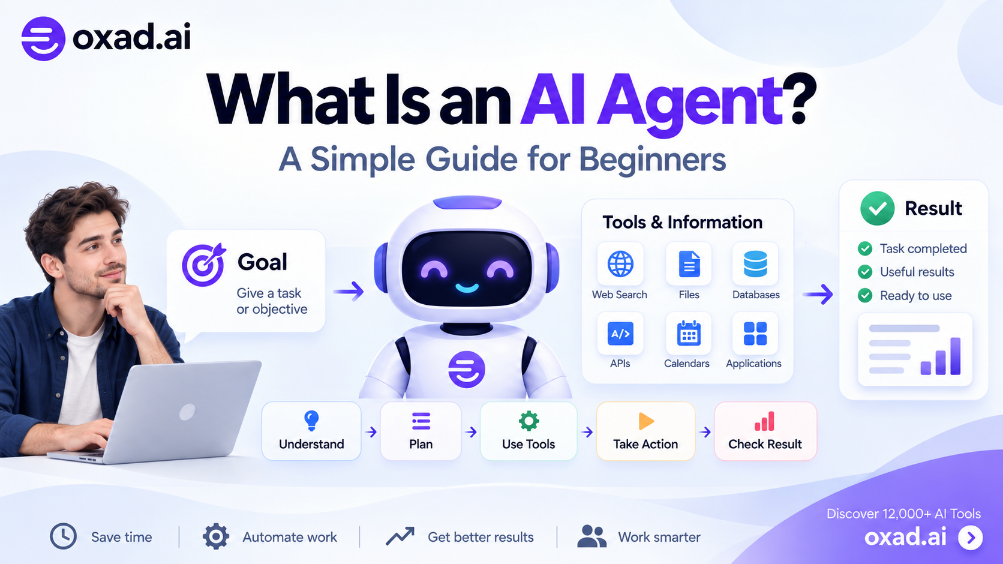
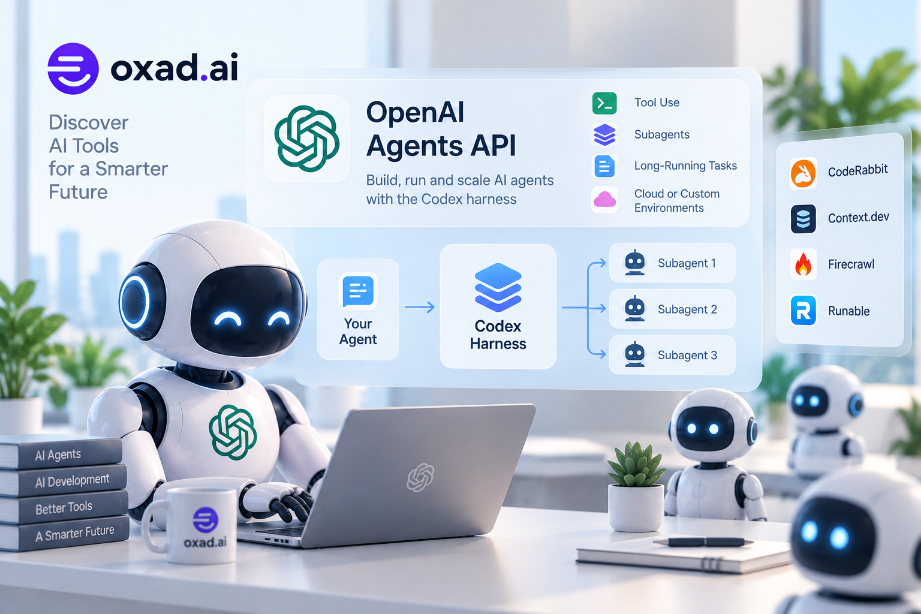
An AI agent is an artificial intelligence system that can understand a goal, decide what needs to be done, use information and tools, take actions, and work toward completing a task.
If you have heard people talking about AI agents and wondered what they actually are, you are not alone. The term sounds technical, but the basic idea is surprisingly simple.
A traditional chatbot mainly responds to what you type. An AI agent can go further by taking a goal and working through a series of steps to achieve it.
In this guide, we will explain the concept in simple language, show how an agent works, compare it with chatbots and AI assistants, and look at where these systems are useful.
What Does AI Agent Mean?
The word agent describes something that acts on behalf of someone else.
In artificial intelligence, an AI agent is a system designed to pursue a goal by making decisions and taking actions within the tools and permissions available to it.
Instead of asking the AI to perform every small step, you can give it a larger objective. The system can then determine some of the steps required to move toward that objective.
The simplest definition:
An AI agent is AI that can understand a goal and take actions to work toward it.
AI Agent at a Glance
Question
Simple Answer
What is an AI agent?
An AI system designed to work toward a goal.
Can it take actions?
Yes, when it has the necessary tools and permissions.
Can it use external information?
Yes, through connected tools, databases, files, search, or other sources.
Is it always autonomous?
No. Some systems require human approval.
Is every chatbot an agent?
No. A chatbot can simply provide conversational answers.
How Does an AI Agent Work?
Although AI agents can be built in many different ways, the basic workflow is easy to understand.
1
Goal
You give the agent an objective.
2
Understand
It interprets what you need.
3
Plan
It determines possible steps.
4
Use Tools
It accesses available tools.
5
Act
It performs the task.
6
Check
It evaluates the result.
This does not mean every agent performs all six steps in exactly the same way. The workflow depends on how the system was designed.
The AI Agent Mental Map
The following mental model makes the whole concept easier to remember:
YOUR GOAL
What do you want?
↓
AI AGENT
Understand → Plan → Decide
↓
TOOLS & INFORMATION
Search · Files · APIs · Databases · Apps
↓
ACTION
The system performs a task
↓
RESULT
Check → Continue or Finish
What Is a Simple Example of an AI Agent?
Imagine telling an AI:
“Find a suitable laptop for video editing and compare the best options.”
A basic chatbot might explain which specifications are important for video editing.
An agent connected to suitable tools could potentially work through a process such as:
Step
Possible Action
1. Understand
Identify the user’s budget and video-editing requirements.
2. Research
Search for suitable laptops.
3. Collect
Gather specifications and relevant information.
4. Compare
Evaluate the available options.
5. Report
Present the most suitable choices.
The important point is not that every AI agent can perform these exact actions. The important point is that an agent can be designed to work through a multi-step objective.
What Can AI Agents Do?
AI agents can be designed for many different types of work.
Area
Possible Uses
Typical Tools
Research
Find and organize information.
Search, databases
Customer Support
Handle common questions and retrieve information.
CRM, knowledge bases
Business
Automate repetitive workflows.
Business apps, APIs
Programming
Help write code and investigate problems.
Code tools, testing environments
Productivity
Organize tasks and information.
Calendars, task apps
Data Work
Retrieve and organize information.
Databases, spreadsheets, APIs
AI Agent vs Chatbot
One of the easiest ways to understand an AI agent is to compare it with a traditional chatbot.
Capability
Chatbot
AI Agent
Answer questions
Yes
Yes
Have a conversation
Yes
Yes
Plan multiple steps
Limited
Often
Use external tools
Sometimes
Commonly
Perform actions
Usually limited
Often
Work toward a goal
Limited
Core capability
The distinction is not absolute. Modern chatbots can use tools and perform actions, so some systems sit somewhere between a traditional chatbot and a fully agentic system.
AI Agent vs AI Assistant
An AI assistant usually focuses on helping a person with information, communication, or tasks.
An AI agent puts greater emphasis on pursuing an objective and taking actions to achieve it.
Example
Possible Role
Writing an email
An assistant can help draft the message.
Managing an email workflow
An agent could identify relevant information, prepare a response, and request approval.
In modern AI products, the terms can overlap because an assistant may include agent-like capabilities.
What Are the Main Components of an AI Agent?
Thinking about an agent as a collection of components can make the technology easier to understand.
Component
What It Does
AI Model
Helps understand instructions and reason about the task.
Instructions
Define the agent’s purpose, rules, and boundaries.
Tools
Allow the system to interact with external services.
Knowledge
Provides access to relevant information and data.
Memory
Can store or retrieve useful information when designed to do so.
Guardrails
Help control what the system is allowed to do.
Do AI Agents Use Tools?
Many AI agents do.
Tools give an agent capabilities that the underlying AI model does not have by itself.
AI model
Understands and generates information.
+
Tools
Search, APIs, databases, files, applications, and other systems.
=
More capable AI workflow
Common tools can include:
Web search
Databases
APIs
Calendars
Business applications
File systems
Code execution environments
Other AI services
The availability of these tools depends entirely on the specific AI system.
Do AI Agents Use RAG?
They can.
Retrieval-Augmented Generation (RAG) allows an AI system to retrieve relevant information from external sources before generating an answer.
This can be useful for an agent that needs access to company documents, product information, internal knowledge bases, or other information that may change over time.
Simple connection: RAG helps an AI access relevant information; tools help an agent interact with systems and perform actions.
You can learn more about RAG in our beginner-friendly guide: What Is RAG?
Do AI Agents Use MCP?
They can also use Model Context Protocol (MCP) to connect AI applications with external tools and information through a standardized approach.
This can be useful for agentic systems that need to work with multiple tools or information sources.
The important idea for beginners is simple: MCP helps AI applications connect with external capabilities in a consistent way.
Do AI Agents Have Memory?
Some do, but memory is not automatically included in every AI agent.
Memory can allow an agent to retrieve useful information from previous interactions or stored data when working on an ongoing task.
For example, a productivity agent could use stored preferences when helping organize future tasks.
Memory should be designed carefully because storing information creates privacy and security considerations.
Are AI Agents Fully Autonomous?
No. An AI agent does not automatically have unlimited independence.
Autonomy can be thought of as a spectrum:
Level
Description
Human-Guided
The AI suggests an action and waits for the user.
Partially Autonomous
The AI handles routine steps but asks for approval when needed.
More Autonomous
The AI can complete longer workflows with fewer interruptions.
For sensitive, expensive, or irreversible actions, human approval can be an important part of the design.
What Are the Benefits of AI Agents?
Benefit
Why It Matters
Automate repetitive work
The system can handle recurring digital steps.
Handle multi-step tasks
A larger goal can be divided into several actions.
Use external systems
Tools can extend what the AI can access and do.
Adapt during a workflow
Some agents can evaluate results and decide what to do next.
What Are the Limitations of AI Agents?
AI agents are powerful, but they are not perfect digital workers.
Limitation
What It Means
Incorrect decisions
The system can misunderstand a task or choose an unsuitable action.
Wrong information
AI-generated information can still contain errors.
Tool limitations
An agent cannot use tools that it has not been given access to.
Security risks
Greater access can increase the consequences of mistakes.
Need for testing
Multi-step workflows need appropriate testing and monitoring.
For these reasons, well-designed systems can include permissions, monitoring, testing, clear boundaries, and human oversight.
Are AI Agents the Same as Generative AI?
No.
Generative AI is a broad category of artificial intelligence that can create content such as text, images, audio, video, or code.
An AI agent can use a generative AI model as one part of its system. The agent adds another layer that can help it pursue goals, use tools, and perform actions.
Generative AI creates content.
+
Agent capabilities help AI work toward goals and take actions.
AI Agent vs Generative AI vs Chatbot
Concept
Main Purpose
Generative AI
Create new content or information.
Chatbot
Communicate with users through conversation.
AI Agent
Work toward goals using reasoning, tools, information, and actions.
Why Are AI Agents Becoming Important?
AI is increasingly moving beyond systems that only generate responses. Modern AI applications can interact with software, retrieve information, use tools, coordinate multiple steps, and complete parts of a workflow.
This has made concepts such as agentic AI, tool calling, AI memory, orchestration, and MCP increasingly relevant when learning about modern AI systems.
However, the term “AI agent” does not describe one specific product or technology. Different systems can have very different levels of capability and autonomy.
How to Choose an AI Agent
If you are considering an AI agent for work or personal use, look beyond the marketing label.
What to Check
Why It Matters
Tools
Shows what the agent can actually access and do.
Integrations
Determines whether it works with your existing software.
Permissions
Defines which actions the system can perform.
Human Approval
Important when actions are sensitive or difficult to reverse.
Privacy
Important when the system handles personal or business information.
Reliability
Shows how consistently it performs the intended workflow.
An AI agent is an AI system that can understand a goal, decide what steps may be needed, use available tools, and take actions toward completing the task.
Is an AI agent the same as a chatbot?
No. A traditional chatbot mainly focuses on conversation and answers, while an agent can also plan and perform actions. Modern chatbots can, however, include agent-like capabilities.
Can AI agents replace humans?
They can automate some tasks, but they do not automatically replace human judgment. People remain important for complex, sensitive, and high-impact decisions.
Can an AI agent browse the internet?
Some can, when web access or a search tool is available. Internet access is not automatically part of every AI agent.
Can AI agents use APIs?
Yes. APIs can allow an agent to interact with external applications and services when the appropriate integration and permissions are available.
Do all AI agents have memory?
No. Memory depends on how the agent is designed. Some systems can store or retrieve information across interactions, while others cannot.
Are AI agents autonomous?
Some have a high degree of autonomy, while others require human approval for important actions. Autonomy depends on the system’s design and permissions.
What is agentic AI?
Agentic AI generally refers to AI systems designed to pursue goals with greater ability to plan, make decisions, use tools, and take actions with limited step-by-step instructions.
Conclusion: What Is an AI Agent?
An AI agent is AI designed to work toward a goal.
It can understand an objective, plan steps, use information and tools, perform actions, and sometimes evaluate the result.
The easiest way to remember the difference is:
A chatbot mainly talks with you. An AI agent can work toward a goal for you.
The exact capabilities vary from one system to another, but understanding this basic idea makes it much easier to understand the rapidly developing world of agentic AI.