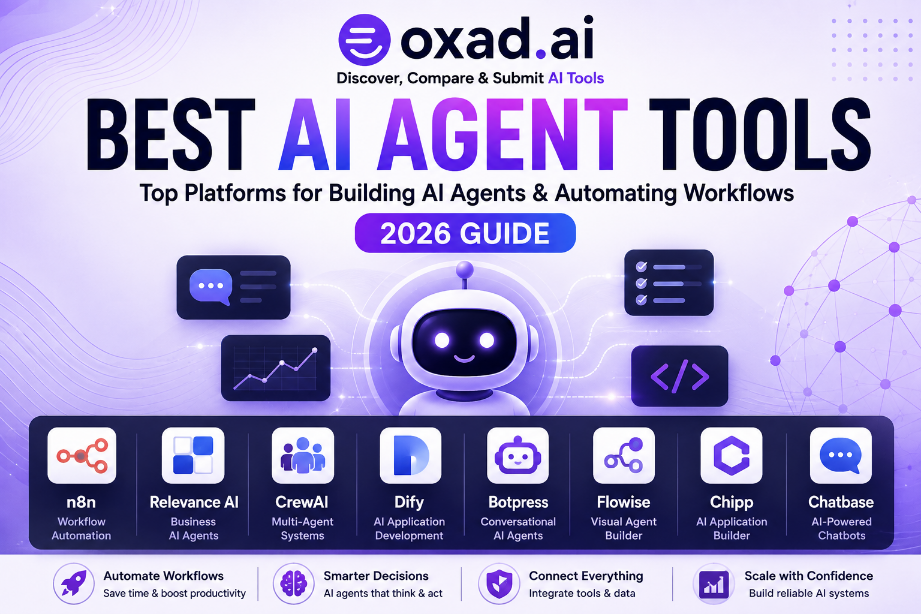
This guide compares the best AI agent tools in 2026 for building autonomous workflows, AI applications, business agents, conversational assistants, multi-agent systems, and automated workflows.
Editorial Trust
Independent editorial review
Based on publicly available product information and practical AI workflows
No sponsored rankings
Focused on real-world AI agent use cases
Product capabilities, pricing, and integrations may change over time
AI agents are becoming one of the most important developments in modern artificial intelligence. Unlike traditional chatbots that primarily respond to individual prompts, AI agents can be designed to understand goals, use tools, retrieve information, make decisions, and complete multi-step workflows.
This shift is creating a rapidly expanding ecosystem of AI agent tools designed for developers, businesses, startups, and creators.
Some platforms focus on visual agent building, while others specialize in workflow automation, conversational AI, multi-agent systems, business processes, or AI application development.
Choosing the right platform therefore depends on what you want the agent to accomplish. A customer-support agent has different requirements from a research agent, an automated business workflow, or a multi-agent software system.
This guide compares leading AI agent platforms and frameworks available through Oxad.ai, focusing on practical capabilities, workflow integration, automation, developer experience, conversational interfaces, and real-world use cases.
AI agents can perform multi-step tasks instead of simply generating conversational responses.
The best AI agent platform depends on your workflow, integrations, data sources, and technical requirements.
n8n is particularly strong for AI-powered workflow automation.
Relevance AI is well suited to business-oriented AI agents and automated workflows.
CrewAI is designed around multi-agent systems and collaborative agent workflows.
Dify provides an accessible environment for developing AI applications and agent workflows.
Botpress is particularly relevant for conversational AI agents.
Flowise provides a visual approach to building LLM and agent workflows.
Chipp can help users build AI-powered applications and experiences.
Chatbase is useful for conversational AI and user-facing AI assistants.
External data sources can significantly expand what AI agents are capable of doing.
What Are AI Agents?
AI agents are software systems that use artificial intelligence to understand objectives, determine actions, interact with tools, retrieve information, and complete tasks.
A conventional chatbot generally waits for a user prompt and generates a response. An AI agent can instead be designed to take a goal and execute multiple steps to achieve it.
An AI agent may be able to:
Understand a user’s objective.
Break complex tasks into smaller steps.
Retrieve information from external sources.
Call APIs and software tools.
Search websites and databases.
Analyze documents.
Generate structured outputs.
Perform business workflows.
Interact with users through conversational interfaces.
Coordinate multiple AI agents.
The combination of reasoning, tools, data, and automation is what makes agentic AI different from a basic question-and-answer chatbot.
Important:
AI agents can interact with external systems and potentially perform actions automatically. Sensitive workflows should therefore use appropriate permissions, validation, monitoring, testing, and human oversight.
How We Evaluated These AI Agent Tools
AI agent platforms serve different purposes, so comparing them requires more than looking at a single feature.
We considered the capabilities that matter when designing practical agent-based applications and workflows.
Evaluation Area
Why It Matters
Agent Building
Determines how easily users can create functional agents.
Workflow Automation
Allows agents to participate in multi-step processes.
Tool Integration
Agents often need APIs and external applications.
Context
Relevant information improves agent responses and decisions.
Web Access
Current external information expands agent capabilities.
Multi-Agent Support
Multiple specialized agents can collaborate on complex tasks.
Conversational AI
Important for customer-facing agents and assistants.
Developer Experience
Simple development workflows reduce implementation time.
Scalability
Production systems may require reliable infrastructure.
Ratings are editorial assessments based on the criteria described in this guide and are not official product ratings.
n8n Review
n8n is particularly interesting for AI agents because it combines automation workflows with integrations and AI capabilities.
Instead of building an isolated AI assistant, users can connect AI models with applications, databases, APIs, triggers, and business processes.
This makes n8n especially useful when an AI agent needs to do something after generating a decision or response.
Why n8n Stands Out
Strong workflow automation capabilities.
Useful for connecting AI with external applications.
Suitable for multi-step processes.
Relevant for business automation.
Can connect different services into unified workflows.
Best For
AI workflow automation
Business processes
API integrations
Automated agents
Developers building connected AI workflows
Relevance AI Review
Relevance AI focuses on AI-powered business workflows and agent-based automation.
This makes it particularly relevant for organizations that want AI agents to handle repetitive operational tasks rather than simply answer questions.
Business-oriented agents can be useful for research, operations, sales support, customer workflows, data processing, and other repetitive activities.
Potential Strengths
Business-focused AI agents.
Automation-oriented workflows.
Useful for operational processes.
Relevant to teams exploring agentic AI.
Can support AI-powered business workflows.
Best For
Business AI automation
Operational workflows
AI employees and agents
Sales and research workflows
Organizations exploring agentic automation
CrewAI Review
CrewAI takes a different approach by focusing on multi-agent systems.
Instead of relying on a single general-purpose agent, multi-agent architectures can assign different responsibilities to specialized agents that collaborate on a larger objective.
For complex AI workflows, this approach can make it possible to separate research, analysis, planning, execution, and review into different roles.
Why Multi-Agent Systems Matter
Different agents can perform specialized tasks.
Complex workflows can be divided into smaller responsibilities.
Agents can collaborate on shared objectives.
Specialized roles can simplify complex application designs.
Useful for developers exploring advanced agentic architectures.
Best For
Multi-agent applications
AI research workflows
Complex automation
Developers
Agent orchestration
Dify Review
Dify provides an accessible environment for building AI applications and workflows.
It can be useful for teams that want to move beyond simple model experimentation and create functional AI applications with workflows, knowledge, and agent-oriented capabilities.
Dify can therefore serve as a bridge between experimenting with LLMs and building more complete AI-powered applications.
Potential Strengths
Accessible AI application development.
Useful workflow capabilities.
Relevant for LLM applications.
Suitable for experimentation and prototyping.
Useful for teams developing AI products.
Best For
AI application development
LLM workflows
AI prototypes
Knowledge-based applications
Teams exploring AI agents
Botpress Review
Botpress is particularly relevant for conversational AI and user-facing agents.
Conversational agents can serve as digital interfaces between users and business systems, allowing customers or employees to interact with information and services using natural language.
This makes Botpress especially interesting for customer support, business assistants, and conversational applications.
Potential Strengths
Strong conversational AI focus.
Useful for customer-facing assistants.
Suitable for interactive AI experiences.
Relevant to business chatbots.
Can support conversational workflows.
Best For
Customer support agents
Conversational AI
Business assistants
Interactive AI applications
Chat-based workflows
Flowise Review
Flowise provides a visual approach to building LLM-based applications and agent workflows.
Visual development can be particularly useful for users who want to understand and connect different components of an AI workflow without writing every integration from scratch.
This makes Flowise relevant for experimentation, prototyping, RAG applications, and agent-oriented workflows.
Potential Strengths
Visual workflow development.
Useful for LLM applications.
Suitable for experimentation.
Can simplify complex AI workflows.
Relevant to developers and technical creators.
Best For
Visual AI workflows
LLM applications
AI prototypes
RAG workflows
Agent experimentation
Chipp Review
Chipp is relevant for users who want to build AI-powered applications and experiences.
AI agents become more useful when they are transformed into practical applications that users can interact with.
Platforms focused on AI application development can help bridge the gap between experimenting with AI and delivering a usable product.
Potential Strengths
AI application development.
Useful for rapid experimentation.
Suitable for AI-powered experiences.
Relevant for business applications.
Can complement agent-based workflows.
Best For
AI application builders
AI prototypes
Business AI projects
Creators building AI experiences
Teams exploring agent applications
Chatbase Review
Chatbase focuses on conversational AI experiences and AI-powered assistants.
For businesses, a conversational agent can become the interface through which customers interact with company information, services, and support systems.
This makes conversational AI platforms an important part of the broader AI agent ecosystem.
Potential Strengths
Conversational AI focus.
Useful for customer-facing assistants.
Suitable for business AI experiences.
Natural-language interaction.
Relevant for support-oriented workflows.
Best For
AI chatbots
Customer support
Business assistants
Conversational applications
Knowledge-based AI experiences
AI Agents and Web Data
One of the biggest limitations of an AI agent can be access to current external information.
An agent may need to research a website, retrieve documentation, monitor public information, or collect current data before it can complete a task.
This is where web data infrastructure becomes important.
Firecrawl can be relevant for agents and AI applications that need to crawl and extract information from websites.
Context.dev can also be relevant when an AI application needs external web information and structured context.
These tools are complementary to agent platforms. An agent can provide the reasoning and orchestration layer, while web data tools can provide information that the agent needs to complete its task.
Related Reading: Developers interested specifically in web data extraction can also explore our guide to Best AI Web Scraping Tools.
AI Agent Workflows and Automation
Automation is one of the main reasons organizations are adopting AI agents.
A useful agent does not necessarily need to operate completely autonomously. It can also be embedded inside a workflow where AI handles specific decisions or tasks while conventional automation handles predictable operations.
A typical AI workflow might look like this:
A trigger starts the workflow.
The AI agent interprets the request.
The agent retrieves relevant information.
The agent decides what action is required.
An external tool or API performs the action.
The result is returned to the workflow.
A human reviews the result when necessary.
n8n is particularly relevant to this type of architecture because workflow automation can connect AI decisions with external applications and services.
Relevance AI is also relevant for organizations exploring AI-powered business workflows and agents.
Multi-Agent AI Systems
Some problems are too complex for a single AI agent. Multi-agent architectures address this by assigning different responsibilities to multiple specialized agents.
For example, a research workflow could use one agent to collect information, another to analyze it, and another to review the result.
CrewAI is particularly relevant to this approach because it focuses on agent collaboration and orchestration.
Potential benefits of multi-agent systems include:
Specialized responsibilities.
Separation of complex tasks.
Collaborative reasoning.
More structured workflows.
Greater flexibility for complex applications.
However, multi-agent architectures can also increase complexity, cost, latency, and debugging requirements. A single well-designed agent may be preferable when the task does not require multiple specialized roles.
AI Agents for Business
Businesses are among the most promising environments for AI agents because many organizational processes contain repetitive information-based tasks.
Potential business applications include:
Customer support.
Lead qualification.
Market research.
Data processing.
Internal knowledge assistants.
Sales research.
Document analysis.
Workflow automation.
Employee assistance.
Reporting and information retrieval.
Relevance AI is particularly relevant to business-focused agent workflows, while n8n can connect AI capabilities to broader automation processes.
For customer-facing interactions, Botpress and Chatbase are worth considering as conversational AI platforms.
AI Agent Use Cases
Research Agents
Research agents can gather information from multiple sources, organize findings, and help users analyze large amounts of information.
Customer Support Agents
Conversational agents can answer common questions, retrieve information, and guide customers through support workflows.
Business Automation Agents
Business agents can participate in repetitive workflows such as research, classification, data processing, and reporting.
AI Coding Agents
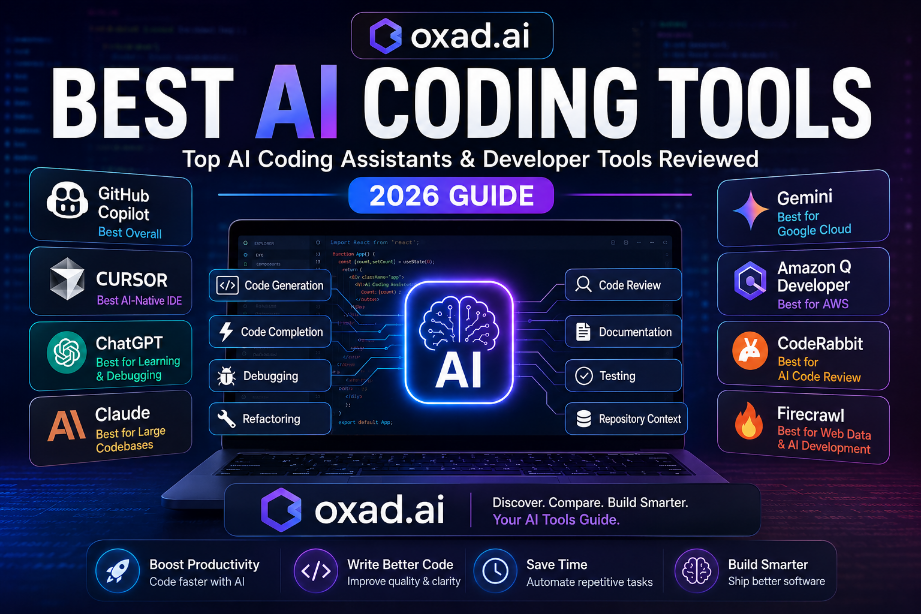
Developer-focused agents can help with software development, debugging, documentation, testing, and repository tasks. Developers can explore our Best AI Coding Tools guide for a broader comparison of AI coding assistants.
Knowledge Agents
Knowledge-based agents can retrieve relevant information from documents, databases, websites, and other sources before generating responses.
Voice Agents
Voice interaction is another emerging interface for AI agents. VoiceOS is relevant when exploring voice-based interaction and AI-powered workflows.
How to Choose the Best AI Agent Tool
The best AI agent platform depends on the problem you are trying to solve.
AI agents can introduce additional security considerations because they may access external data, call APIs, and perform actions on behalf of users.
Important safeguards include:
Use least-privilege permissions.
Validate agent-generated actions.
Protect API credentials and secrets.
Monitor external tool usage.
Restrict access to sensitive information.
Log important agent actions.
Test failure scenarios.
Use human approval for high-impact operations.
Review data privacy requirements.
Monitor unexpected agent behavior.
Best Practice: Treat autonomous behavior as a controlled capability rather than giving an AI agent unrestricted access to important systems.
Frequently Asked Questions
What are AI agent tools?
AI agent tools are platforms and frameworks that help users build AI systems capable of using tools, retrieving information, and completing multi-step tasks.
What is the best AI agent tool?
The best choice depends on your use case. n8n is strong for automation, Relevance AI for business agents, and CrewAI for multi-agent systems.
What is the best AI agent builder?
There is no universal winner. Dify, Flowise, Chipp, Botpress, and other platforms target different agent-building requirements.
What is the best platform for AI agents?
The right platform depends on whether you need automation, business workflows, conversational AI, visual development, or multi-agent orchestration.
Can AI agents automate business tasks?
Yes. AI agents can participate in research, customer support, data processing, classification, reporting, and other information-based workflows.
What is a multi-agent AI system?
A multi-agent system uses multiple specialized AI agents that collaborate or coordinate to complete a larger task.
Is CrewAI good for multi-agent systems?
CrewAI is specifically relevant to developers exploring collaborative AI agents and multi-agent application architectures.
Can AI agents access the web?
Yes. Agents can be connected to web search, crawling, scraping, APIs, and other external information sources.
How can AI agents get current web information?
Developers can connect agents to web data services such as Firecrawl and other retrieval systems.
Can AI agents be used for customer support?
Yes. Conversational AI platforms such as Botpress and Chatbase can support customer-facing AI experiences.
Can AI agents replace employees?
AI agents can automate parts of some workflows, but organizations still need human oversight, accountability, judgment, and domain expertise.
Are AI agents the same as chatbots?
No. Chatbots primarily focus on conversation, while agents can use tools, retrieve information, make decisions, and perform multi-step tasks.
Final Verdict
The best AI agent tool is not necessarily the platform with the most features. It is the platform that fits the workflow you actually need to automate.
n8n is a strong choice when workflow automation and integrations are central to the project. Relevance AI is particularly relevant for business-oriented AI agents, while CrewAI is an attractive option for multi-agent architectures.
Dify and Flowise provide accessible approaches to AI application and workflow development, while Botpress and Chatbase are particularly useful for conversational AI experiences.
Chipp adds another option for building AI-powered applications and experiences, while VoiceOS demonstrates how voice interaction can become part of the broader agent ecosystem.
The most capable AI agent architectures may combine several specialized tools. An agent platform can handle orchestration, an automation platform can connect external applications, a web data tool can provide current information, and a conversational interface can give users a practical way to interact with the system.
This article was independently prepared using publicly available product information, AI application workflows, developer use cases, automation requirements, conversational AI scenarios, and practical considerations for building AI agents.
Editorial rankings are not sponsored placements. Product capabilities, pricing, integrations, APIs, and availability can change over time, so readers should verify current information through the relevant provider before making purchasing decisions.
Editorial Note: This article was independently researched and written for Oxad.ai. Our editorial approach focuses on practical usability, AI application development, automation, developer workflows, and long-term value rather than sponsored rankings. Product capabilities, pricing, and integrations may change over time, so readers should verify the latest information through each provider’s official documentation before making purchasing decisions.