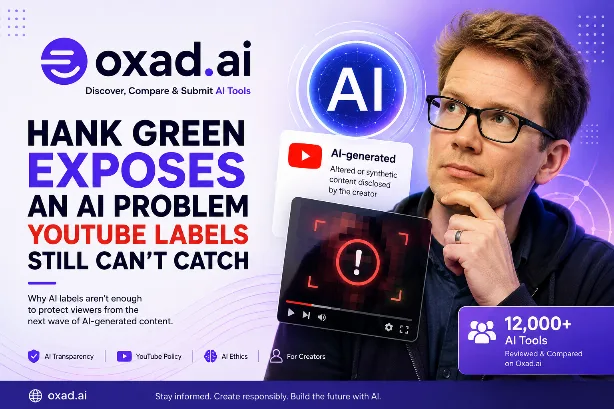
Hank Green Exposes an AI Problem YouTube Labels Still Can’t Solve
AI News & Creator Economy Analysis
Popular science creator Hank Green has reignited an important conversation about AI-generated content and online trust. His observations suggest that simply adding AI labels to videos may not be enough to help viewers distinguish authentic human work from increasingly sophisticated AI-assisted productions.
As generative AI becomes a standard tool for creators, educators, businesses, and media organizations, platforms such as YouTube face a growing challenge: improving transparency without discouraging responsible AI use. This analysis explores why Hank Green’s comments matter, how YouTube currently approaches AI disclosures, and what creators should expect as AI-generated media continues to evolve.
Topic
AI Content Authenticity
Focus
YouTube & AI Labels
Reading Time
Approximately 12 Minutes
Editorial Summary
Artificial intelligence has transformed how online content is produced. Today’s creators use AI to write scripts, edit videos, generate voiceovers, remove backgrounds, improve audio, create subtitles, and even produce realistic visual effects. While these tools improve productivity, they also blur the line between human creativity and machine assistance. Hank Green argues that current AI labels cannot fully explain how AI contributed to a video’s production, raising broader questions about transparency and digital trust.
Key Takeaways
AI-assisted content is becoming increasingly difficult to identify.
Simple disclosure labels may not provide enough context for viewers.
Responsible AI use involves transparency without discouraging innovation.
Platforms must balance creator freedom, viewer trust, and misinformation risks.
The discussion extends beyond YouTube and affects the future of digital media.
Who Is Hank Green?
Hank Green is a science communicator, entrepreneur, author, and digital creator best known for producing educational content across YouTube and other online platforms. Over the years, he has built a reputation for explaining complex scientific and technological topics in an accessible way while actively participating in discussions about internet culture, media ethics, and emerging technologies.
Because of his long-standing influence within the creator community, his observations about artificial intelligence attract significant attention from educators, journalists, technology professionals, and fellow creators. Rather than criticizing AI itself, Green has focused on how AI-generated content should be communicated to audiences in ways that preserve trust without creating unnecessary confusion.
Why This Discussion Matters
Generative AI has become deeply integrated into modern content production. Many videos published today involve at least some level of AI assistance, whether for editing, transcription, translation, thumbnail generation, script drafting, or audio enhancement. As these tools become more capable, viewers may find it increasingly difficult to understand how much of a video’s final presentation was created by humans versus artificial intelligence.
This creates a new challenge for digital platforms. Simply displaying a small “AI-generated” label may satisfy disclosure requirements, but it does not explain how AI was used or whether the technology significantly altered the information being presented.
Why It Matters
The debate is no longer about whether creators should use AI. Instead, the conversation is shifting toward transparency, accountability, and helping audiences understand the role AI plays in modern content creation.
How YouTube Currently Handles AI Labels
Over the past year, YouTube has introduced policies requiring creators to disclose certain types of realistic AI-generated or significantly altered content. These labels are intended to inform viewers when synthetic media could affect their understanding of real-world events or people.
However, many creators now use AI only for specific production tasks rather than generating an entire video. For example, AI may improve sound quality, translate subtitles, remove background noise, generate graphics, or help edit footage. These increasingly common workflows make it difficult to determine exactly what should be labeled and how much information viewers actually need.
As AI becomes a standard production tool rather than an unusual technology, platforms may need more nuanced disclosure systems capable of distinguishing between minor AI assistance and heavily AI-generated content.
Expert Insight
The future of AI transparency is unlikely to depend on a single label. Instead, platforms may eventually adopt richer disclosure methods that explain how AI contributed to different stages of content creation while preserving creative flexibility for responsible creators.
Why AI Labels May Not Be Enough, Hidden AI Workflows, Deepfakes vs AI-Assisted Content, and What Creators Should Do Next.
The AI Problem YouTube Labels Can’t Solve
Hank Green’s central argument is not that AI labels are unnecessary—it is that they are increasingly too simplistic for the way creators actually use artificial intelligence today.
Modern content creation rarely falls into two clear categories of either “human-made” or “AI-generated.” Instead, most professional workflows combine human creativity with AI-powered tools at multiple stages of production.
A creator may research a topic manually, draft an outline with AI assistance, record their own narration, edit the footage using AI-powered software, generate subtitles automatically, enhance audio with AI noise removal, and create thumbnails using generative image tools.
Should that video receive the same AI label as a fully synthetic video generated almost entirely by artificial intelligence?
This growing grey area is precisely what current disclosure systems struggle to explain.
The Core Question
Instead of asking “Was AI used?”, platforms may increasingly need to answer “How was AI used?”
AI Is Becoming Invisible
Artificial intelligence is gradually becoming part of everyday creative software. Many editing applications already include AI-powered features that automatically stabilize video, remove background noise, improve image quality, generate captions, detect scene changes, and recommend edits.
As these capabilities become standard features, creators may not even think of them as “using AI.” They simply become part of the editing process in the same way spell checkers or automatic color correction became ordinary over time.
This creates a practical challenge for platforms attempting to build transparent disclosure systems. If nearly every professional creator relies on AI in some way, universal AI labels may eventually lose their meaning.
Examples of Everyday AI Assistance
Automatic subtitle generation.
Speech enhancement and noise reduction.
Video upscaling.
Background removal.
Thumbnail creation.
Script brainstorming.
Translation into multiple languages.
AI-assisted video editing.
AI-Assisted Content vs Fully AI-Generated Content
Not all AI content carries the same level of risk. A documentary edited with AI-powered software differs significantly from a synthetic video where realistic people, voices, and events are generated entirely by artificial intelligence.
This distinction is becoming increasingly important for viewers, advertisers, educators, journalists, and regulators.
AI-Assisted Content
Fully AI-Generated Content
Human creator remains responsible for the final work.
Artificial intelligence produces most or all visual or audio elements.
AI improves production efficiency.
AI creates the primary content itself.
Human narration, filming, and editorial decisions remain central.
Synthetic voices, avatars, or generated scenes may replace human production.
Treating both categories identically may confuse viewers instead of improving transparency.
Why This Matters for Content Creators
For professional creators, AI has become a productivity tool rather than a replacement for creativity. Video editors, educators, journalists, marketers, and businesses increasingly rely on AI to reduce repetitive work while maintaining editorial control.
Creators therefore face a new responsibility: using AI efficiently without undermining audience trust.
Best Practices for Responsible AI Use
Disclose meaningful AI-generated elements when appropriate.
Fact-check AI-generated information.
Maintain human editorial oversight.
Avoid misleading synthetic media.
Respect copyright and intellectual property.
Use AI to enhance creativity—not replace accountability.
The Future of AI Transparency
As generative AI continues evolving, platforms will likely need more sophisticated disclosure systems than simple binary labels. Future transparency tools could distinguish between AI-generated narration, AI-assisted editing, synthetic imagery, translated audio, or entirely machine-generated productions.
Rather than discouraging AI adoption, these systems would help viewers better understand the production process while allowing creators to continue benefiting from increasingly powerful creative technologies.
The broader conversation started by Hank Green ultimately reflects a larger industry question: how can digital platforms preserve trust when artificial intelligence becomes part of almost every creative workflow?
FAQ, Final Analysis, Future Outlook, Related Articles, and Editorial Methodology.
Frequently Asked Questions
Who is Hank Green?
Hank Green is an American science communicator, entrepreneur, author, and YouTube creator known for producing educational content about science, technology, and internet culture. His opinions on emerging technologies often influence discussions among creators, educators, and technology professionals.
What AI issue did Hank Green highlight?
Hank Green argued that today’s AI disclosure labels cannot fully explain how artificial intelligence is used during content creation. Modern videos often combine human creativity with AI-assisted editing, writing, translation, voice enhancement, and visual production, making simple labels increasingly inadequate.
Does YouTube require AI labels?
YouTube asks creators to disclose certain realistic AI-generated or significantly altered content, particularly when it could mislead viewers about real people, places, or events. However, many common AI-assisted production tools do not always fit neatly within these disclosure categories.
Are AI-generated videos always harmful?
No. Artificial intelligence has become an important productivity tool for many creators. AI can improve accessibility, automate subtitles, enhance audio quality, translate videos into multiple languages, and accelerate editing workflows. Problems generally arise when AI-generated content is presented in misleading or deceptive ways.
Will AI labels become more detailed?
Many industry experts believe future transparency systems may move beyond simple labels by providing additional context about how AI contributed to the production process. Whether platforms adopt more detailed disclosures remains an evolving discussion.
Oxad.ai Analysis
The conversation started by Hank Green reflects a much larger challenge facing the entire digital content industry. Artificial intelligence is no longer a separate technology used by a small group of early adopters—it has become part of everyday creative workflows. Writers use AI to brainstorm ideas, editors rely on AI-powered video tools, educators generate subtitles automatically, and businesses use AI to localize content for international audiences.
As these capabilities become standard, viewers deserve greater transparency without creating unnecessary fear around responsible AI use. The future is unlikely to involve labeling every piece of AI-assisted content in the same way. Instead, platforms may eventually adopt more informative disclosure systems that distinguish between minor production assistance and content that is largely generated by artificial intelligence.
Ultimately, transparency should strengthen trust—not discourage innovation. The most successful platforms will be those that help audiences understand how AI contributes to content while continuing to support creators who use these technologies responsibly.
Related Articles on Oxad.ai
Continue exploring AI-powered content creation with these in-depth guides:
Discover what’s new in OpenAI’s latest flagship model, including improved reasoning, coding capabilities, and enterprise features.
Editorial Methodology
This article was independently researched and prepared by the Oxad.ai Editorial Team. Our analysis combines publicly available information, platform policies, creator discussions, and industry best practices to provide balanced, vendor-neutral insights into artificial intelligence and digital content creation.
Rather than evaluating AI technologies solely through headlines or social media discussions, Oxad.ai examines how these tools affect real-world creators, businesses, educators, and developers. We emphasize transparency, practical applications, responsible AI adoption, and long-term industry trends.
Because AI platforms, creator policies, and disclosure requirements continue to evolve, readers should consult official platform documentation for the latest guidance. This article reflects information available at the time of publication and will be updated as significant developments occur.
How the Creator Economy May Change
The discussion sparked by Hank Green extends far beyond YouTube. As generative AI becomes embedded in nearly every creative application, the distinction between “AI-generated” and “human-created” content will continue to blur.
Video editors increasingly rely on AI to remove silence, improve audio quality, stabilize footage, generate subtitles, translate narration, recommend edits, and even create B-roll footage. These features are quickly becoming standard productivity tools rather than optional AI experiments.
This evolution raises an important question for platforms, creators, advertisers, and audiences alike: how much AI involvement should be disclosed, and in what way?
The Next Generation of AI Transparency
Future disclosure systems may move beyond a simple “AI-generated” label by providing more meaningful context. Instead of treating every workflow equally, platforms could classify AI usage according to how it influenced the final content.
AI-assisted editing
AI-generated voice
AI-generated visuals
AI-translated audio
AI-generated script
Fully synthetic video
What Creators Can Do Today
Even before platforms introduce more advanced disclosure systems, creators can strengthen audience trust by adopting transparent publishing practices. Responsible AI use is becoming an important element of long-term brand credibility.
Be Transparent
Explain when AI played a meaningful role in creating your content, particularly if synthetic media could influence audience understanding.
Verify Information
Review AI-generated facts, statistics, quotes, and references before publishing to reduce the risk of spreading inaccurate information.
Keep Human Oversight
AI should support creativity—not replace editorial judgment, ethical decision-making, or responsibility for published content.
Final Thoughts
Hank Green’s comments highlight an issue that extends well beyond a single YouTube policy update. As AI becomes deeply integrated into creative software, audiences will increasingly expect greater transparency about how digital content is produced.
The challenge for platforms is finding the right balance between informing viewers and avoiding overly simplistic labels that fail to reflect modern production workflows. For creators, the opportunity lies in using AI responsibly while maintaining the trust that audiences place in authentic, well-researched content.
Whether future solutions involve richer AI disclosures, technical content authentication standards, or entirely new transparency frameworks, one thing is clear: the conversation about AI-generated media is only beginning.
About Oxad.ai
Oxad.ai helps readers discover, compare, and understand the latest AI tools through independent reviews, practical guides, industry news, and expert analysis. Our editorial team focuses on accuracy, transparency, and real-world usefulness to help professionals, creators, developers, and businesses make informed decisions in the rapidly evolving AI landscape.
Looking Ahead: The Future of AI Content Transparency
The conversation sparked by Hank Green reflects a broader shift occurring across the digital content industry. Artificial intelligence is no longer an experimental technology—it has become part of the everyday toolkit used by creators, journalists, educators, businesses, and marketing teams around the world.
As AI capabilities continue to improve, audiences will naturally expect greater transparency about how digital content is produced. Future disclosure systems are likely to become more informative, helping viewers distinguish between AI-assisted editing, synthetic media, and fully AI-generated productions without discouraging responsible innovation.
At the same time, creators who prioritize accuracy, transparency, and editorial responsibility are likely to build stronger long-term relationships with their audiences. Trust will become an increasingly valuable asset as AI-generated content becomes more common across every major online platform.
Key Takeaways
AI labels improve transparency but cannot fully explain modern production workflows.
Most professional creators already combine human creativity with AI-powered tools.
Clear editorial standards remain essential regardless of the technology used.
Future disclosure systems will likely provide more context than today’s simple labels.
Responsible AI adoption depends on maintaining audience trust through honesty and accuracy.
Why Trust Oxad.ai?
At Oxad.ai, our editorial team follows a vendor-neutral approach when reviewing AI technologies, industry developments, and digital creator tools. We combine publicly available technical documentation, official platform policies, expert commentary, and practical workflow analysis to produce balanced, informative, and actionable content.
Rather than focusing solely on headlines, we examine how emerging AI technologies affect developers, creators, educators, businesses, and everyday users. Our goal is to help readers understand not only what is changing, but also why those changes matter in real-world applications.
Editorial Standards
Independent and unbiased analysis.
Fact-based reporting using reliable public sources.
Clear distinction between verified information and editorial interpretation.
Regular content updates as AI platforms evolve.
Focus on practical value for creators, businesses, and professionals.
Explore More AI Insights on Oxad.ai
Looking for more expert guides? Discover our latest articles covering AI content creation, productivity, video editing, voice generation, and the newest AI models shaping the future of technology.
Discover 12,000+ AI Tools
Compare AI tools, read expert reviews, explore practical guides, and stay up to date with the latest developments in artificial intelligence.
Editorial note: This article reflects publicly available information and platform policies at the time of publication. AI technologies and disclosure requirements continue to evolve, and this article may be updated as significant developments emerge.