AI Agents Are Learning to Buy Things: The Rise of Agentic Commerce
For years, artificial intelligence has helped people search for products, compare prices, summarize reviews, and decide what to buy. The next step is considerably more ambitious: allowing an AI agent to complete the purchase itself.
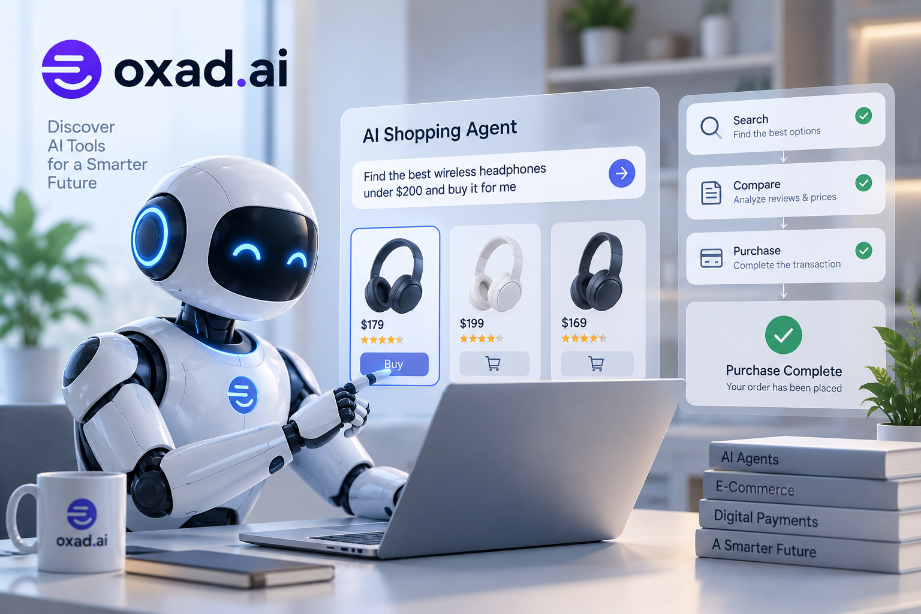
This shift is giving rise to a new concept known as agentic commerce. Instead of simply asking an AI assistant to find the best laptop, flight, hotel, subscription, or household product, a user could eventually give the agent permission to search, compare options, select the best choice according to predefined preferences, and complete the transaction.
The idea is moving beyond experimentation. Payment companies, technology platforms, merchants, and financial institutions are now developing infrastructure specifically designed for transactions initiated by AI agents.
That makes agentic commerce one of the most important developments to watch in the evolution of AI agents.
Key takeaway: Agentic commerce could change online shopping from a process driven by searches, clicks, comparisons, and manual checkout into an experience where users express an intention and an AI agent handles much of the transaction on their behalf.
What Is Agentic Commerce?
Agentic commerce describes a shopping experience in which an AI agent can participate in multiple stages of a purchasing journey.
Traditional online shopping generally looks like this:
Search → Compare → Select → Checkout → Pay
An agentic commerce workflow could look more like this:
Instead of manually visiting several websites and completing every step, the user could tell an AI agent what they want and establish rules around the purchase.
For example, a user might ask an agent to find a suitable hotel under a specific budget, prioritize a particular location, avoid certain conditions, and only complete the reservation after receiving approval.
The agent would then perform the research and return a recommendation rather than simply providing a list of search results.
The ultimate goal is to make digital commerce more intent-driven.
Why Payments Are the Missing Piece
AI assistants have become increasingly capable at discovering information. The difficult part has been allowing them to safely cross the boundary between recommendation and transaction.
Finding a product is relatively low risk.
Buying that product with someone’s money is different.
An AI agent needs to know who authorized the transaction, what the agent is allowed to purchase, how much it can spend, which payment credentials it can use, and what happens if the transaction is incorrect.
This is why payment infrastructure has become one of the most important pieces of the agentic commerce ecosystem.
Visa describes its Intelligent Commerce initiative as infrastructure for AI-initiated transactions that combines payment credentials, authentication, controls, and protections. Mastercard has similarly developed Agent Pay around trusted and traceable agent-led payments. 0
Why Visa, Mastercard and Ant International Are Working on Agent Identity
A major development reported in September 2026 is a joint initiative involving Visa, Mastercard, and Ant International to develop common standards for identifying and verifying AI agents that can make purchases on behalf of users.
The underlying problem is simple but fundamental:
If software is going to spend your money, how do you know which software is actually authorized to do so?
Traditional payments are built around identifiable participants such as a cardholder, merchant, bank, and payment network.
Agentic commerce introduces another participant: the AI agent.
The agent may act on behalf of the consumer, interact with merchants, negotiate or compare options, and initiate a transaction.
Creating reliable identity and authorization mechanisms for these agents could therefore become as important as payment authentication itself.
The new initiative reflects an industry effort to establish common trust mechanisms rather than allowing every AI platform and payment provider to create completely separate systems. 1
The Rise of the “Know Your Agent” Model
One of the concepts emerging around agentic payments is effectively a digital version of knowing who or what is participating in a financial transaction.
Mastercard, for example, emphasizes registered agents, traceability, network tokens, authenticated user intent, and explicit consent within its Agent Pay infrastructure.
These mechanisms address a fundamental challenge: an AI agent should not be treated as an anonymous piece of software when it is interacting with financial systems. 2
Imagine that a shopping agent is authorized to spend up to $200 on a particular category of products.
The payment system should ideally be able to establish:
Which agent is making the request
Which user authorized the agent
What the agent is permitted to do
What spending limits apply
Whether the transaction matches the user’s intent
Whether the transaction can be traced and reversed when appropriate
Without these mechanisms, autonomous shopping could create enormous security and consumer-protection problems.
From Shopping Assistant to Shopping Agent
There is a major difference between an AI shopping assistant and a true shopping agent.
An assistant might say:
“Here are five laptops that match your requirements.”
A more autonomous agent could potentially say:
“I found the best option within your budget and according to your preferences. Would you like me to purchase it?”
With sufficient authorization, the next step could eventually be:
“The purchase has been completed within the limits you specified.”
This progression changes the role of AI from an information interface into an operational layer between consumers and businesses.
Meta Is Also Moving Toward Agentic Shopping
The development is not limited to payment networks.
Meta has introduced its consumer AI agent, Muse, with capabilities that include shopping and other actions performed on behalf of users. Reports about the system indicate that it can participate in online purchasing workflows, including checkout and payment with user consent.
This is important because Meta controls several major consumer platforms. If agentic shopping becomes integrated into applications people already use every day, the transition from conventional search to AI-assisted purchasing could happen gradually rather than through a completely new shopping platform.
The result could be a world where the user does not necessarily visit a retailer first.
The user might begin with an AI conversation.
Search Could Become Less Important
Traditional e-commerce depends heavily on search.
Consumers type keywords into Google, Amazon, retailer websites, or marketplaces. They browse pages, compare products, read reviews, and eventually make a decision.
Agentic commerce could change that process.
Instead of searching for:
“Best noise-cancelling headphones under $300”
a user might simply tell an AI agent:
“Find me the best noise-cancelling headphones under $300 for long flights. Prioritize comfort and battery life.”
The agent could interpret the requirements, investigate products, compare specifications and reviews, and return a smaller selection.
The user’s attention would shift from navigating websites to evaluating the recommendation.
This could make product discovery dramatically more efficient.
But It Could Also Change Which Businesses Get Visibility
Agentic commerce creates a new challenge for merchants.
Today, businesses compete for visibility in search engines, marketplaces, social media, advertising networks, and shopping platforms.
In an agentic environment, they will also need to become understandable and trustworthy to AI systems.
Product information will need to be structured clearly. Prices, availability, specifications, shipping conditions, return policies, reviews, and merchant reputation may all become inputs used by AI agents when deciding what to recommend.
This could create a new form of optimization:
Optimization for AI purchasing agents.
Instead of optimizing only for human visitors and search engines, businesses may increasingly need to make their products easy for AI systems to discover, understand, compare, and purchase.
Agentic Commerce Could Favor Trusted Marketplaces
There is an interesting tension here.
AI agents could theoretically make it easier for consumers to compare thousands of independent merchants. But the opposite could also happen.
Large marketplaces already have structured product catalogs, customer reviews, payment systems, established fulfillment networks, and recognizable trust signals.
These characteristics can make them easier for AI agents to work with.
Recent analysis of AI-referred retail traffic suggests that marketplaces are already capturing significant AI-driven shopping activity, highlighting the importance of structured product information and established trust infrastructure. 3
That means agentic commerce may not automatically eliminate the power of large platforms.
In some cases, it could strengthen them.
Security Becomes More Important When AI Can Spend Money
The cybersecurity implications are substantial.
An AI agent with access to payment capabilities becomes a high-value target.
An attacker who compromises the agent, manipulates its context, alters product information, or tricks it into interpreting malicious instructions could potentially influence real financial transactions.
This connects directly to the broader security concerns surrounding increasingly autonomous AI agents.
Agentic commerce adds another dimension to the problem because the potential consequence is not simply incorrect information.
It could be an unauthorized transaction.
Permission Systems Will Be Critical
The safest agentic commerce systems are unlikely to give AI unlimited authority.
Instead, permission systems could become one of the most important components of the technology.
A user might establish rules such as:
Maximum transaction amount
Approved merchants
Approved product categories
Geographic restrictions
Frequency limits
Required approval for expensive purchases
Automatic cancellation conditions
This creates a model similar to access control in software.
The agent receives enough authority to perform useful work, but not enough authority to make unrestricted decisions with the user’s money.
Why AI Agents Need Better Context
Another important challenge is context.
An AI agent needs to understand not only what the user said, but what the user actually intended.
Suppose someone says:
“Buy me a new laptop.”
That instruction is incomplete.
What budget? Which operating system? What screen size? What country? What warranty? How important is battery life? Is refurbished acceptable?
A good agent needs enough context to make a useful decision without inventing preferences.
This is one reason context management is becoming increasingly important in agentic systems. Platforms such as Context.dev illustrate the broader movement toward giving AI systems the relevant context needed to perform complex tasks reliably.
Agentic Commerce Could Create a New Type of Internet
The internet was originally designed primarily for humans.
Websites display information for people. Search engines help people find that information. Online stores allow people to browse and purchase products.
Agentic commerce introduces another participant: software that can navigate digital environments and act on behalf of humans.
That could eventually create an internet where machines communicate with businesses and other machines much more frequently.
A buyer agent could communicate with a merchant agent.
A merchant agent could check inventory.
A logistics agent could arrange delivery.
A payment agent could authorize the transaction.
All of these interactions could happen with limited direct human involvement.
This is much more than AI-powered shopping.
It is potentially a new machine-to-machine economic layer.
What Happens to Affiliate Marketing?
Agentic commerce could also change digital marketing.
Affiliate links, product reviews, comparison websites, advertising, and search rankings have traditionally been designed to influence human purchasing decisions.
AI agents may increasingly become the decision-maker between the consumer and the merchant.
That raises an important question for publishers and content websites:
Will AI agents recommend the website with the best content, the best product, the best price, or the easiest transaction?
Possibly all of them will matter.
For AI directories such as OXAD.AI, this makes structured tool information increasingly important. AI systems need clear information about what a tool does, who it is for, pricing, capabilities, and alternatives.
The shift toward agentic discovery could therefore create opportunities for websites that organize software and AI products in a way that machines can easily understand.
Agentic Commerce Is Still Early
It is important not to assume that autonomous shopping will immediately replace conventional e-commerce.
Consumers still want control over their money. They may not trust an AI to make expensive purchases. Retailers need to support new technical standards. Payment networks need to manage fraud and liability. Regulators need to determine how responsibility works when an AI makes an error.
These challenges will slow adoption.
But they do not necessarily stop the trend.
Payment companies are already testing real-world agentic transactions. Mastercard has reported live end-to-end agentic payments in Europe, while other initiatives are extending the concept into different markets and transaction types. 4
India is also developing an AI-agent registry connected to its UPI payment ecosystem, illustrating how governments and payment networks are beginning to think about authentication and accountability for agentic transactions. 5
The Real Question Is Trust
The technical ability to allow AI agents to buy things is becoming less difficult.
The harder question is whether people will trust them.
Consumers need confidence that an agent will follow their instructions, protect their payment information, respect spending limits, and explain what it did.
Merchants need confidence that the agent is legitimate.
Payment networks need confidence that transactions are authorized.
Regulators need mechanisms for accountability when something goes wrong.
In other words, agentic commerce will not be built purely on better AI models.
It will require a new layer of identity, permissions, authentication, security, and accountability.
What Agentic Commerce Could Look Like
Imagine planning a trip without manually opening dozens of websites.
You tell an AI agent your destination, dates, budget, preferences, and constraints.
The agent searches flights and hotels, compares options, checks cancellation policies, evaluates reviews, and prepares an itinerary.
You approve the plan.
The agent completes the bookings and payments within the permissions you established.
Later, if a flight changes, another agent could potentially identify the problem, search for alternatives, and ask for approval before making an expensive change.
This is the promise of agentic commerce: not simply making search faster, but reducing the number of manual decisions required to complete a real-world task.
Final Takeaway
Agentic commerce represents one of the clearest examples of AI moving from information generation to real-world action.
The recent collaboration between major payment companies around AI-agent identity and trust shows that the industry is beginning to build infrastructure for a world where software can participate directly in commerce.
But the technology will succeed only if autonomy is balanced with control.
The most useful shopping agent will not necessarily be the one with unlimited authority. It may be the one that understands the user’s preferences, knows its limits, explains its decisions, and operates inside clearly defined permissions.
For consumers, this could eventually mean fewer searches, fewer comparison pages, and much less time spent navigating checkout processes.
For businesses, it could create a new battle for visibility in which products need to be discoverable not only by humans and search engines, but also by AI purchasing agents.
And for the broader AI industry, agentic commerce may become one of the first major tests of whether autonomous AI can safely move from the digital conversation into the real economy.
Explore AI Tools on OXAD.AI
Discover AI agents, automation platforms, developer tools, and other technologies shaping the next generation of AI-powered workflows.