Cursor Projects: The Rise of AI Coding Projects That Work for Months
AI coding is entering a new phase.
For years, AI coding assistants have mainly helped developers complete individual tasks: write a function, fix a bug, explain a file, generate a test, or make a small change to an existing project.
Cursor is now moving the concept much further with Cursor Projects.
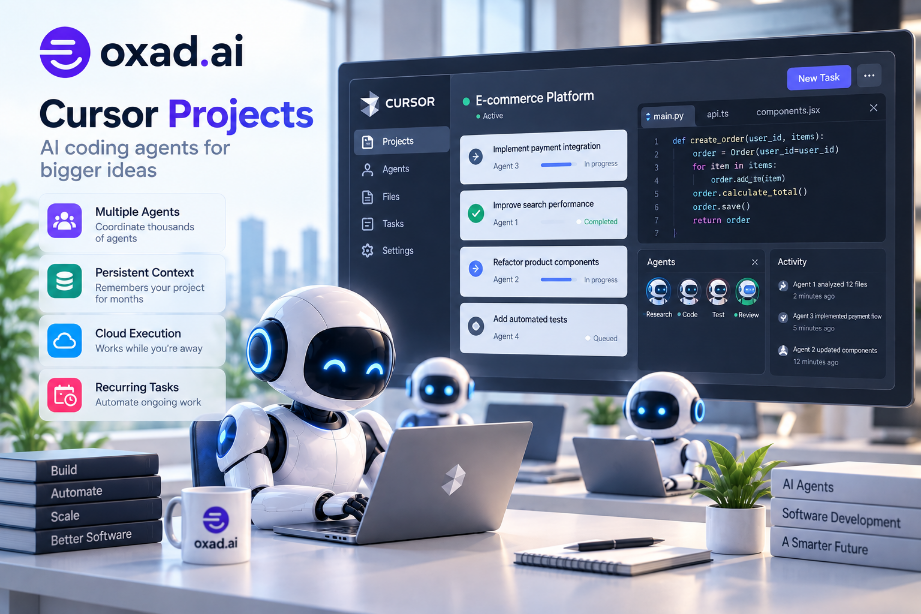
Introduced as a beta feature, Projects is designed for larger bodies of work such as complete features, migrations, applications, and ongoing codebase maintenance. Instead of asking an AI agent to complete one task at a time, developers can give a project to a coordinator agent that plans the work and delegates tasks to other agents.
Cursor says Projects can maintain context over months, delegate work to thousands of subagents, and perform recurring tasks without waiting for a new prompt.
Key takeaway: Cursor Projects changes the abstraction level of AI coding. Instead of managing individual coding agents, developers can increasingly manage the work itself while AI agents handle the implementation.
What Is Cursor Projects?
Cursor Projects is a new way of organizing AI-assisted software development around an ongoing project rather than a single conversation.
A Project can represent something much larger than a typical coding request, such as:
A major product feature
A large code migration
A complete application
A long-running refactoring effort
Continuous codebase maintenance
Bug monitoring and resolution
Recurring engineering tasks
The key difference is that a Project has its own persistent context and can continue working after the developer leaves the computer.
Instead of repeatedly explaining the same codebase to different agents, the Project maintains information that can be reused by future agents.
One Coordinator Instead of Managing Many Agents
The most interesting architectural idea behind Cursor Projects is the coordinator agent.
The coordinator does not necessarily write the code itself.
Instead, it acts as a manager.
A developer describes the objective, and the coordinator determines how the work should be divided. It can then delegate individual tasks to implementation agents and bring the results back for review.
This creates a hierarchy that looks something like this:
Developer
↓
Project Coordinator
↓
Agent 1 | Agent 2 | Agent 3 | Agent 4
↓
Code, Tests, Research, Reviews & Changes
This is fundamentally different from simply opening multiple AI chats.
The coordinator has a persistent understanding of the larger objective and can organize the work between different agents.
Why Thousands of Subagents Matter
Cursor says Projects can delegate tasks to thousands of subagents.
That number is less important as a literal measure than what it represents architecturally.
It demonstrates that AI coding is moving toward parallel software engineering.
A traditional developer typically works through a task sequentially:
An agent-based system can potentially divide a large project into many independent tasks and execute several of them simultaneously.
For example, imagine migrating a large application from one framework to another.
Instead of one agent processing the entire codebase sequentially, a coordinator could divide the migration into smaller units, assign them to different agents, review the resulting changes, and continue until the migration is complete.
This is particularly useful for work that contains hundreds of relatively independent changes.
Projects Can Keep Working While You Are Away
One of the most important differences between Projects and traditional AI coding sessions is that the work does not have to stop when the developer closes the laptop.
Cursor says a Project runs on its own computer in the cloud. This means the Project can continue operating even when the developer is no longer actively using the local machine.
When something needs to be tested on the developer’s own computer, the coordinator can use a local agent for that task.
This creates an interesting hybrid model:
Environment
Purpose
Cloud
Long-running agent work and parallel execution
Local
Tasks that require access to the developer’s machine
Shared context
Knowledge and artifacts shared between agents
This model is important because it separates the developer’s physical workstation from the AI’s ongoing workload.
Shared Context Could Be More Important Than More Powerful Models
One of the biggest problems with AI coding agents is context.
A developer may spend weeks working on a project, but a new AI session can still behave as though it knows very little about the codebase.
Projects attempts to address this through persistent shared context.
Cursor says each Project maintains files that synchronize across the cloud and local environments used by its agents.
Agents can add research, artifacts, instructions, and information about the codebase to this shared context.
This means knowledge discovered by one agent can potentially benefit another agent later.
For example, suppose one agent discovers exactly how a particular internal service must be tested.
Instead of forcing the next agent to rediscover that information, the Project can preserve the knowledge for future work.
Over time, the Project effectively develops its own operational memory.
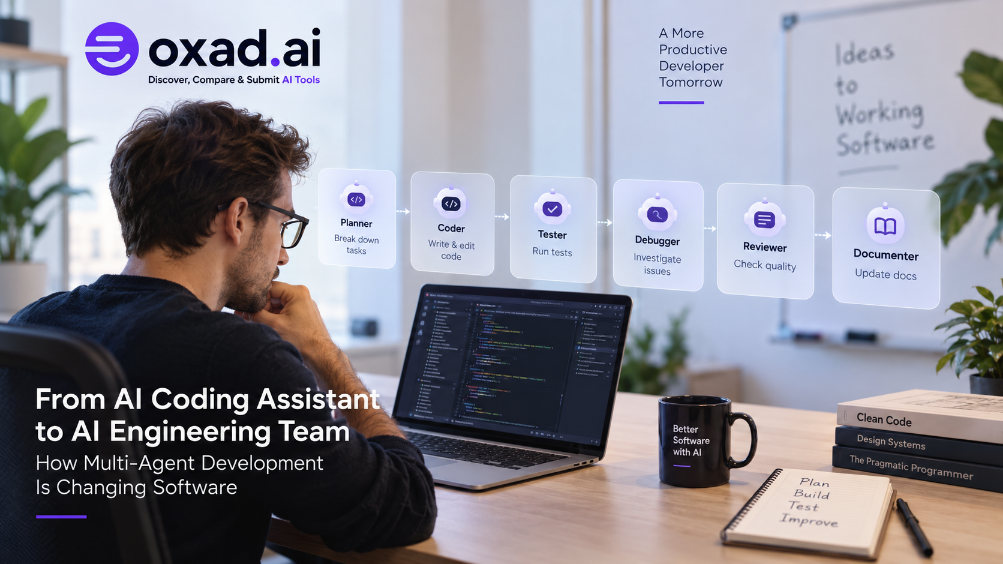
From AI Coding Assistant to AI Engineering Team
This is where Cursor Projects becomes more interesting than a normal AI coding feature.
The traditional AI coding assistant can be thought of as an individual collaborator.
Projects is closer to an AI engineering team.
The developer defines the objective.
The coordinator organizes the work.
Specialized agents perform individual tasks.
The developer reviews important results.
This resembles the structure of a real engineering organization.
Instead of asking:
“Can AI write this function?”
The more important question becomes:
“Can AI coordinate the development of this entire system?”
That is a much bigger ambition.
Projects Are Particularly Interesting for Large Migrations
One of the strongest use cases for Projects is software migration.
Migrations are often easy to understand conceptually but difficult to complete at scale.
A team might know exactly what needs to change, but the work could involve hundreds or thousands of files and pull requests.
Cursor says its own team has used Projects for migrations involving hundreds of pull requests.
The coordinator can establish an approach, delegate individual changes, and continue working through the migration while developers gradually reduce the amount of manual review as confidence increases.
This is a perfect example of where agentic coding can offer something beyond faster code generation.
The value comes from coordination and persistence.
Continuous Codebase Maintenance
Another particularly interesting use case is what Cursor describes as “gardening.”
Software projects are never truly finished.
New code is added, old patterns return, bugs appear, dependencies change, and technical debt accumulates.
Instead of waiting for developers to manually identify every issue, an AI Project can potentially monitor the codebase and respond to new signals.
For example, a Project could be configured to:
Monitor new pull requests
Watch for bug reports
Identify repeated code-quality problems
Suggest or implement improvements
Maintain design-system consistency
Run recurring engineering tasks
Cursor says Projects can connect to Slack, follow pull requests, or run according to a schedule.
This transforms AI coding from a reactive tool into something closer to a continuous engineering service.
The Connection Between Projects and AI Agents
Cursor Projects is part of a much larger trend in AI development.
AI companies are increasingly building systems where agents do not simply answer questions. They plan, delegate, execute, inspect results, and continue working.
OpenAI’s recent Agents API announcement is another example of the same broader movement toward long-running agents, tool use, subagents, context management, and execution environments.
The difference is that Cursor is applying this concept specifically to software development.
Instead of creating a general-purpose digital worker, Cursor is building toward an environment where AI agents can operate around an entire software project.
How Cursor Projects Differs From a Normal Coding Agent
Traditional Coding Agent
Cursor Projects
Focuses on individual tasks
Focuses on larger bodies of work
Usually one active agent
Coordinator can manage multiple agents
Shorter context
Persistent project context
Human initiates most tasks
Can perform recurring work automatically
Primarily local interaction
Cloud-first with local execution when needed
Developer manages agents
Coordinator manages agents
What This Means for Developers
For developers, the biggest change may be the level at which they interact with AI.
Instead of describing individual implementation steps, developers can increasingly describe outcomes.
For example:
Traditional request:
“Fix this authentication error.”
Project-level request:
“Migrate the authentication system to the new architecture, update the affected services, add the required tests, and keep the migration moving until the project is complete.”
The second request requires significantly more planning and coordination.
That is exactly the level at which Projects is designed to operate.
Code Review Becomes Even More Important
Greater AI autonomy does not eliminate the need for developers to review software.
In fact, it may make review more important.
If dozens or hundreds of agents can make changes simultaneously, developers need effective mechanisms for evaluating those changes.
This creates an opportunity for specialized AI development tools to work alongside agentic coding platforms.
CodeRabbit, for example, focuses on AI-assisted code review and can provide an additional layer of analysis around pull requests and code changes.
The future of AI development may therefore involve several specialized agents working together:
One agent plans the work.
Other agents implement changes.
Testing agents verify functionality.
Code-review systems inspect the results.
Human developers approve important changes.
This is closer to an AI-powered software development pipeline than a traditional coding assistant.
Context and External Data Will Become Critical
Software agents also need information outside the codebase.
They may need documentation, API references, websites, technical specifications, product information, or current external data.
This makes AI context infrastructure increasingly important.
Context.dev is an example of a tool operating in this broader ecosystem, providing web data and extraction capabilities that can help AI systems obtain external context.
Similarly, Firecrawl provides web crawling, scraping, search, and browser-related capabilities that can become useful when AI agents need to retrieve current information from the web.
The more autonomous coding agents become, the more important reliable external context will become.
Where Broader AI Workspaces Fit
Agentic development is also expanding beyond traditional IDEs.
Runable, for example, represents a broader AI workspace approach that combines agents with development, research, documents, applications, media, and other workflows.
This points toward a future where coding is no longer isolated from the rest of the AI workflow.
An AI system could research a requirement, design an application, write the code, test it, prepare documentation, and coordinate deployment-related tasks.
Specialized tools could provide the capabilities required at each stage.
Is Cursor Projects Replacing Developers?
No.
The more realistic interpretation is that it changes what developers spend their time doing.
If AI agents become capable of handling increasingly large portions of implementation work, developers may spend less time manually producing repetitive code and more time on:
System architecture
Product decisions
Security
Requirements
Code review
Testing strategy
Performance
AI supervision
Risk management
The developer increasingly becomes the person responsible for defining the environment and standards under which AI agents operate.
This is an important distinction.
AI may automate more implementation without eliminating the need for engineering judgment.
The Biggest Challenge: Reliability
There is an important reason to remain cautious about the idea of autonomous software projects.
Writing code is not the same as building reliable software.
An agent can produce a technically valid change that is still wrong for the product.
It can misunderstand a requirement, introduce a subtle security problem, modify the wrong component, or solve a local issue while creating a larger architectural problem.
As the number of agents increases, these risks can also multiply.
This means the real measure of Projects will not simply be how many agents it can run.
The more important questions are:
How accurately does the coordinator divide work?
How well do agents understand the project’s architecture?
How effectively are mistakes detected?
How much human supervision is required?
How predictable are the results?
Can developers trust the system with production-critical work?
Those questions will determine whether autonomous coding becomes a reliable engineering practice or remains primarily an impressive productivity experiment.
Cursor Projects and the Future of Software Development
The introduction of Projects reflects a larger shift in the AI coding industry.
The first generation of AI coding tools focused heavily on autocomplete.
The next generation moved toward conversational coding and repository-level agents.
The emerging generation is beginning to focus on long-running software projects managed by fleets of AI agents.
This is a much larger abstraction.
Instead of asking AI to help write code, developers are beginning to ask AI to help manage the process of creating and maintaining software.
That distinction could have significant consequences for development teams.
Cursor Projects vs Traditional AI Coding
The shift can be summarized simply:
Past: AI helps developers write code.
Today: AI agents can implement development tasks.
Emerging: AI coordinates entire bodies of software work.
Cursor Projects is an example of that third stage.
It does not mean that every software project should immediately be handed over to autonomous agents. For many applications, traditional development workflows will remain more appropriate.
But for large migrations, repetitive maintenance, broad refactoring, continuous code quality, and projects with many independent tasks, the model could be particularly powerful.
What Developers Should Watch Next
Cursor Projects is currently rolling out in beta, so the platform will likely evolve quickly.
The most interesting developments to watch are not simply larger agent counts.
Developers should pay attention to improvements in:
Long-term project memory
Agent coordination
Code review and verification
Cloud execution
Local and self-hosted environments
Security controls
Recurring automation
Integration with developer tools
Agent reliability
If these capabilities mature, the development environment itself could become increasingly autonomous.
Final Verdict
Cursor Projects is an important signal that AI coding is moving beyond individual coding sessions.
The most interesting idea is not simply that Cursor can run more agents. It is that developers can delegate an entire body of work to a coordinator that maintains context, distributes tasks, and continues operating over time.
That changes the relationship between developers and AI.
Instead of constantly managing AI agents, developers can increasingly define objectives and supervise the resulting work.
The combination of persistent context, cloud execution, parallel subagents, local testing, and recurring workflows could make AI coding much more useful for large and continuous engineering tasks.
However, autonomy must be accompanied by verification. The ability to generate hundreds of changes is only valuable if those changes remain correct, secure, maintainable, and aligned with the project’s requirements.
For that reason, the future is unlikely to be about AI working completely without humans. A more realistic model is humans directing increasingly capable fleets of AI agents.
Cursor Projects is one of the clearest examples yet of what that future could look like.
Cursor Projects is a beta feature designed for managing larger software-development projects with AI agents. It can maintain project context, coordinate agents, and handle ongoing development work.
How does Cursor Projects work?
A developer describes the objective to a coordinator agent. The coordinator plans the work, delegates tasks to implementation agents, and returns the completed work for review.
Can Cursor Projects use multiple AI agents?
Yes. Projects are designed to coordinate multiple agents and can delegate independent tasks in parallel.
Can Cursor Projects work while my computer is turned off?
Yes. Cursor says Projects run on dedicated cloud computers, allowing work to continue even when the developer closes their laptop.
Does Cursor Projects remember previous work?
Projects maintain shared context that can include research, artifacts, instructions, and information learned about the codebase. This context can be used by future agents working on the same Project.
Can Cursor Projects perform recurring tasks?
Yes. Projects can be configured to respond to recurring schedules and signals such as pull requests or connected Slack activity.
Is Cursor Projects useful for large migrations?
Yes. Large migrations are one of the use cases Cursor highlights because a coordinator can divide repetitive migration work into smaller tasks and delegate them across multiple agents.
Does Cursor Projects replace developers?
No. Developers still need to define requirements, review important changes, make architectural decisions, and ensure that the resulting software meets security and quality standards.
How does Cursor Projects compare with traditional AI coding assistants?
Traditional assistants generally focus on individual coding tasks, while Projects operates at a higher level by coordinating multiple agents around a larger and longer-running body of work.
Where can I find Cursor on OXAD.AI?
You can explore Cursor on OXAD.AI for information about the AI coding platform and its capabilities.