AI Agent Browsers: How AI Is Changing Web Browsing
AI is changing the way people interact with the web. Instead of opening a browser, searching for information, clicking through multiple pages, and completing tasks manually, users can increasingly rely on AI systems that navigate websites and perform actions on their behalf.
This emerging approach is often described as agentic browsing, and it is driving interest in a new category of technology: AI agent browsers.
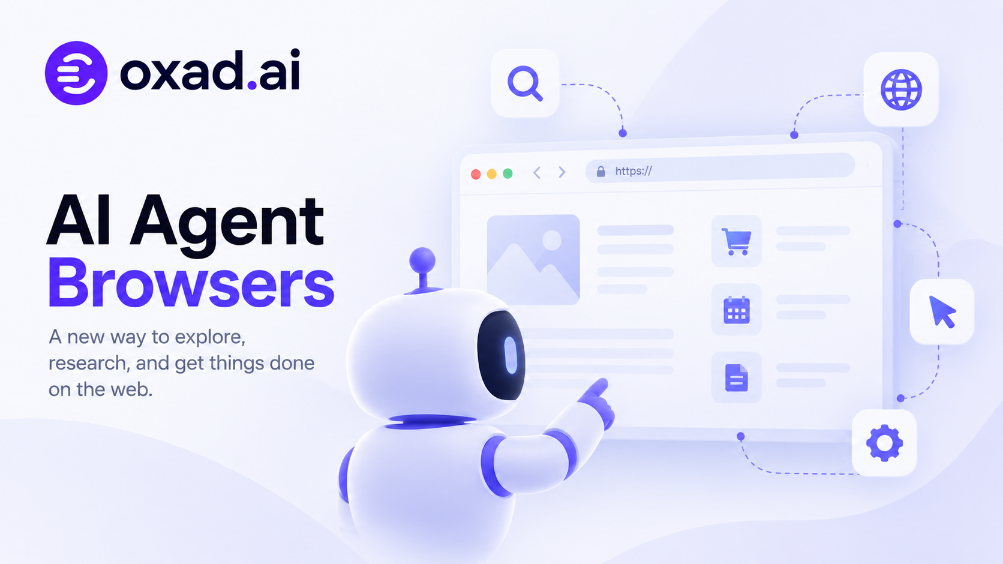
An AI agent browser allows an AI system to interact with websites through a browser-like environment. Depending on the system, an agent may be able to search the web, open pages, read information, click buttons, complete forms, compare products, extract information, and carry out multi-step tasks.
This article explains what AI agent browsers are, how they differ from traditional browsers and AI search, what they can do, their security limitations, and why they could become an important part of the next generation of the web.
Technology
Primary User
Main Function
Can Take Actions?
Traditional browser
Human
Display and interact with websites
Yes, through the user
AI search
Human
Find and summarize information
Usually limited
Browser automation
Software
Execute predefined browser actions
Yes
AI agent browser
AI agent
Understand websites and complete multi-step tasks
Yes, within granted permissions
What Is an AI Agent Browser?
An AI agent browser is a browser environment or browsing system designed to allow an AI agent to interact with the web and perform tasks rather than simply return information to a human.
The important distinction is agency.
A conventional search engine helps a person find a website. An AI agent browser can potentially find the website, open it, understand the page, determine what action is required, interact with the interface, and continue through several steps to complete a larger objective.
For example, instead of asking an AI:
“What are the best hotels in Paris?”
a user might eventually ask:
“Find three highly rated hotels near the city center within my budget, compare them, and prepare the best option for booking.”
The second task requires much more than generating text. It requires browsing, filtering, reasoning, and potentially interacting with websites.
How AI Agent Browsing Works
Although implementations differ, an agentic browsing system generally combines several components.
Understanding the User’s Goal
The process begins with a natural-language objective. The AI needs to determine what the user wants rather than simply match keywords.
A request such as “find the cheapest suitable option” contains several implicit requirements, including relevance, price, constraints, and comparison.
Planning the Task
The agent can break the objective into smaller actions.
A shopping task, for example, might involve searching for products, opening several results, collecting specifications, comparing prices, checking availability, and presenting the findings.
Navigating Websites
The browser environment provides access to web pages. Depending on the implementation, the agent may interact with links, buttons, menus, search boxes, forms, and other interface elements.
Reading and Interpreting Pages
Modern websites contain much more than plain text. An agent may need to understand page structure, labels, tables, images, forms, dynamic content, and changes in page state.
Taking Actions
The agent can then perform permitted actions. These might include entering search terms, selecting filters, moving between pages, or filling out information.
Actions that create financial, legal, account, or other significant consequences should generally require appropriate user authorization rather than unrestricted autonomy.
Checking the Result
A reliable agent should not assume that every action succeeded. It needs to verify page changes and determine whether the requested objective was actually completed.
AI Agent Browsers vs AI Search
AI search and agentic browsing are closely related, but they solve different problems.
AI search primarily focuses on helping users find, understand, and synthesize information. Agentic browsing adds another layer: interaction and task execution.
Capability
AI Search
AI Agent Browser
Search information
Yes
Yes
Summarize websites
Yes
Yes
Navigate multiple pages
Sometimes
Core capability
Fill forms
Usually limited
Potentially
Click through workflows
Limited
Yes
Complete multi-step tasks
Limited
Core objective
This distinction matters because the future of web interaction may not be limited to asking AI questions. Increasingly, AI systems may become capable of performing parts of the workflow that previously required a human to operate a browser manually.
What Can AI Agent Browsers Do?
The practical capabilities depend on the specific system and the permissions it receives, but several use cases are particularly relevant.
Research and Information Gathering
An agent can potentially visit multiple sources, collect relevant information, compare findings, and organize the results.
This could reduce the repetitive work involved in researching competitors, products, suppliers, technical documentation, or market information.
For broader AI research workflows, users can also explore tools listed in the OXAD.AI AI tools directory.
Shopping Research
AI agents can potentially compare products across different websites, check specifications, identify differences, and organize options according to user-defined requirements.
The more important development is that shopping may eventually become less about visiting individual online stores and more about delegating the research process to an agent.
Form Completion
Forms are one of the most repetitive parts of web interaction. Agents could potentially assist with applications, registrations, surveys, support requests, and other structured workflows.
However, sensitive forms require stronger controls because a mistake can have significant consequences.
Business Research
Companies could use browser agents to collect public information from websites, monitor competitors, research prospects, or consolidate information from multiple sources.
This overlaps with the broader development of AI agent tools, where agents increasingly interact with external systems rather than operating only inside a chat interface.
Website Testing
AI agents could also become useful for testing websites from a user’s perspective.
Instead of checking only whether a page loads, an agent could potentially attempt tasks such as finding a product, completing a search, navigating a checkout flow, or locating information.
Administrative Work
Many business processes involve repetitive browser activity. Agents could potentially assist with data entry, information retrieval, scheduling workflows, and other routine tasks.
The key requirement is that the agent must operate within clearly defined permissions and predictable boundaries.
AI Agent Browsers and Browser Automation
AI agent browsers are related to browser automation, but they are not exactly the same.
Traditional browser automation typically follows predefined instructions. A script may be programmed to open a page, click a specific element, enter information, and continue through a known workflow.
An AI agent introduces more flexibility.
Instead of specifying every step in advance, a user can provide a goal and allow the agent to determine some of the steps required to reach it.
The further a system moves toward autonomy, the more important reliability, authorization, monitoring, and security become.
The Security Problem With AI Agent Browsers
The ability to navigate websites and take actions also introduces a new security problem.
A human browsing a malicious page can potentially recognize suspicious instructions. An AI agent may interpret webpage content as part of the task it is trying to complete.
This creates risks such as prompt injection, where malicious instructions embedded in webpage content attempt to influence the agent’s behavior.
For example, a webpage could contain instructions designed to make an agent reveal information, visit another website, or perform an action that was not actually requested by the user.
Excessive Permissions
An agent with unrestricted access can create much greater damage than an agent operating with limited permissions.
This is why the principles discussed in OXAD.AI’s article on AI agent identity are increasingly relevant to agentic browsing.
An AI agent should not automatically inherit every permission available to its human user.
Credential Exposure
Browser agents may interact with authenticated websites. This creates additional risks if credentials, session information, payment details, or private data become accessible to an autonomous system.
Authentication should therefore be designed around explicit authorization and limited access wherever possible.
Unintended Transactions
An agent capable of clicking buttons can eventually encounter actions with real consequences, such as purchases, account changes, messages, or submissions.
High-impact actions should generally include confirmation steps or other safeguards rather than unrestricted execution.
Why Least Privilege Matters
The principle of least privilege is especially important for autonomous browsing.
An agent should receive only the access required for its current task.
For example, an agent that needs to research product specifications does not necessarily need access to a user’s email account, payment information, or administrative settings.
Permission boundaries can reduce the potential impact of agent mistakes and malicious instructions.
Permission
Example
Recommended Control
Read
Read public webpages
Generally lower risk
Navigate
Open links and search results
Domain and task restrictions
Write
Submit information or messages
Require stronger controls
Account changes
Change settings
Explicit authorization
Financial action
Purchase or payment
Human confirmation recommended
How Websites May Need to Adapt
If AI agents become a major way of interacting with the web, website owners may need to think about users differently.
Historically, a website was designed primarily around human visitors.
In an agentic web, a website may have two audiences:
Humans and software agents.
This does not necessarily mean that websites should redesign everything for machines. Instead, websites may need clearer structure, reliable information, accessible interfaces, appropriate authentication mechanisms, and explicit policies governing automated access.
Clear Information Architecture
Well-structured pages are useful for humans and machines alike. Clear headings, descriptive labels, consistent navigation, and meaningful page content can make websites easier to understand.
Machine-Readable Information
Structured data and consistent content can help software systems interpret products, organizations, events, prices, and other information.
Agent Access Policies
Websites may increasingly need to communicate which actions automated agents can perform and which actions require human interaction.
Strong Authentication
As agents interact with authenticated services, websites will need ways to distinguish authorized agent activity from malicious automation.
AI Agents Could Change Web Traffic
One of the biggest implications of agentic browsing is that traditional website traffic metrics may become more complicated.
A human visitor typically generates a page view. An AI agent could visit several pages while representing a single user request.
This raises questions about how websites will measure engagement, attribution, referrals, conversions, and advertising value.
It may also change how businesses think about visibility.
In traditional search, a company wants its website to rank highly so that a human clicks the result.
In an agentic environment, the goal may increasingly become making the company’s information easy for AI systems to discover, understand, evaluate, and use.
Search and browsing are gradually moving closer together.
Traditional search follows a relatively simple model:
User → Search engine → Results → Website → Human action
An agentic workflow can look more like:
User → AI agent → Search → Websites → Reasoning → Actions → Result
The difference is significant because the AI becomes an intermediary capable of performing parts of the process that previously belonged to the user.
This does not mean traditional search will disappear. Humans will continue to browse websites directly, and many searches will still end with conventional results.
However, for tasks involving multiple steps, agentic browsing could become an important alternative.
AI Agent Browsers and Web Scraping
AI agents also overlap with web scraping and data extraction, but the objectives can be different.
Traditional scraping usually focuses on collecting structured information at scale.
Agentic browsing can focus on understanding a task and navigating websites dynamically.
For example, a scraper may collect every product listed on a page. An AI agent might instead be asked to find products that satisfy several conditions and explain why the selected products meet those requirements.
This combination of browsing, reasoning, and action could make agentic systems useful for research and business workflows.
However, automated access must still respect website terms, applicable laws, authentication boundaries, and reasonable technical restrictions.
Challenges That AI Agent Browsers Still Face
Agentic browsing is promising, but it is far from a solved problem.
Reliability
Websites change frequently. A button can move, a page can load dynamically, a login can expire, or an expected element can disappear.
An agent needs to recover from these situations rather than simply continue blindly.
Hallucinations and Misinterpretation
An AI may misunderstand a product description, interpret a page incorrectly, or select an unsuitable option.
For high-stakes decisions, human review remains important.
Prompt Injection
Untrusted webpage content can contain instructions intended to manipulate an agent. Robust systems need to treat webpage content as potentially untrusted input rather than automatically following instructions found on a page.
Privacy
Browser agents can potentially encounter highly sensitive information. Systems therefore need clear policies for data storage, processing, retention, and access.
Cost and Speed
Complex browser tasks can require many model calls and interactions. This can make autonomous browsing slower or more expensive than simply answering a question.
Website Compatibility
Modern websites use JavaScript, authentication systems, dynamic interfaces, CAPTCHAs, anti-bot technologies, and other mechanisms that can make automated interaction difficult.
What Makes a Good AI Agent Browser?
As this category develops, users should look beyond simple demonstrations.
A capable agent browser should ideally provide:
Clear user authorization
Granular permissions
Reliable task planning
Protection against prompt injection
Strong privacy controls
Transparent action history
Human confirmation for high-impact actions
Recovery from failed browser actions
Useful error reporting
Controls over websites and domains the agent can access
The ability to perform an impressive demo is not enough. The more autonomy a browser agent receives, the more important its safety architecture becomes.
AI Agent Browsers vs Traditional Automation
Factor
Traditional Automation
AI Agent Browser
Instructions
Usually predefined
Goal-oriented
Adaptability
Limited
Potentially higher
Reasoning
Usually external to the automation
Integrated into the workflow
Maintenance
Can be high when interfaces change
Potentially more adaptive, but not maintenance-free
Risk
Predictable within defined workflows
Greater autonomy can introduce new risks
The Emerging Agentic Web
The rise of AI agent browsers points toward a broader idea: an agentic web.
In this model, websites are no longer used exclusively by people. AI systems can discover information, evaluate options, and interact with online services on behalf of users.
This could influence:
Search
E-commerce
Customer service
Travel planning
Business research
Software development
Online administration
Data collection
Digital marketing
Web analytics
The most important change may not be the browser itself. It may be the shift in who is performing the interaction.
Today, the human operates the browser.
Tomorrow, the human may describe the objective while the AI handles part of the browsing process.
What This Means for AI Tool Developers
AI tool developers should consider agent compatibility as the ecosystem evolves.
Tools that expose clear APIs, structured data, predictable workflows, permission controls, and machine-readable interfaces may be easier for agents to use than systems designed exclusively around visual interaction.
This does not mean every application needs to become fully autonomous.
Instead, developers should think about which actions can safely be delegated to AI and which actions should remain under human control.
What This Means for Website Owners
Website owners should not assume that the future of online visibility will be based exclusively on human clicks.
As AI systems increasingly retrieve and process information, websites may need to optimize not only for traditional search engines but also for systems that interpret content on behalf of users.
Useful foundations include:
Clear and authoritative content
Logical site architecture
Accessible navigation
Structured information
Fast and reliable pages
Transparent policies
Strong security
Appropriate authentication
For publishers and businesses, this reinforces the importance of creating information that is easy for both humans and machines to understand.
Will AI Agent Browsers Replace Web Browsers?
Probably not in the foreseeable future.
Human browsing remains useful for exploration, entertainment, creativity, shopping, social interaction, reading, and situations where users want direct control.
AI agent browsers are more likely to become an additional layer between people and the web.
Instead of replacing the browser completely, they could increasingly automate repetitive parts of browsing while allowing humans to remain in control of important decisions.
The Future of AI Agent Browsing
The long-term direction is more significant than the current browser implementations.
If AI systems become reliable enough to navigate websites, understand changing interfaces, maintain context, and operate within strict permissions, browsing could become a delegated activity.
A user might describe the desired outcome rather than manually execute every step.
That could lead to a fundamental change in how online services are designed.
The web has historically been built around pages, links, buttons, and human interaction. The agentic web introduces another participant: software that can reason about those interfaces and act on behalf of a person.
The challenge will be finding the right balance between autonomy and control.
Frequently Asked Questions
What is an AI agent browser?
An AI agent browser is a browsing environment that allows an AI system to navigate websites, understand their content, and potentially perform actions on behalf of a user.
How is an AI agent browser different from Google Search?
Search primarily helps users find information. An AI agent browser can potentially go beyond discovery by navigating websites and completing multi-step tasks.
Can AI agents fill out websites?
Some agentic systems can interact with web forms and other interface elements. However, sensitive or consequential submissions should use appropriate authorization and human confirmation.
Are AI agent browsers safe?
Safety depends heavily on implementation. Permissions, authentication, privacy controls, prompt-injection defenses, activity monitoring, and human confirmation can reduce risk, but no autonomous system should be assumed to be risk-free.
Can AI agents shop online?
Agentic systems can potentially research products and interact with shopping websites. Fully autonomous purchasing introduces additional financial and security risks and should require appropriate safeguards.
Will AI agents replace traditional browsers?
AI agents are more likely to complement traditional browsers than immediately replace them. Humans will continue to need direct control over many online activities.
What is agentic browsing?
Agentic browsing refers to using AI agents to navigate and interact with websites in pursuit of a user-defined objective rather than requiring the user to perform every browser action manually.
Why is AI agent security important?
An autonomous browser agent can potentially access information and perform actions. If its permissions are too broad or it is manipulated by malicious content, the consequences can be greater than those of a conventional AI chatbot.
Final Takeaway
AI agent browsers represent an important emerging direction in how people may interact with the web.
The shift is not simply from one browser to another. It is from manually performing browser actions toward describing an objective and allowing an AI system to complete some of the work.
The opportunity is significant: research, shopping, administration, business workflows, testing, and information gathering could become more automated.
But autonomy introduces responsibility. The most successful agentic browsing systems will need to combine useful capabilities with strong permissions, privacy protection, security controls, transparent actions, and meaningful human oversight.
For users, developers, and website owners, the important question is no longer only how AI can read the web. It is increasingly how AI can interact with it safely.
As this technology develops, AI agent browsing could become one of the foundations of a more agent-driven web.
Explore more AI tools and emerging technologies on OXAD.AI.
Affiliate disclosure: Some tools or services mentioned on OXAD.AI may use affiliate links. If you purchase through an affiliate link, OXAD.AI may earn a commission at no additional cost to you.