AI Pesticide Recommendations: How Artificial Intelligence Is Changing Pest Management
Managing pests is one of the most challenging parts of modern agriculture. A problem that looks minor today can spread quickly, while unnecessary treatment can increase costs and create avoidable environmental pressure.
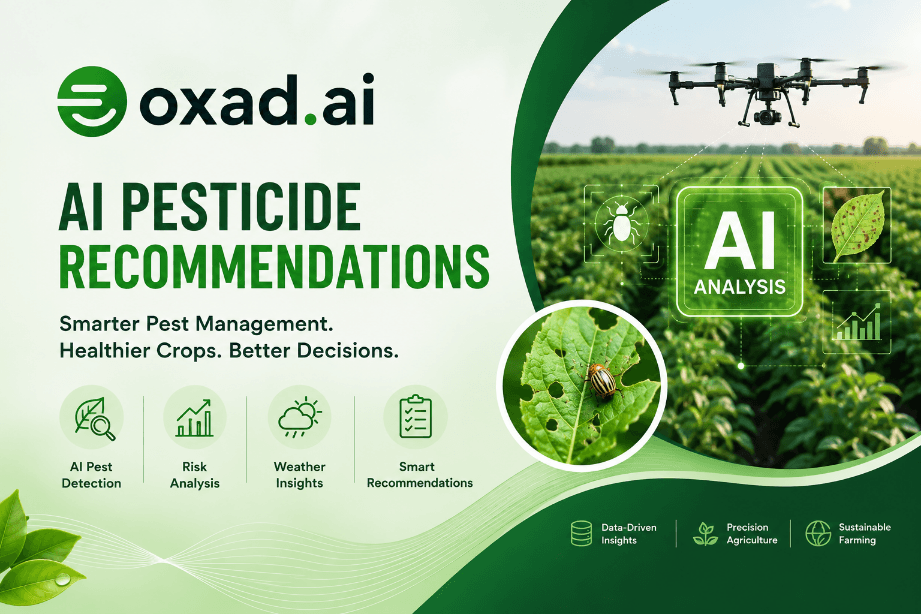
This is where AI pesticide recommendations are becoming increasingly interesting. Artificial intelligence can analyze agricultural data, recognize visual symptoms, identify potential pest threats, monitor field conditions, and help farmers make more informed pest-management decisions.
Important: AI should be used as a decision-support tool rather than as an independent authority for pesticide application. Pesticide decisions should always consider the product label, local regulations, crop requirements, environmental conditions, and qualified agricultural advice.
What Are AI Pesticide Recommendations?
AI pesticide recommendations describe the use of artificial intelligence to support decisions related to crop pests and pest management.
Instead of looking at pesticide selection as an isolated decision, AI can help analyze the wider situation first. It may examine crop type, plant images, weather conditions, field observations, pest history, and other information to determine whether a pest problem is likely and whether further investigation is necessary.
A modern AI system may help with several stages of the process:
Identifying possible pests from images
Detecting early signs of crop damage
Estimating pest risk
Monitoring changing field conditions
Analyzing historical pest activity
Supporting crop scouting
Comparing possible management approaches
Helping farmers organize field observations
The important point is that an AI recommendation does not necessarily mean apply a pesticide. In many situations, the most useful recommendation may be to monitor the field, investigate the cause, improve crop management, or seek expert confirmation.
Why AI Is Useful for Pest Management
Agriculture involves a huge amount of information. Temperature, rainfall, crop development, soil conditions, pest populations, previous treatments, and field history can all influence the outcome.
For a farmer managing a large area, manually connecting all of these factors can be difficult.
AI can help organize and analyze this information much faster. Instead of examining individual data points separately, an AI system can look for patterns that may indicate increasing pest pressure or an emerging crop problem.
Early Detection
AI can help identify potential pest problems before they become widespread.
Better Monitoring
Field observations can be organized and analyzed more consistently.
Reduced Guesswork
Data-driven analysis can support more informed agricultural decisions.
Resource Efficiency
Targeted decision-making may help reduce unnecessary interventions.
AI and Integrated Pest Management
The strongest use of AI in pest management is not simply replacing one pesticide decision with another. It is supporting a broader Integrated Pest Management (IPM) strategy.
IPM considers the pest, the crop, the environment, monitoring information, prevention, and different control options before intervention is selected.
This changes the question from:
“Which pesticide should I use?”
to:
“What is causing the problem, how serious is it, and what is the most appropriate response?”
This distinction makes AI considerably more useful. An intelligent system can help identify when a farmer should investigate a problem rather than immediately recommending chemical treatment.
How AI Can Identify Agricultural Pests
Computer vision is one of the most practical AI technologies being used in agriculture.
A farmer can photograph a leaf, fruit, stem, insect, or damaged section of a crop. An AI model can analyze visual characteristics and compare them with patterns learned from agricultural datasets.
Examples of Visual Information AI Can Analyze
Leaf discoloration
Chewing or feeding damage
Leaf spots
Wilting
Plant deformation
Visible insects
Eggs or larvae
Damage patterns across plant surfaces
This type of analysis can provide a useful first assessment, particularly when access to an agricultural specialist is limited.
Why AI Identification Is Not Always Perfect
A photograph rarely tells the entire story.
Different pests and diseases can produce similar symptoms. Poor lighting, image quality, crop variety, plant growth stage, environmental stress, and nutritional problems can also make visual identification difficult.
For this reason, an AI result should be treated as an initial assessment, not automatically as a confirmed diagnosis.
Best practice: use AI to narrow down possibilities, then verify important findings through field inspection, reliable agricultural references, product labels, or a qualified professional when necessary.
How AI Uses Weather Data
Weather can have a major influence on pest development and crop vulnerability.
Temperature, humidity, rainfall, wind, and other environmental conditions can affect pest populations and the speed at which certain agricultural problems develop.
An AI system can combine weather information with crop and pest observations to identify periods when additional monitoring may be worthwhile.
Data
Possible AI Use
Practical Benefit
Temperature
Identify conditions associated with pest activity
Improved monitoring
Rainfall
Analyze environmental changes
Better field awareness
Humidity
Identify conditions favorable to certain problems
Earlier investigation
Crop Data
Combine crop stage with pest risk
More contextual decisions
AI Pest Risk Prediction
One of the most promising applications is moving from reactive pest control toward predictive pest management.
Instead of waiting until visible damage becomes widespread, AI can analyze historical and current information to identify areas where pest pressure may increase.
This does not mean that AI can predict every pest outbreak accurately. Agricultural environments are complex, and predictions depend heavily on the quality and relevance of the available data.
Nevertheless, even an imperfect early warning can encourage farmers to inspect specific fields or areas more closely.
AI Recommendations Should Start With Monitoring
A responsible AI pest-management workflow should normally begin with observation.
Observe: Identify unusual symptoms or pest activity.
Document: Capture photographs and field information.
Analyze: Use AI to identify possible causes or risks.
Verify: Confirm important findings using reliable sources.
Assess: Determine whether intervention is actually necessary.
Choose: Consider appropriate management options.
Follow the label: If a pesticide is used, follow the current product label and applicable requirements.
Monitor: Evaluate the result and continue observing the crop.
This approach keeps the farmer involved in the decision rather than treating AI as an autonomous agricultural authority.
AI Technologies Behind Modern Pest Management
The most interesting part of AI pesticide recommendations is not the final recommendation itself. It is the technology working behind the scenes to collect, organize, and interpret agricultural information.
Modern agricultural AI can combine images, weather observations, field records, satellite data, sensor readings, and historical information to create a more complete picture of what is happening in a crop.
For farmers, this can turn scattered information into practical insights that are easier to understand and act upon.
Computer Vision for Pest Detection
Computer vision is one of the most widely discussed AI technologies in precision agriculture. It allows software to analyze images and identify visual patterns that may be difficult to detect consistently through manual observation.
In pest management, cameras can capture images of plants, insects, leaves, fruits, stems, and other parts of a crop. AI models can then analyze those images to look for signs associated with particular pests or types of damage.
How Computer Vision Can Help
Detect visible insects
Identify feeding damage
Recognize unusual leaf patterns
Estimate the affected area
Monitor changes over time
Flag plants that require closer inspection
The biggest advantage is scale. A farmer or agronomist may inspect a limited number of plants manually, while cameras and automated systems can potentially examine much larger areas.
AI Image Analysis for Crop Problems
Image-based AI is particularly useful when symptoms are visible but their cause is unclear.
For example, a farmer might notice that leaves are developing unusual spots or that sections of a crop are showing signs of damage. An AI system can analyze the image and provide possible explanations that can then be investigated further.
Human + AI approach: The most reliable workflow is to use AI for rapid screening and pattern recognition, followed by field inspection or expert verification when the decision has significant consequences.
What Makes Agricultural Images Difficult?
Real agricultural environments are rarely as clean as laboratory datasets. Plants can overlap, lighting can change, leaves can be damaged by several causes at the same time, and symptoms can appear differently depending on crop variety and growth stage.
This means that image-based AI should communicate uncertainty rather than presenting every identification as a guaranteed diagnosis.
Satellite Imagery and AI
AI can also work with imagery collected from satellites. Instead of analyzing one plant at a time, satellite imagery can provide information about much larger areas.
Machine-learning systems can examine changes in vegetation patterns and identify areas that may deserve closer attention.
For precision agriculture, this can be useful for detecting differences between fields or sections of the same field.
Technology
What AI Can Analyze
Potential Use
Satellite imagery
Vegetation patterns and field changes
Identify areas for further scouting
Drone imagery
High-resolution crop conditions
Detailed field inspection
Smart cameras
Plants, insects, and visible damage
Continuous monitoring
Field sensors
Environmental conditions
Risk monitoring and alerts
Drone-Based AI Pest Monitoring
Drones add another layer of flexibility because they can collect detailed images from specific areas of a farm.
AI can analyze drone imagery to identify patterns that may not be obvious from ground level. A system might highlight areas where vegetation appears different from surrounding sections, allowing a farmer or agronomist to investigate those locations.
This can support a scout-first approach rather than automatically treating an entire field.
Why Drones Matter
Cover large areas quickly
Capture high-resolution imagery
Monitor difficult-to-reach areas
Track changes over time
Support targeted field scouting
Create visual records for future analysis
Drone imagery can be particularly valuable when combined with historical images. Instead of looking at a single snapshot, AI can compare observations over time and identify developing patterns.
Smart Sensors and Agricultural AI
AI becomes more useful when it receives information from multiple sources.
Field sensors can provide information about environmental conditions, while cameras provide visual information. Weather services can contribute forecasts, and farm-management systems can provide historical records.
Combining these sources can give an AI system more context than any single dataset could provide.
Weather
Temperature, rainfall, humidity, wind, and forecasts.
Field Sensors
Environmental and crop-condition measurements.
Images
Photos, drone imagery, and satellite observations.
Farm Records
Previous observations, treatments, and field history.
Combining Multiple Data Sources
The real potential of agricultural AI appears when different types of information are combined.
Imagine a system receiving a weather forecast, historical pest observations, crop-development information, recent drone imagery, and field sensor readings. Instead of looking at each source independently, AI can analyze them together and identify patterns that may deserve attention.
This is sometimes referred to as data fusion.
Data fusion can help AI move beyond simple image recognition toward broader agricultural decision support.
AI and Pest Forecasting
Pest forecasting attempts to estimate when pest pressure may increase or when environmental conditions could favor a particular problem.
AI models can learn from historical observations and environmental information to identify relationships between conditions and pest activity.
For example, an AI system might identify that particular combinations of weather and crop-development conditions have historically been associated with increased pest observations.
The resulting information can be used to encourage additional scouting or monitoring.
Prediction Is Not Certainty
This distinction is important.
A forecast does not mean that an infestation will definitely occur. It means that the available data suggests a higher or lower level of risk.
Farmers should therefore use AI predictions as signals that guide investigation rather than treating them as guaranteed outcomes.
AI for Field Scouting
Field scouting remains an important part of pest management, even when AI is involved.
The difference is that AI can help make scouting more targeted.
Instead of inspecting every area with the same priority, farmers can potentially use AI-generated risk maps or alerts to identify locations that deserve closer examination.
Without AI Support
With AI Decision Support
Broad field inspection
Risk-based scouting priorities
Manual comparison of records
Automated pattern analysis
Separate weather and field information
Combined data analysis
Reactive investigation
Earlier risk alerts
AI Risk Maps for Agriculture
A risk map can provide a visual representation of where pest or crop problems may be more likely.
These maps can potentially combine satellite imagery, drone observations, sensor readings, historical records, and weather information.
For farmers managing large properties, a visual risk map can be easier to understand than a long list of data points.
However, risk maps should be treated as guidance. A highlighted area still needs appropriate field verification before an important management decision is made.
AI and Precision Agriculture
Precision agriculture aims to manage agricultural resources according to differences within a field rather than assuming every area has identical conditions.
AI fits naturally into this approach because it can analyze large quantities of spatial and temporal data.
For pest management, this may support more targeted scouting and potentially more targeted interventions when intervention is justified.
The broader goal is simple: apply the right management strategy in the right place at the right time, rather than treating every part of a farm identically.
From Data to Decision Support
The most useful agricultural AI systems create a chain between raw information and practical decisions.
Collect data: Gather images, weather information, sensor readings, and field observations.
Process data: Clean and organize the information.
Detect patterns: Use AI to identify unusual conditions or potential risks.
Estimate risk: Determine which areas or situations may deserve attention.
Support scouting: Direct human attention toward relevant locations.
Evaluate options: Consider prevention, biological, cultural, physical, or chemical approaches.
Verify: Confirm important findings before acting.
Monitor results: Continue observing the crop after intervention or management changes.
Why the Human Expert Still Matters
It is easy to imagine that enough data could eventually allow AI to manage pest problems completely automatically. Agriculture is more complicated than that.
Experienced farmers and agronomists understand local conditions that may not appear in a dataset. They can recognize unusual situations, question questionable recommendations, and consider practical factors that an algorithm may not know.
The strongest model is therefore not AI versus agricultural expertise.
It is AI plus agricultural expertise.
A Better Agricultural AI Model
AI analyzes the data.
The farmer observes the field.
The agronomist provides context when needed.
The applicable label and regulations define permitted pesticide use.
How AI Can Support Better Pest-Management Decisions
The real value of AI pesticide recommendations appears when artificial intelligence is used to support the decision-making process rather than simply generate a product name.
A farmer may have several possible responses to a pest problem. The right approach depends on the crop, pest pressure, field conditions, timing, weather, economic impact, local requirements, and the effectiveness of available management options.
AI can help organize these factors and present them in a way that makes the decision easier to evaluate.
AI Does Not Always Mean Using a Pesticide
One of the most important principles in responsible agricultural AI is recognizing that a detected pest does not automatically require chemical treatment.
Some pest populations may remain below economically important levels. In other situations, biological controls, cultural practices, physical methods, sanitation, crop rotation, or improved monitoring may be appropriate.
This is why AI should ideally support an Integrated Pest Management approach.
Management Approach
How AI Can Help
Example Role
Monitoring
Analyze field observations
Identify areas requiring inspection
Biological control
Support pest identification and risk analysis
Help evaluate whether biological strategies may be relevant
Cultural practices
Analyze historical field conditions
Identify recurring patterns
Physical control
Detect affected areas
Support targeted intervention
Chemical control
Support risk assessment and decision-making
Help determine whether further evaluation is warranted
Economic Thresholds and AI
Farmers often need to consider whether a pest problem is significant enough to justify intervention. This is where the concept of an economic threshold becomes important.
The basic idea is that intervention may be justified when the expected economic damage from a pest approaches the cost of controlling it.
AI can potentially help estimate risk by combining information such as pest observations, crop stage, historical data, weather conditions, and expected crop value.
However, thresholds are highly dependent on the crop, pest, region, production system, and economic conditions. AI should therefore not invent a threshold or assume that one threshold applies everywhere.
AI-Based Pest Risk Scoring
A risk score can make complex agricultural information easier to interpret.
For example, an AI platform could classify a field area as:
Low risk: Continue routine monitoring.
Moderate risk: Increase scouting and collect additional information.
High risk: Investigate promptly and evaluate appropriate management options.
A risk score is useful because it gives farmers a starting point for prioritization.
Important: A risk score is not the same thing as a confirmed diagnosis. It indicates that a situation deserves a particular level of attention based on the information available to the system.
AI and Targeted Pest Management
One of the biggest opportunities for AI is reducing unnecessary blanket treatment.
If AI identifies that pest pressure appears concentrated in particular areas, farmers may be able to investigate those areas first instead of assuming the entire field has the same problem.
This approach is closely related to precision agriculture.
The objective is not necessarily to use less treatment in every situation. The objective is to make management more targeted and evidence-based.
Site-Specific Decision Support
Two farms growing the same crop can face very different pest-management challenges.
Differences in climate, soil, crop variety, irrigation, surrounding vegetation, pest history, and management practices can all influence pest pressure.
For this reason, AI systems become more useful when they can incorporate local information rather than relying entirely on generic agricultural advice.
Factor
Why It Matters
Crop variety
Different varieties may respond differently to pests and diseases.
Growth stage
Pest impact can vary throughout crop development.
Weather
Environmental conditions influence pest and disease activity.
Field history
Previous problems can provide useful context.
Location
Pest populations and regulatory requirements vary by region.
Can AI Recommend a Specific Pesticide?
This is where caution becomes especially important.
An AI system may be technically capable of producing a pesticide-related recommendation, but a generic AI answer should not automatically be treated as an authorized agricultural prescription.
A valid pesticide decision can depend on information that a general-purpose AI model may not know or may have misunderstood.
Information That Can Matter
The exact crop
The exact pest
The location
The intended use
The current product label
Application restrictions
Crop-stage requirements
Environmental conditions
Worker and bystander protections
Harvest or other applicable intervals
Resistance-management requirements
Protection of pollinators and beneficial organisms
In the United States, the Environmental Protection Agency explains that pesticide labels provide directions and requirements that must be followed when using registered pesticide products. ([epa.gov](https://www.epa.gov/pesticide-labels/introduction-pesticide-labels?utm_source=chatgpt.com))
Requirements differ between countries and regions, so users should always rely on the applicable authority and current product information for their location.
Why Generic AI Chatbots Can Be Risky for Pesticide Advice
General-purpose AI models are trained to generate useful language, but that does not mean they have access to every current pesticide registration, regional restriction, product label, or local agricultural condition.
They can also misunderstand the user’s crop, pest, location, or intended application.
A confident-sounding answer can therefore be misleading even when it appears technically plausible.
Do Not Treat AI Output as a Pesticide Label
An AI-generated recommendation should never override the current pesticide label, applicable regulations, or qualified agricultural advice. The label and relevant regulatory requirements determine how a registered pesticide may legally be used.
AI for Safer Decision Support
The safest role for AI is often to help users ask better questions.
Instead of saying:
“Use this pesticide.”
a responsible agricultural AI system could help a user determine:
What could be causing the observed symptoms?
What additional information should be collected?
How confident is the identification?
Does the situation require immediate investigation?
What non-chemical management options should be considered?
What information should be verified before selecting a treatment?
This approach makes AI more useful while reducing the risk of treating an uncertain model output as a definitive instruction.
Resistance Management and AI
Pesticide resistance is a major concern in modern agriculture. Repeated reliance on the same mode of action can contribute to selection pressure and reduced effectiveness over time.
AI can potentially support resistance-management planning by organizing historical treatment records and helping professionals identify patterns that deserve attention.
However, resistance-management recommendations should be based on appropriate agricultural guidance and current regional or crop-specific recommendations rather than generated from generic assumptions.
AI and Environmental Considerations
A good pest-management system should consider more than crop protection.
Environmental conditions can influence the potential impact of pest-management activities on surrounding ecosystems, water resources, beneficial insects, and other organisms.
AI can help organize environmental information, but environmental decisions still require appropriate scientific and regulatory context.
Potential Environmental Benefits
More targeted scouting
Better identification of problem areas
Reduced unnecessary interventions
Improved monitoring
Better record keeping
More informed timing decisions
Benefits of AI-Assisted Pest Management
Benefit
How AI Can Contribute
Faster analysis
Processes large amounts of agricultural information quickly.
Earlier alerts
Can identify patterns that deserve investigation.
Targeted scouting
Helps prioritize areas requiring closer inspection.
Better records
Connects current observations with historical information.
Decision support
Helps organize factors that influence pest-management decisions.
Limitations of AI Pesticide Recommendations
AI can be extremely useful, but it is not infallible.
1. Incorrect Identification
An AI model may confuse similar pests, diseases, or environmental damage.
2. Poor Data Quality
Incomplete field records, low-quality images, inaccurate sensor readings, or outdated weather information can reduce reliability.
3. Local Conditions
A recommendation developed from data in one region may not be appropriate for another location.
4. Outdated Information
Pesticide registrations, labels, restrictions, and agricultural recommendations can change. Systems need current information to remain useful.
5. False Confidence
AI can produce an answer that sounds certain even when the underlying evidence is weak. Users should therefore pay attention to uncertainty and verification requirements.
6. Human Oversight
Important agricultural decisions should remain subject to appropriate human judgment and professional oversight.
What Should a Responsible AI Pest Platform Provide?
If you are evaluating an AI tool for agricultural pest management, do not judge it only by whether it can identify a plant from a photograph.
A stronger platform should provide meaningful context around its results.
Feature
Why It Matters
Image analysis
Supports visual identification.
Confidence information
Helps users understand uncertainty.
Weather integration
Adds environmental context.
Field history
Provides historical context.
IPM support
Encourages broader pest-management strategies.
Current information
Reduces the risk of relying on outdated information.
Human verification
Provides an additional layer of decision quality.
What Makes an AI Recommendation Trustworthy?
Trust should not come from the AI’s confidence or the sophistication of its interface.
A trustworthy agricultural AI system should make it clear:
What information it used
What it actually knows
What it is uncertain about
When additional information is needed
When professional verification is recommended
Where regulatory information comes from
When its information was last updated
This level of transparency is particularly important when AI is used for decisions that can affect crops, workers, consumers, or the environment.
How to Choose an AI Tool for Pest Management
Choosing an AI system for agricultural pest management should not be based on impressive screenshots or a simple claim that the tool can “identify pests.” The important question is whether the technology can provide useful, understandable, and appropriately cautious decision support in the conditions where it will actually be used.
Before adopting an AI pesticide recommendation platform, farmers and agricultural professionals should consider the quality of its data, the crops and pests it supports, how it handles uncertainty, whether it integrates local information, and how easily its results can be verified.
1. Check What the AI Actually Does
Not every agricultural AI tool provides the same capabilities. Some focus on image recognition, while others concentrate on weather forecasting, crop monitoring, farm records, or pest-risk analysis.
Start by identifying the specific problem you want the technology to solve.
Do you need help identifying insects?
Do you want to analyze plant images?
Do you need pest-risk alerts?
Do you want to monitor large fields?
Do you need weather-based agricultural insights?
Do you want better scouting records?
Do you need a broader farm-management platform?
A focused tool can sometimes be more useful than a platform that promises to solve every agricultural problem.
How to Evaluate an AI Pest-Management Platform
Evaluation Area
Questions to Ask
Why It Matters
Accuracy
How reliable are the identifications?
Incorrect identification can lead to poor decisions.
Coverage
Which crops, pests, and regions are supported?
Agricultural conditions vary significantly.
Data quality
What information does the system use?
Better context can improve decision support.
Transparency
Does the platform explain its results?
Users need to understand uncertainty.
Updates
How frequently is agricultural information updated?
Outdated information can reduce reliability.
Privacy
How are farm images and data handled?
Farm data can be commercially sensitive.
AI Pest Management for Small Farms
Small farms can benefit from AI without necessarily installing a complex precision-agriculture system.
A smartphone-based crop identification or monitoring tool can provide a practical starting point. Farmers can photograph suspicious symptoms, organize observations, and use AI to identify possibilities that deserve further investigation.
The key is to keep the workflow simple.
A useful small-farm system should reduce administrative work rather than create another complicated platform that requires constant data entry.
Practical Small-Farm Workflow
Photograph the affected crop.
Record the field and crop information.
Use AI to identify possible causes.
Compare the result with reliable agricultural information.
Inspect the affected area directly.
Determine whether action is necessary.
Document the final decision.
Continue monitoring the crop.
AI Pest Management for Large Farms
Large agricultural operations have different needs. The amount of information can become difficult to manage manually, particularly when thousands of acres are involved.
AI can potentially connect:
Satellite imagery
Drone imagery
Weather stations
Field sensors
GPS information
Crop-management records
Scouting observations
Historical pest data
When these systems work together, AI can help create field-level or zone-level risk information that supports more targeted scouting.
AI in Greenhouse Pest Management
Greenhouses provide another interesting environment for agricultural AI because many environmental variables can be monitored continuously.
Temperature, humidity, irrigation, lighting, crop growth, and pest observations can be collected through sensors and cameras.
AI can then analyze these inputs to identify unusual patterns or conditions that deserve attention.
Because greenhouse environments are relatively controlled, AI systems may have access to more consistent data than they would in open-field agriculture.
AI and Sustainable Pest Management
The long-term value of AI should not be measured by how many pesticide applications it can generate.
A better measure is whether AI helps farmers protect crops while using resources more intelligently and reducing unnecessary risks.
AI-supported monitoring can contribute to sustainability when it helps identify problems early, supports targeted scouting, and encourages decisions based on actual field conditions.
A More Sustainable Goal
Better information → better monitoring → better decisions → more targeted management.
The objective is not simply to use less pesticide in every situation. It is to use pest-management strategies more intelligently and only when justified.
Environmental Considerations
Pest-management decisions can affect more than the crop being protected.
Depending on the product and circumstances, pesticide use can have implications for non-target organisms, water resources, beneficial insects, workers, and surrounding ecosystems.
This is another reason AI recommendations should include broader context rather than focusing only on pest elimination.
An AI system can help organize environmental information, but it should not be assumed to know every local ecological or regulatory requirement.
Privacy and Agricultural Data
AI-powered agriculture increasingly depends on data. That data can include field maps, crop images, production records, sensor readings, equipment information, and historical management practices.
Farmers should therefore understand how an AI platform handles their information.
Questions to Ask About Data Privacy
Who owns uploaded field data?
Where is the data stored?
Is farm information used to train AI models?
Can users delete their data?
Is data shared with third parties?
Can employees control access to farm information?
What happens to data if the service is discontinued?
For commercial farms, these questions can be just as important as model accuracy.
Human Oversight Is Essential
AI can process information extremely quickly, but speed should not be confused with correctness.
A farmer or agronomist can notice details that are missing from the dataset. They can question an unusual result, recognize local conditions, and decide when additional investigation is necessary.
For high-impact decisions, the strongest workflow combines automation with human review.
AI Can Help With
Human Expertise Remains Important For
Processing large datasets
Understanding local field conditions
Image analysis
Confirming uncertain diagnoses
Risk prediction
Deciding whether intervention is justified
Pattern recognition
Evaluating practical agricultural constraints
Record organization
Final responsibility for management decisions
Best Practices for Using AI Pesticide Recommendations
AI can be extremely useful when it is incorporated into a disciplined agricultural workflow.
Use AI as a Second Opinion
Do not automatically accept an AI identification or recommendation. Use it to generate possibilities and questions that can then be verified.
Provide Better Context
The more relevant information the system has, the more useful its analysis can potentially become. Include the crop, location, growth stage, symptoms, images, and relevant field observations when the platform supports them.
Check the Date of the Information
Agricultural information can change. Verify that important recommendations and regulatory information are current.
Verify Pesticide Information
If a pesticide is being considered, consult the current product label and the applicable regulatory requirements before use. The label is the authoritative source for permitted use conditions.
Keep Monitoring
AI should not end the decision process. Continue monitoring the crop to determine whether the situation is improving, worsening, or changing.
Common Mistakes When Using AI for Pest Management
Trusting a single image: One photograph may not provide enough information.
Ignoring local conditions: Agricultural conditions vary by location.
Skipping field inspection: AI should not replace appropriate scouting.
Using outdated information: Regulations and product information can change.
Assuming confidence means accuracy: A confident response can still be incorrect.
Ignoring non-chemical options: Pest management should consider the wider IPM strategy.
Skipping documentation: Historical records can improve future decisions.
The Future of AI Pesticide Recommendations
The future of agricultural AI is likely to be less about one standalone chatbot and more about connected systems.
Imagine a farm where cameras monitor crops, weather stations continuously collect environmental data, drones survey selected areas, satellite imagery provides a broader field view, and farm-management software stores historical information.
An AI system could potentially connect these sources and provide alerts when something unusual appears.
The farmer would still remain in control, but instead of manually searching through thousands of data points, the farmer could focus attention on the situations that matter most.
Where AI Could Go Next
Several developments could make agricultural AI increasingly useful:
More accurate pest recognition
Better crop-specific models
Improved weather and pest forecasting
Real-time field monitoring
More advanced drone analysis
Integration with farm-management platforms
Improved explainability
Better regional agricultural datasets
More transparent uncertainty estimates
Stronger integration with IPM workflows
The most valuable systems will likely be those that combine technological capability with agricultural knowledge instead of treating AI as a replacement for expertise.
Frequently Asked Questions About AI Pesticide Recommendations
What are AI pesticide recommendations?
They are AI-supported insights that use agricultural data to help assess pest problems and support pest-management decisions. They should not automatically be treated as pesticide prescriptions.
Can AI identify crop pests from photographs?
Yes, computer-vision systems can analyze crop and insect images and identify possible pests or damage patterns. Results should be verified when the decision is important.
Can AI predict pest outbreaks?
AI can analyze historical observations, weather conditions, crop information, and other data to estimate pest risk. Predictions are not guarantees and should support monitoring rather than replace it.
Can AI recommend pesticides?
Some agricultural systems may provide treatment-related recommendations, but users should verify any pesticide information against the current product label, applicable regulations, and appropriate agricultural expertise.
Is AI a replacement for an agronomist?
No. AI can process information and provide decision support, while agricultural professionals can provide context, field experience, diagnosis, and appropriate management judgment.
Can AI reduce pesticide use?
AI may help reduce unnecessary interventions by improving monitoring, identifying areas that require attention, and supporting more targeted pest-management decisions. Actual results depend on the technology and farming system.
What data does agricultural AI use?
Depending on the platform, it may use crop images, weather data, field observations, sensor information, satellite imagery, drone imagery, and historical farm records.
Is AI pest detection always accurate?
No. Accuracy can vary according to image quality, crop type, pest species, environmental conditions, training data, and the specific AI model.
Final Checklist Before Acting on an AI Recommendation
Question
Check
Has the pest or problem been properly identified?
✓
Is the level of pest pressure known?
✓
Have non-chemical management options been considered?
✓
Is the information current and appropriate for the location?
✓
Has pesticide information been verified against the current label?
✓
Have applicable regulations and safety requirements been checked?
✓
Is professional advice needed?
✓
Conclusion
AI pesticide recommendations are best understood as part of a larger agricultural decision-support system.
The technology can help farmers identify potential pests, analyze images, monitor field conditions, interpret weather data, prioritize scouting, recognize patterns, and organize large amounts of agricultural information.
But the strongest use of AI is not simply asking a machine which pesticide to apply. It is using AI to understand the problem better before deciding how to respond.
When combined with Integrated Pest Management, field observation, reliable agricultural information, current pesticide labels, regulatory requirements, and human expertise, AI can become a valuable tool for more informed and targeted pest management.
The future of agricultural AI should therefore focus on better decisions, better monitoring, and more responsible resource use rather than replacing farmers or agricultural professionals with automated recommendations.
AI Can Support the Decision — People Remain Responsible for the Decision
Use artificial intelligence to analyze information, identify patterns, and prioritize attention. Verify important findings and follow current agricultural, safety, and regulatory requirements before taking action.
Key Takeaways
AI can support pest identification and crop monitoring.
Computer vision can analyze images of plants and insects.
Weather and field data can improve pest-risk analysis.
AI can help prioritize agricultural scouting.
Integrated Pest Management should remain central to responsible pest management.
AI recommendations should not replace current pesticide labels or applicable regulations.
Human verification remains important for consequential decisions.
The greatest opportunity is more targeted and informed pest management.