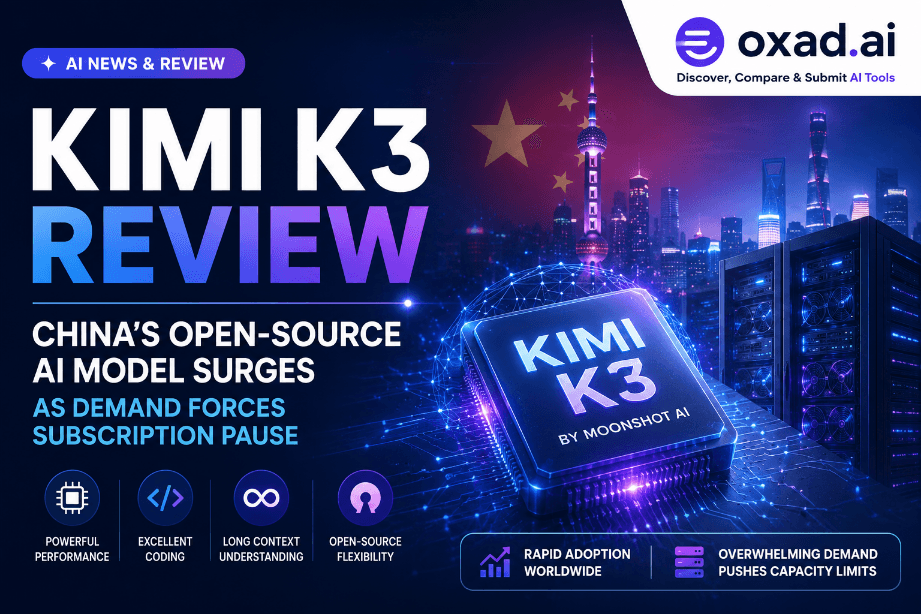
Kimi K3 Review: China’s AI Model Surges in Popularity as Demand Forces Subscription Pause
AI Industry News & Analysis
Moonshot AI’s latest open-source model, Kimi K3, has become one of the most talked-about AI releases of 2026. Within days of launch, overwhelming global demand pushed the company’s computing infrastructure close to capacity, forcing a temporary pause on new subscriptions.
This in-depth review explores what Kimi K3 offers, why developers are paying attention, how it compares with OpenAI, Anthropic, Google, and DeepSeek, and what its rapid adoption means for the future of open-source artificial intelligence.
Developer
Moonshot AI
Category
Large Language Model (LLM)
Reading Time
13 Minutes
Editorial Summary
Kimi K3 is one of the largest open-source AI models released to date and represents another milestone in China’s rapidly expanding AI ecosystem. Rather than simply reporting breaking news, this review examines the model’s capabilities, industry impact, adoption challenges, and competitive position within today’s rapidly evolving AI landscape.
Key Takeaways
Kimi K3 reached capacity only days after its public launch.
Moonshot AI temporarily paused new subscriptions while expanding infrastructure.
The model is designed as an advanced open-source competitor to leading proprietary AI systems.
Kimi K3 highlights the accelerating pace of China’s AI innovation.
Growing demand demonstrates increasing global interest in open-source frontier AI models.
What Is Kimi K3?
Kimi K3 is the latest flagship large language model developed by Moonshot AI, a Beijing-based artificial intelligence company focused on advanced generative AI technologies. Designed as an open-source foundation model, Kimi K3 aims to compete with many of today’s leading AI systems while giving developers greater flexibility to customize and deploy the model within their own applications.
Unlike closed commercial platforms, open-source models allow researchers and organizations to inspect model architectures, fine-tune them for specialized tasks, and integrate them into private infrastructure. This approach has become increasingly popular among enterprises seeking more control over security, deployment, and operating costs.
Following its public release, Kimi K3 attracted immediate attention across the AI community due to its reported scale, strong coding performance, and rapid adoption by developers worldwide.
Why This Matters
Kimi K3 demonstrates how China’s AI industry continues narrowing the technology gap with leading Western AI laboratories. The model reflects growing investment in open-source AI development while expanding competition across the global AI market.
Why Kimi K3 Is Making Headlines
Only a short time after becoming publicly available, Kimi K3 experienced an unexpected surge in user demand. According to Moonshot AI, interest during the first two days significantly exceeded internal expectations, pushing available computing resources close to maximum capacity.
Rather than allowing service quality to deteriorate, the company temporarily paused new paid subscriptions while prioritizing existing users and expanding GPU infrastructure. The decision illustrates one of the biggest operational challenges facing modern AI companies: serving millions of users requires enormous computational resources, networking capacity, and continuous hardware investment.
Although temporary subscription pauses are uncommon, they are not unprecedented in the AI industry following high-profile product launches. Similar spikes in demand have accompanied several major model releases over the past two years.
Who Is Moonshot AI?
Founded in Beijing, Moonshot AI is among China’s fastest-growing artificial intelligence startups. The company focuses on developing advanced language models capable of reasoning, coding, document understanding, multilingual communication, and enterprise AI applications.
Moonshot has increasingly positioned itself as one of China’s leading frontier AI companies alongside organizations such as DeepSeek, Alibaba, Zhipu AI, and Baidu. Its strategy emphasizes high-performance models combined with open access for developers, encouraging innovation across research institutions, startups, and enterprise software providers.
With the release of Kimi K3, Moonshot AI has significantly expanded its international visibility, drawing attention from developers, investors, and technology analysts interested in the rapidly evolving global AI landscape.
Why Were New Subscriptions Paused?
The temporary suspension of new subscriptions was not caused by software instability or technical failures within the model itself. Instead, it resulted from exceptional demand that exceeded the company’s available computing capacity.
Running a frontier AI model requires thousands of powerful GPUs working together to process user requests in real time. As millions of prompts arrive simultaneously, infrastructure requirements grow rapidly, making compute availability one of the most valuable resources for AI companies today.
Moonshot AI announced that existing subscribers would continue receiving service while engineers added new compute capacity before reopening registrations in stages.
Expert Insight
Rapid adoption is generally viewed as a positive indicator for a newly released AI model. While temporary capacity limits may inconvenience prospective users, they often reflect stronger-than-expected market demand rather than weaknesses in the underlying technology.
Continue to Part 2 → Kimi K3 Features, Performance Benchmarks, Open-Source Strategy, Competitive Comparison, and What This Means for the Global AI Industry.
Key Features of Kimi K3
Kimi K3 has attracted significant attention not only because of its rapid adoption but also because of the ambitious capabilities Moonshot AI aims to deliver through its latest foundation model. The platform is designed to handle a broad range of professional tasks, including software development, technical writing, research, multilingual communication, and AI-powered automation.
Unlike many traditional chatbots, Kimi K3 is built as a general-purpose large language model that developers can integrate into applications, enterprise systems, and custom AI workflows. Its open-source approach also allows organizations to adapt the model for specialized industries without relying entirely on proprietary cloud services.
Core Features
Advanced natural language understanding.
Large-context document analysis.
Code generation and debugging assistance.
Multilingual conversation support.
Reasoning for complex tasks.
API integration for enterprise applications.
Open-source deployment and customization.
Developer-friendly architecture.
Performance & Early Benchmarks
Although benchmark scores represent only one aspect of AI performance, early evaluations suggest that Kimi K3 competes with many of today’s leading language models across reasoning, coding, and agent-oriented tasks.
Industry analysts have noted particularly strong results in programming-related workloads, document understanding, and long-context reasoning. These areas have become increasingly important as businesses deploy AI beyond simple chatbot interactions into software engineering, research, and workflow automation.
Real-world performance will ultimately depend on prompt quality, deployment configuration, and workload requirements. Nevertheless, Kimi K3’s early results indicate that China’s frontier AI ecosystem continues making rapid progress.
Editorial Note
Independent benchmarks provide useful comparisons, but production deployments should always include real-world testing. Factors such as latency, stability, infrastructure costs, and integration quality often matter more than benchmark rankings alone.
The Importance of Open Source
One of Kimi K3’s defining characteristics is its open-source strategy. Unlike closed commercial AI platforms, open-source models enable developers to inspect model behavior, build custom applications, fine-tune performance, and deploy AI within private environments.
For enterprises, this flexibility can improve data governance while reducing dependence on a single cloud provider. Organizations operating in finance, healthcare, government, or regulated industries often prefer solutions that offer greater control over infrastructure and security.
The growing popularity of open-source AI has also accelerated innovation, allowing researchers and software developers worldwide to collaborate on improving models, creating specialized tools, and expanding AI adoption across multiple industries.
Why Open Source Matters
Greater deployment flexibility.
Custom fine-tuning for specific industries.
Improved transparency.
Reduced vendor lock-in.
Faster community-driven innovation.
Kimi K3 vs Leading AI Models
Rather than replacing every competing AI platform, Kimi K3 enters an increasingly competitive landscape where different models excel in different areas. OpenAI, Anthropic, Google, DeepSeek, Alibaba, and Moonshot AI all pursue slightly different strategies regarding openness, enterprise deployment, reasoning quality, and developer experience.
Model
Primary Strength
Best For
Kimi K3
Open-source flexibility and large-scale reasoning
Developers, enterprises, researchers
ChatGPT 5.6
Balanced reasoning, coding, productivity
General users and businesses
Claude
Long-context analysis and writing
Research and enterprise workflows
Gemini
Google ecosystem integration
Workspace productivity
DeepSeek
Efficient open-source reasoning
Developers and AI research
Rather than declaring a single winner, the most suitable AI model depends on the user’s priorities. Organizations focused on open-source deployment may prefer Kimi K3 or DeepSeek, while teams invested in commercial ecosystems may continue choosing OpenAI, Anthropic, or Google depending on their workflow requirements.
What the Subscription Pause Means for the AI Industry
Kimi K3’s temporary subscription pause highlights one of the defining challenges of modern artificial intelligence: infrastructure scalability. Building a frontier model is only the first step. Delivering fast, reliable responses to millions of users requires vast investments in GPU clusters, networking, storage, and energy.
As AI adoption accelerates worldwide, compute capacity has become one of the industry’s most valuable competitive advantages. Companies capable of expanding infrastructure quickly will be better positioned to support growing demand and maintain consistent service quality during major product launches.
The rapid interest surrounding Kimi K3 also reflects the increasing global influence of Chinese AI companies. With organizations such as Moonshot AI, DeepSeek, Alibaba, and Zhipu AI releasing increasingly capable models, competition within the international AI ecosystem is expected to intensify over the coming years.
Expert Perspective
The story behind Kimi K3 is not simply about one model reaching capacity. It illustrates how rapidly demand for advanced AI continues to grow and how infrastructure investment has become just as important as model quality in determining long-term success.
Continue to Part 3 → Pros & Cons, Who Should Use Kimi K3, Global AI Competition, FAQ, Final Verdict, Related Guides, and Editorial Methodology.
Pros & Cons of Kimi K3
Kimi K3 represents one of the most ambitious open-source AI releases of 2026. Its rapid adoption demonstrates strong interest from developers and businesses seeking alternatives to proprietary AI platforms. However, like every frontier model, it also has limitations that potential users should consider before deploying it in production environments.
Advantages
Powerful open-source large language model.
Strong coding and software development capabilities.
Designed for enterprise deployment.
Excellent multilingual support.
Flexible API integration.
Supports research and custom fine-tuning.
Growing international developer community.
Competitive with many leading frontier AI models.
Limitations
Temporary subscription restrictions following launch.
Independent long-term benchmark data is still evolving.
Organizations should evaluate security and compliance requirements before deployment.
Who Should Use Kimi K3?
Kimi K3 is designed primarily for developers, researchers, enterprises, and organizations that value flexibility and control over their AI infrastructure. While casual users may appreciate its conversational abilities, its greatest strengths become apparent in technical and professional environments where customization and scalability matter.
User
Recommendation
Software Developers
★★★★★ Excellent choice for coding and AI integration.
Research Teams
★★★★★ Strong candidate for experimentation and model customization.
Enterprise Organizations
★★★★★ Suitable for organizations requiring greater deployment flexibility.
Students & Casual Users
★★★★☆ Useful, although commercial AI assistants may offer a more polished experience.
The Bigger Picture: China’s Expanding AI Ecosystem
Kimi K3 is more than another language model—it reflects the rapid evolution of China’s artificial intelligence industry. Over the past two years, Chinese companies have accelerated development of advanced open-source AI systems capable of competing with established Western models across coding, reasoning, multilingual communication, and enterprise automation.
Companies including Moonshot AI, DeepSeek, Alibaba, Zhipu AI, and Baidu are investing heavily in next-generation AI infrastructure while embracing open-source development strategies that encourage adoption beyond domestic markets.
As these models continue improving, organizations worldwide will likely benefit from greater competition, increased innovation, and a broader range of AI deployment options.
Our Verdict
Kimi K3 has quickly established itself as one of the most significant open-source AI releases of 2026. Its rapid adoption demonstrates strong global demand for powerful, flexible language models that can be deployed beyond proprietary ecosystems. Although temporary capacity constraints slowed new subscriptions, they also highlight the growing appetite for advanced AI solutions. If Moonshot AI continues expanding infrastructure while maintaining strong technical performance, Kimi K3 could become one of the most influential open-source AI platforms in the coming years.
Frequently Asked Questions
What is Kimi K3?
Kimi K3 is an open-source large language model developed by Beijing-based Moonshot AI. It is designed for reasoning, coding, research, multilingual communication, and enterprise AI applications.
Why did Moonshot AI stop accepting new subscriptions?
The company temporarily paused new subscriptions after demand exceeded its available computing capacity. Existing users continued receiving service while Moonshot AI expanded its infrastructure.
Is Kimi K3 open source?
Yes. Kimi K3 is released as an open-source model, allowing developers and organizations to inspect, customize, and deploy it according to their own requirements.
Can Kimi K3 compete with ChatGPT and Claude?
Early benchmark results suggest Kimi K3 performs competitively across several technical tasks. However, the best model depends on the intended workload, deployment strategy, ecosystem integration, and business requirements.
Who should consider using Kimi K3?
Developers, research teams, AI startups, and enterprises seeking open-source deployment flexibility are likely to benefit the most from Kimi K3.
Stay informed with independent reviews, comparisons, and expert analysis of the latest AI tools and large language models.
Editorial Methodology
This article was researched and written by the Oxad.ai Editorial Team. Our reviews combine official product documentation, publicly available technical information, benchmark data, and independent editorial analysis. Rather than relying solely on marketing materials, we evaluate AI models based on practical capabilities, developer value, deployment flexibility, and long-term industry relevance.
Because artificial intelligence evolves rapidly, product features, pricing, infrastructure, and availability may change over time. Readers should consult official documentation before making technical or business decisions based on newly released AI models.
How We Evaluate AI Models at Oxad.ai
At Oxad.ai, every AI model is reviewed using a consistent editorial methodology designed to evaluate practical performance rather than marketing claims alone. Our reviews consider real-world usability, developer experience, enterprise readiness, and long-term value.
Instead of relying exclusively on benchmark rankings, we analyze how AI models perform across common professional workflows, including coding assistance, research, writing, reasoning, automation, multilingual communication, and business productivity.
Programming assistance, debugging, documentation and code quality
Enterprise Readiness
Deployment flexibility, scalability, API support and integrations
Ease of Use
User experience, documentation and accessibility
Value
Pricing, licensing, infrastructure requirements and overall ROI
What Kimi K3 Means for the Future of AI
Kimi K3 demonstrates that competition in artificial intelligence is no longer limited to a handful of Western technology companies. Chinese AI developers are rapidly expanding both research capabilities and open-source innovation, giving developers around the world access to increasingly capable foundation models.
The temporary subscription pause highlights another important reality: future AI leadership will depend not only on model intelligence but also on the ability to build and operate massive computing infrastructure. As demand continues to grow, investment in GPUs, networking, energy, and cloud platforms will become just as critical as advances in machine learning.
For developers and businesses, this increasing competition is ultimately positive. More capable AI models, diverse deployment options, and faster innovation cycles are likely to improve performance while driving down costs across the industry.
Stay Updated with Oxad.ai
The AI landscape evolves rapidly. At Oxad.ai, we continuously publish independent reviews, breaking AI news, detailed comparisons, and practical buying guides to help developers, businesses, creators, and students discover the best AI tools for every use case. Check back regularly as we update this article with new benchmarks, feature releases, and industry developments.