Disclosure: This review may contain affiliate links. If you purchase a service through one of these links, OXAD.AI may earn a commission at no additional cost to you. Our review focuses on the product’s documented capabilities, pricing, use cases, strengths, and limitations.
If you are building an AI agent, one of the biggest challenges is not choosing a language model. It is giving that model reliable context.
AI applications increasingly need to understand websites, companies, products, people, brands, documentation, and other information available on the web. Building that infrastructure from scratch can require scraping systems, browser rendering, data extraction, entity resolution, enrichment APIs, image services, and continuous maintenance.
Context.dev takes a different approach. Instead of treating web scraping as an isolated feature, the platform positions itself as an infrastructure layer for structured web data that AI agents and AI-native applications can consume through APIs.
In this Context.dev review, we examine what the platform does, its most important features, pricing, practical use cases, strengths, limitations, alternatives, and the types of AI applications that can benefit most from it.
Context.dev is an API platform designed to turn information from the web into structured data that applications and AI agents can use.
The platform combines several capabilities under one API ecosystem, including web scraping, website crawling, structured extraction, brand intelligence, entity enrichment, product extraction, news search, people enrichment, and logo delivery.
Its underlying idea is straightforward: developers should be able to provide a domain or other entity reference and receive structured information without having to build an entire web-data infrastructure themselves.
According to its documentation, Context.dev turns raw internet content into structured, AI-ready knowledge and is designed for AI agents, workflows, and LLM-powered products.
A developer sends information such as a website domain, URL, email address, company identifier, or other supported entity reference to an endpoint. Context.dev processes the request and returns structured information that can then be used by the developer’s application.
This makes the platform fundamentally different from a typical consumer AI assistant.
You are not primarily visiting Context.dev to chat with an AI. Instead, you are using its infrastructure to give another application better information.
A simplified architecture might look like this:
Your AI agent receives a company or website reference.
Context.dev retrieves relevant information.
The API returns structured data.
Your application processes the response.
The AI model uses that information as context.
This approach is particularly useful for applications where the AI needs structured information rather than another generic text response.
Context.dev provides web extraction capabilities that allow developers to retrieve content from websites through an API.
One of the attractive aspects of the platform is its focus on returning information that can be consumed directly by applications rather than forcing developers to maintain their own scraping stack.
The API supports Markdown and HTML scraping, screenshots, sitemap crawling, and other extraction workflows.
Standard Markdown and HTML scraping requests currently cost one credit, while browser actions can change the credit cost depending on the request.
Website Crawling
Scraping a single page is useful, but many AI applications need information from an entire website.
Context.dev supports website crawling, allowing developers to process multiple pages as part of a larger data workflow.
This can be useful for applications that need to build knowledge bases from documentation, product websites, company pages, or other structured web sources.
Structured Extraction
One of Context.dev’s most important capabilities is structured extraction.
Instead of simply returning a large block of page text, developers can define the type of information they want to extract and receive structured output that fits an application-defined schema.
For example, an application could extract:
Product names
Product descriptions
Pricing information
Features
Company information
Contact information
Business categories
Other structured fields
This is particularly valuable for AI applications because structured data is easier to validate, store, compare, and pass into downstream workflows.
Brand Intelligence
Brand Intelligence is one of the areas where Context.dev goes beyond ordinary web scraping.
The platform can resolve a domain into structured company information and return details such as company name, industry, slogan, location, social profiles, logos, colors, fonts, and other firmographic information.
This can be useful for applications that need to understand companies rather than simply read their websites.
For example, a sales application could enrich a company record, while an AI research agent could use structured company information as part of a larger research workflow.
Context.dev describes this capability as resolving domains, emails, tickers, and other company references into typed business information.
Logo Link
Logo Link is another distinctive feature.
Instead of requiring developers to maintain their own logo database or make a separate API request for every company logo, Context.dev provides a direct image URL based on a domain.
This can be particularly convenient for interfaces that display company information.
For example, an application can use a direct image URL rather than downloading and storing every logo itself.
Logo Link also has a separate quota from the main API credit system.
Product Extraction
Context.dev also provides structured product extraction capabilities.
This can help applications identify and structure product information found on websites rather than treating every page as unstructured text.
For ecommerce applications, shopping assistants, market research systems, and product intelligence tools, this can be more useful than basic HTML scraping.
News Search
The platform includes a news search capability designed to retrieve current and historical company news.
This opens the door to applications that need to combine company information with recent events.
For example, an AI research system could identify a company, retrieve its structured profile, and then search for relevant news as part of the same broader workflow.
People Enrichment
Context.dev also provides people enrichment capabilities.
This allows applications to enrich information about individuals using supported identifiers and references.
For sales intelligence, research, recruiting, and other business applications, this can reduce the number of separate enrichment services required by an application.
Context.dev for AI Agents
AI agents need more than a language model.
They need access to tools, information, and external systems.
Context.dev can act as one of the information layers behind an agent.
Imagine an AI sales agent receiving the name of an unfamiliar company. Instead of relying on the model’s existing knowledge, the agent could retrieve structured company information from Context.dev and use that information to produce a more relevant response.
Another agent could receive a website URL, crawl relevant pages, extract specific information, and then use the results as context for a task.
This makes Context.dev particularly interesting for developers building AI-native products rather than standalone chatbots.
Context.dev for RAG
Retrieval-Augmented Generation depends heavily on the quality of the information being retrieved.
A RAG system can have an excellent language model and still produce poor results if its retrieval layer contains incomplete, outdated, or poorly structured information.
Context.dev can contribute to the ingestion and retrieval pipeline by turning web pages into cleaner, application-ready information.
A typical workflow could look like this:
Identify a website or source.
Scrape or crawl relevant pages.
Convert the content into a usable format.
Extract structured information when necessary.
Store or index the results.
Retrieve relevant information during an AI interaction.
Pass the retrieved context to the language model.
The important distinction is that Context.dev is not itself a complete RAG application. It is infrastructure that can support the data layer of a RAG architecture.
Context.dev Use Cases
AI Research Agents
Research agents can use structured web information to investigate companies, products, websites, and current events.
Company Enrichment
Business applications can transform a domain into structured company information without manually researching every organization.
Sales Intelligence
Sales platforms can enrich company records with firmographic, brand, website, and other contextual information.
AI Search
AI search applications can use web extraction and structured information as part of their retrieval infrastructure.
RAG Knowledge Bases
Developers can crawl websites and prepare content for knowledge bases and retrieval systems.
Ecommerce Applications
Product extraction can help applications understand products and their associated information.
Lead Enrichment
Applications can combine company and people information to enrich leads and prospects.
AI-Powered Onboarding
An application could ask for a company website and automatically populate parts of a business profile using structured information from that domain.
Company Research
Analysts and research applications can combine brand intelligence, web content, product information, and news to create richer company profiles.
Context.dev Pricing
Context.dev currently offers a free tier and several paid plans. The pricing model is based primarily on API credits, with different operations consuming different numbers of credits.
Plan
Monthly Credits
Starting Price
Best For
Free
500
$0
Testing and prototypes
Developer
10,000
$25/month
First production workflows
Pro
200,000
$149/month
Production applications
Scale
1,000,000
$499/month
High-volume applications
Enterprise
2M+ available
Custom
Large teams and custom requirements
The free plan currently includes 500 API credits per month without requiring a credit card. Context.dev also provides 10,000 one-time Logo Link requests separately from the API credit balance.
Paid plans include Developer at $25 per month, Pro at $149 per month, and Scale at $499 per month. Enterprise plans are available for organizations requiring higher volumes, custom limits, security features, or procurement support.
Context.dev uses different credit costs for different operations. A standard page scrape costs one credit, while more advanced operations such as structured extraction and some enrichment operations consume more credits.
Because API pricing can change, developers should verify the current pricing before making a purchasing decision.
Is Context.dev Free?
Yes. Context.dev currently offers a free plan with 500 API credits per month.
This is enough to experiment with standard scraping and test how the API behaves with a real project. The company recently announced the return of its free tier, specifically positioning it for weekend projects, agent prototypes, and company-enrichment experiments.
For serious production workloads, however, developers will likely need a paid plan because the free allocation is designed primarily for testing and experimentation.
Context.dev Pros
API-first architecture designed for developers.
Combines web extraction and structured data capabilities.
Strong focus on AI agents and AI-native applications.
Useful brand intelligence features.
Structured extraction can reduce custom parsing work.
Includes product and entity enrichment capabilities.
Provides a free tier for experimentation.
Logo Link simplifies company-logo integration.
Supports multiple programming languages through official SDKs.
Paid plans scale to high-volume API usage.
Context.dev Cons
Primarily designed for developers rather than casual users.
Large production workloads can become expensive.
Credit consumption varies by endpoint.
Users still need to build their own application around the API.
It is not a complete AI agent platform.
It is not a complete RAG platform.
Some advanced enrichment operations consume significantly more credits than basic scraping.
Context.dev vs Firecrawl
Firecrawl and Context.dev overlap in web data extraction, but their positioning is not identical.
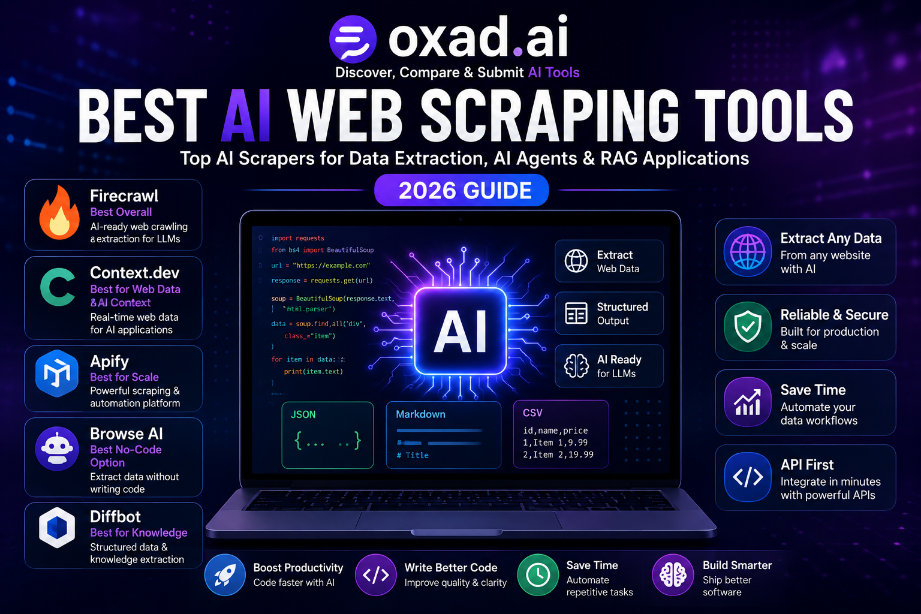
Firecrawl places strong emphasis on crawling, scraping, search, browser interaction, and web data for AI applications. Context.dev combines web extraction with structured company, brand, product, people, and entity intelligence.
Capability
Context.dev
Firecrawl
Web scraping
Yes
Yes
Website crawling
Yes
Yes
Structured extraction
Strong
Strong
Brand intelligence
Strong
Less central
People enrichment
Yes
Not a primary focus
Browser interaction
Available through supported extraction workflows
Strong focus
Company enrichment
Core capability
Not the primary focus
If the primary objective is crawling and extracting web content for an AI pipeline, Firecrawl is a strong competitor. If the application needs structured company and entity intelligence in addition to web data, Context.dev becomes particularly interesting.
Context.dev Alternatives
Firecrawl
Firecrawl is one of the most relevant alternatives for developers who primarily need web crawling, scraping, search, and AI-ready web content.
It can be a better fit when web extraction itself is the central requirement.
Other Web Data APIs
Developers can also choose specialized scraping APIs, browser automation platforms, search APIs, or build their own extraction infrastructure.
The advantage of Context.dev is consolidation. Instead of integrating separate services for company data, web extraction, product information, people enrichment, and logos, developers can potentially cover several requirements through one ecosystem.
Who Should Use Context.dev?
Context.dev is especially relevant for:
AI agent developers
AI startup teams
RAG developers
Sales intelligence platforms
Market research applications
Company enrichment tools
AI search products
Ecommerce intelligence applications
Developer tools that need web context
Applications that need structured company information
It is less suitable for someone who simply wants to scrape a few websites manually without writing code.
Context.dev for Developers
Context.dev is clearly designed with developers in mind.
The platform provides official SDKs for multiple programming languages, including TypeScript, Python, Ruby, Go, and PHP.
This makes it easier to integrate the API into existing applications rather than forcing developers to communicate with the service manually through raw HTTP requests.
The API-first approach also makes Context.dev suitable for backend systems, automated workflows, AI agents, and SaaS products.
Is Context.dev Worth It?
Context.dev is worth considering when an application needs more than basic web scraping.
Its strongest value proposition comes from combining web data with structured entity and company intelligence.
If your application only needs to turn URLs into Markdown, there are simpler or more specialized solutions available. But if you need to understand companies, brands, products, people, websites, and related entities, Context.dev offers a broader foundation.
The pricing also makes experimentation relatively accessible because the current free plan provides 500 API credits per month without a credit card.
For production applications, however, the economics need to be evaluated according to actual API usage. Advanced extraction and enrichment operations can consume more credits than simple scraping, so developers should estimate their workload before selecting a plan.
Our Context.dev Assessment
Category
OXAD Assessment
Web Data
9.2/10
Structured Extraction
9.4/10
Brand Intelligence
9.5/10
AI Agent Use Cases
9.3/10
Developer Flexibility
9.2/10
Ease for Non-Developers
6.5/10
Value for Small Projects
8.7/10
Overall
9.1/10
This is an OXAD.AI editorial assessment based on the platform’s documented capabilities, pricing model, intended use cases, and product positioning. It is not an aggregate score taken from third-party reviews.
Frequently Asked Questions About Context.dev
What is Context.dev?
Context.dev is an API platform that provides structured web, company, brand, product, and entity data for applications and AI agents.
Is Context.dev free?
Yes. Context.dev currently offers a free plan with 500 API credits per month.
What can Context.dev scrape?
Context.dev can retrieve web content and supports scraping, crawling, screenshots, structured extraction, and related web-data workflows.
Is Context.dev good for AI agents?
Yes. Its structured web and entity data can provide useful context for AI agents and LLM-powered applications.
Can Context.dev be used for RAG?
Yes. Developers can use its web extraction and crawling capabilities as part of a RAG data-ingestion pipeline.
Does Context.dev provide company information?
Yes. Brand Intelligence can provide structured company information including brand and firmographic data.
Does Context.dev provide logos?
Yes. Its Logo Link service provides direct logo URLs based on domains.
What programming languages does Context.dev support?
Official SDKs are available for TypeScript, Python, Ruby, Go, and PHP.
How much does Context.dev cost?
Paid plans currently start at $25 per month for Developer, with larger Pro and Scale plans available.
Is Context.dev better than Firecrawl?
It depends on the use case. Context.dev is particularly strong for structured company and entity intelligence, while Firecrawl has a strong focus on web crawling and AI-ready web extraction.
Final Verdict
Context.dev is more than a web scraper.
Its most interesting proposition is the combination of web extraction with structured company, brand, product, people, and entity intelligence.
That makes it particularly relevant to the next generation of AI applications, where an agent needs to understand the world around a user rather than simply generate text.
For developers building AI agents, RAG systems, sales intelligence platforms, research tools, company-enrichment products, or AI-native SaaS applications, Context.dev is a strong platform to evaluate.
Its main limitation is the same characteristic that makes it powerful: it is infrastructure for developers, not a finished consumer application. Teams still need to design the application, manage API usage, validate returned data, and build the AI workflow around it.
Overall, Context.dev earns a 9.1/10 OXAD.AI editorial rating for its combination of structured web data, brand intelligence, enrichment capabilities, and relevance to AI-agent development.
If you are building an AI product that needs reliable context from the web, Context.dev is worth testing with your own real-world data before choosing a larger production plan.