AI Crawlers: Search, Training, Agents & the Future of the Web
The web was built around a relatively simple relationship: people visit websites, search engines crawl them, and publishers receive traffic in return.
Artificial intelligence is changing that relationship.
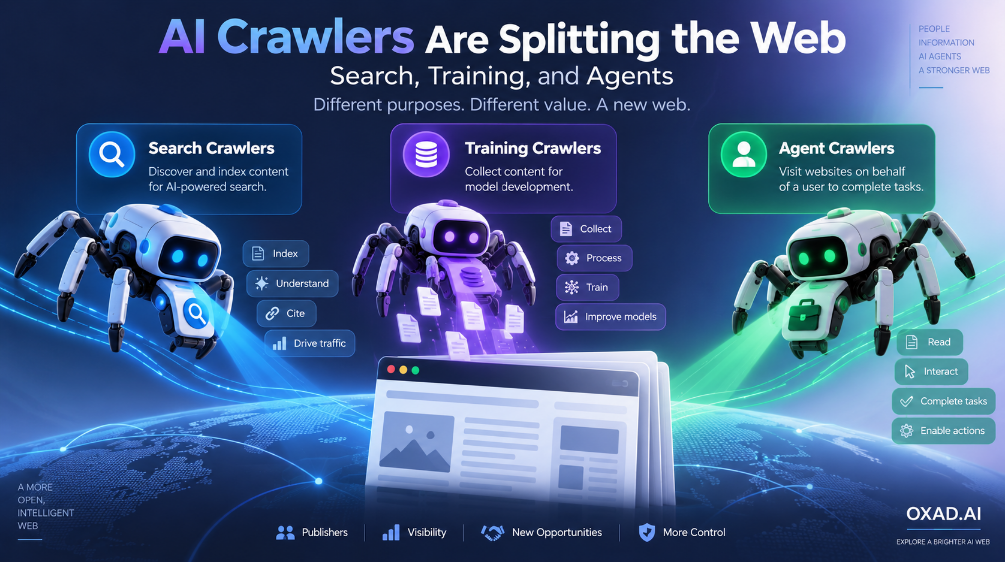
Today, an AI system may access a website for several very different reasons. It may be discovering and indexing information for AI-powered search. It may be acting on behalf of a person who needs information or wants to complete a task. Or it may be collecting content for model training or fine-tuning.
These activities can look similar in server logs, but they create very different economic and strategic outcomes for website owners.
The important question is no longer simply “Should I allow AI bots?” It is “What kind of AI access do I want to allow, and why?”
This distinction is becoming increasingly important as the web moves toward a more AI-driven discovery and interaction model.
The key idea
AI access is not one single activity. Search crawlers, AI agents, and training crawlers can provide very different value to a website. Treating them as one category can lead to unnecessary blocking or uncontrolled access.
The Web Is Moving Beyond One Type of Crawler
For years, website owners mainly thought about automated web access in terms of search engines.
Search crawlers discover pages, process their content, and help search systems determine which information may be useful to users.
AI has introduced additional forms of automated access that require a more precise distinction.
A useful framework is to think about three major purposes:
AI Access Type
Primary Purpose
Potential Website Value
Search
Discovering and indexing information for future answers
Discovery, citations, referrals and visibility
Agent
Accessing information or interacting with websites on behalf of a user
Potential traffic, transactions and direct interactions
Training
Collecting content for model training or fine-tuning
Potentially limited direct traffic or attribution
Cloudflare now uses these three behavioral categories in its AI traffic controls, allowing website owners to make different decisions about Search, Agent, and Training activity.
Why Search Crawling and AI Training Are Different
Consider a website that publishes an original article.
A search crawler may discover the article and make its information available to a search or answer system. If the content is surfaced in an answer, the website may receive a citation, referral, or new visitor.
Training is a different relationship.
A training crawler may collect content to help develop or improve a model. The immediate objective is not necessarily to send a user back to the original website.
This creates an important distinction for publishers.
A website may want:
Search visibility
AI citations
Referral traffic
Brand discovery
Inclusion in AI-generated answers
while simultaneously wanting to limit:
Uncontrolled training use
Large-scale content extraction
Automated reproduction of original material
Access that creates infrastructure costs without meaningful value
The result is a new strategic distinction between being discoverable by AI and being used as training data.
AI Agents Create a Different Relationship With Websites
AI agents introduce another major change.
Imagine asking an AI assistant:
“Find me the best laptop under $1,000 and compare the available options.”
An AI system may need to visit several websites in real time to gather information.
Now consider a different request:
“Find a restaurant, check availability, and help me make a reservation.”
An agent may need to interact with websites rather than simply read them.
This is fundamentally different from both search indexing and model training.
The agent is using the web as a live information and action layer.
Cloudflare defines Agent traffic as automated activity acting in real time on behalf of a person, including chat fetch bots and browser-use agents.
The Rise of the Agentic Web
The traditional web was designed primarily around human interaction.
Search engines introduced a second layer of interaction:
Human → Search Engine → Website
AI search introduces another model:
Human → AI Search → Sources → Answer
AI agents introduce an even more significant possibility:
Human → AI Agent → Websites → Actions → Result
In this model, a website is no longer simply a page that a person reads.
It can become a service that an AI system discovers, interprets, and interacts with on behalf of a user.
This has implications for:
E-commerce websites
SaaS platforms
Travel websites
Booking services
Financial platforms
Online directories
Educational websites
Local businesses
Any website offering structured information or digital actions
Why Blocking All AI Bots Is Becoming Too Simple
When AI crawling first became a major concern, a simple response was to block AI bots altogether.
That strategy may be too broad for an increasingly agentic web.
A publisher may want to allow AI search while restricting training access.
A software company may want AI agents to access its documentation and product information.
An online store may eventually see AI agents as a new discovery and purchasing channel.
A content-heavy website may want to limit automated access that consumes infrastructure resources without producing meaningful value.
These are different business situations.
The future of AI crawler management is therefore likely to focus more on purpose, behavior, value, and control rather than treating every AI request as identical.
Cloudflare’s AI Crawler Split
Cloudflare has formalized this distinction by allowing website owners to manage Search, Agent, and Training behavior separately. Each category can be allowed, blocked everywhere, or blocked on pages that display advertisements, depending on the configuration.
September 15, 2026 marks an important change for new domains joining Cloudflare. Cloudflare’s updated defaults block Training and Agent traffic on pages that display ads while keeping Search allowed by default. Existing customers can change their preferences, and the defaults do not mean that every Cloudflare-hosted website automatically receives the same restrictions.
This distinction matters because it is easy to misinterpret the announcement as a universal rule for every website.
It is better understood as a shift toward purpose-based AI traffic controls.
Mixed-Purpose AI Crawlers Make the Problem Harder
The situation becomes more complicated when one crawler performs more than one function.
A crawler may support search while also being used for training or other AI-related purposes.
This creates a difficult question for website owners:
Should the crawler be allowed because it provides search value, or restricted because it also has a purpose the publisher does not accept?
Cloudflare explicitly addresses mixed-purpose crawlers. Its current approach can apply the more restrictive applicable behavior when a site owner chooses to block Training, rather than automatically treating the crawler as purely a Search crawler.
This is one reason transparency from AI crawler operators is becoming increasingly important.
AI Search Could Change SEO Again
Traditional SEO focuses heavily on helping pages become discoverable in search engines.
Does it consider the source useful and trustworthy?
Can it cite the page?
Can that citation generate a visit?
Can an AI agent use the information to complete a task?
This is why concepts such as AI visibility, Answer Engine Optimization, and AI search optimization are becoming increasingly relevant.
The objective is moving beyond:
“Rank in traditional search.”
It increasingly includes:
“Be discoverable, understandable, citable, and useful across AI-driven discovery systems.”
For publishers, this does not mean abandoning traditional SEO. It means building content that works well for both human readers and machine-driven discovery.
What AI Crawling Means for AI Tool Directories
The shift is particularly relevant to websites that organize information about AI products and services.
An AI tool directory depends on discoverability.
A tool page needs to be understandable to users, search engines, AI search systems, and potentially AI agents looking for a suitable product.
This creates a new distribution path:
AI Tool → Directory Page → Search or AI Discovery → User
In an increasingly agentic web, another path becomes possible:
User → AI Agent → Tool Directory → Tool → Action
This could increase the value of structured directories.
Clear descriptions, categories, pricing information, capabilities, use cases, and structured page content can make it easier for both people and machines to understand what a tool does.
For AI directories, discoverability may therefore become a combination of traditional SEO, AI search visibility, structured information, and agent readiness.
AI Crawler Policy Is Becoming a Business Decision
Website owners traditionally treated crawler management as a technical SEO or security issue.
AI access makes the decision much broader.
AI traffic can affect:
Organic visibility
AI citations
Referral traffic
Brand discovery
Agent interactions
Model training
Content licensing
Infrastructure costs
Security and abuse prevention
This means AI crawler policy can become part of a website’s broader business strategy.
A publisher may value Search traffic while restricting Training.
A SaaS company may prioritize Agent access because an AI system can potentially become a new route into its product.
A data-heavy website may place greater emphasis on infrastructure protection.
There is no universal policy.
The right decision depends on what the website is trying to achieve.
Should Websites Allow AI Agents?
There is no reason to automatically treat AI agents as harmful.
Agents could become an important discovery and transaction channel for some websites.
Consider an AI assistant helping a user:
Compare software
Find a product
Book a service
Research a company
Choose an online course
Find a restaurant
Compare available options
The agent needs access to relevant web information to complete these tasks.
Blocking all agent traffic could therefore mean blocking a potential future distribution channel.
The better question is:
Does allowing AI agents create enough value for this website to justify the access?
Robots.txt May Need to Become More Purpose-Aware
Robots.txt remains an important mechanism for communicating crawling preferences, but AI introduces additional questions.
Who is accessing the content?
Why is the content being accessed?
Is the access for search?
Is it for a live user request?
Is it for training?
Should the content be reproduced?
Should the AI provide attribution?
Should the website receive traffic or compensation?
These questions are more complex than simply deciding whether a crawler can access a URL.
Cloudflare’s Bot Preference Sync reflects this direction by connecting AI bot preferences with robots.txt, helping keep published crawling preferences aligned with enforcement settings.
The broader trend suggests that web infrastructure may increasingly communicate not only “you may crawl”, but also “you may access this content for this purpose under these conditions.”
What Website Owners Should Do Now
Understand the AI traffic reaching your website
Review server logs, analytics, CDN dashboards, and bot-management tools to identify which automated systems are accessing your content and how frequently they visit.
Separate discovery from training
If AI search can generate visibility or referrals, blocking every AI crawler may be counterproductive. Consider whether Search and Training should be treated differently.
Evaluate the potential value of agents
Websites offering products, services, bookings, or structured information should consider whether AI agents could become a future discovery or transaction channel.
Make important information easy to understand
Clear headings, descriptive page titles, structured content, accurate metadata, useful tables, and well-organized information can help both human readers and machine systems understand a website.
Keep crawling preferences and enforcement consistent
A website should avoid a situation where robots.txt communicates one preference while its security or CDN layer enforces something completely different.
Cloudflare’s Bot Preference Sync is one example of the industry moving toward greater alignment between stated preferences and technical enforcement.
Measure value before making permanent decisions
The AI web is changing quickly. A type of automated access that appears unimportant today could become an important source of discovery or transactions later.
Where possible, measure actual traffic, citations, infrastructure impact, and business value before adopting a permanent policy.
The Future of Web Discovery
The web has already passed through several major discovery models.
Web Era
Main Discovery Mechanism
Early Web
Directories and hyperlinks
Search Era
Search engines and rankings
Social Era
Feeds and social recommendations
AI Search Era
Answers, sources and citations
Agentic Era
AI-driven discovery and actions
Each transition changes how websites are discovered and how value flows between publishers, platforms, and users.
The next stage could be particularly significant because AI systems will not simply recommend pages.
They may read them, compare them, summarize them, cite them, interact with them, and eventually perform actions on behalf of users.
The value of being visible on the web may therefore increasingly depend on being visible to both people and machines.
What the AI Crawler Split Really Means
The most important development is not simply that one company has introduced three categories.
The bigger change is that web infrastructure is beginning to recognize that AI access can have different purposes and different economic value.
Search can create discovery.
Agents can enable actions.
Training can contribute to model development.
These outcomes are not equivalent.
For website owners, this means the future of web access is likely to become more granular.
Instead of asking:
“Should AI crawl my website?”
Website owners may increasingly ask:
Which AI systems should discover my content?
Which agents should interact with my website?
Should my content be available for model training?
What value does each type of access create?
What level of infrastructure cost is acceptable?
The Bottom Line
AI is not simply creating another generation of web crawlers.
It is changing what crawling means.
A Search crawler can help an AI system discover information. An Agent can use the web to complete a task for a person. A Training crawler can contribute content to model development.
These activities may occur on the same website, but they create very different relationships between AI systems and content owners.
The emerging separation between Search, Agent, and Training is therefore more than a technical change. It is an early sign that the economics and infrastructure of the web are being redesigned for an AI-driven internet.
For website owners, the strongest strategy may not be to block AI or allow everything.
It may be to become much more precise about who can access the content, why they access it, and what value that access creates.
That is the beginning of a web where visibility is no longer only about ranking in search results.
It is also about being discoverable, understandable, citable, and usable by AI.