How to Create a Professional Logo with AI Without Losing Brand Identity
AI Design Guide
How to Create a Professional Logo with AI Without Losing Brand Identity
Artificial intelligence has made logo creation faster and more accessible than ever. Modern AI design tools can generate dozens of concepts in seconds, helping entrepreneurs, startups, and designers explore visual directions without starting from a blank page.
However, a professional logo is far more than an attractive icon. It must communicate your brand, remain memorable, scale perfectly across every platform, and support your business for years—not just look impressive in an AI preview.
Key Takeaways
Use AI for brainstorming—not final approval.
Always begin with a clear brand brief.
Simple logos outperform complex illustrations.
Typography is as important as the symbol.
Always verify originality before commercial use.
Prepare professional vector files before launch.
Editorial Note
This guide was reviewed by the Oxad.ai Design Desk in July 2026. It provides educational information only and does not guarantee trademark availability or legal ownership of any AI-generated design.
Table of Contents
Why AI Logo Design Is Growing
Create a Brand Brief First
Using AI the Right Way
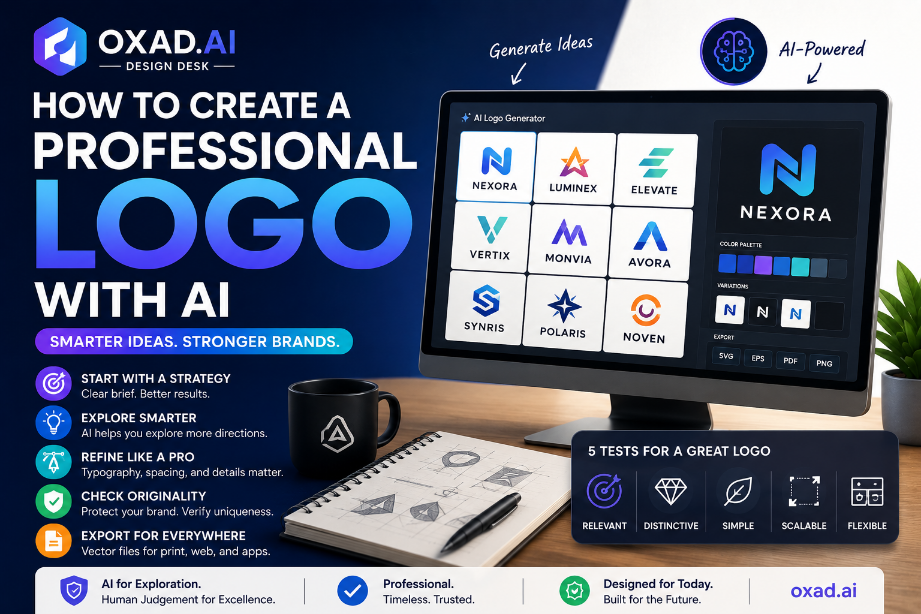
Five Tests Every Logo Must Pass
Typography Best Practices
Checking Originality
Preparing Professional Logo Files
Common AI Logo Mistakes
Frequently Asked Questions
Final Recommendation
Why AI Logo Design Has Become So Popular
AI logo generators can instantly produce multiple visual concepts based on a short prompt. Instead of spending hours sketching initial ideas, designers can explore different directions within minutes.
This makes AI particularly useful during the early creative phase. Businesses can quickly compare icons, monograms, abstract symbols, geometric concepts, typography styles, and color palettes before investing time in refinement.
However, AI should support creative thinking—not replace professional design judgment.
Expert Insight
The strongest brands rarely succeed because of a beautiful logo alone. They succeed because every visual element consistently supports a clear brand strategy.
Create a Brand Brief Before Opening an AI Tool
Many disappointing AI logos begin with vague prompts like “modern logo” or “minimal technology icon.”
Instead, create a short design brief answering these questions:
What is the exact company name?
What products or services are offered?
Who is the target audience?
What emotions should the logo communicate?
Which competitors exist?
Which visual clichés should be avoided?
Where will the logo appear?
Which languages or alphabets are required?
Professional Tip
The clearer your design brief, the fewer AI-generated concepts you’ll need before discovering promising ideas.
Use AI for Exploration—Not Final Approval
Instead of generating hundreds of nearly identical designs, explore several fundamentally different directions.
Consider experimenting with:
Wordmarks
Lettermarks
Abstract geometric symbols
Minimal icons
Monograms
Emblems
Combination marks
Avoid prompts requesting logos that imitate famous companies or living designers. Your objective is originality—not imitation.
Five Tests Every Logo Should Pass
Evaluation
Question
Relevance
Does it represent the intended audience?
Distinctiveness
Could customers confuse it with another brand?
Simplicity
Is it immediately recognizable?
Scalability
Does it remain readable at favicon size?
Flexibility
Does it work in color, black, white, horizontal, and square layouts?
Typography Matters as Much as the Icon
Many AI-generated images contain distorted or incorrect lettering. Never rely on AI-generated text as the final logo.
Professional designers normally recreate the wordmark manually using properly licensed fonts or custom vector lettering.
Check:
Letter spacing
Alignment
Readability
Consistency
Font licensing
Verify Originality Before Launch
AI generators cannot guarantee uniqueness.
Before investing in signage, packaging, advertising, or trademarks:
Search similar businesses.
Review trademark databases.
Compare visual similarities.
Confirm icon licensing.
Review font licenses.
Check stock graphic rights.
Important
A visually attractive logo may still create legal problems if it resembles an existing trademark.
Prepare Production-Ready Files
A professional logo package normally includes:
SVG
EPS
PDF
Transparent PNG files
Full-color version
Black version
White version
Monochrome version
Horizontal layout
Square icon
Color codes
Typography specifications
Spacing guidelines
Minimum size recommendations
Common AI Logo Mistakes
Choosing the First Result
Excellent logos usually emerge after refinement—not from the first AI generation.
Too Much Detail
Complex illustrations become unreadable on mobile apps and favicons.
Always research similar logos before launching a brand.
Professional Logo Checklist
✓ Clear brand strategy
✓ Memorable concept
✓ Simple design
✓ Professional typography
✓ Vector files
✓ Trademark review
✓ Responsive layouts
✓ Brand color system
✓ Usage guidelines
Frequently Asked Questions
Can an AI-generated logo look professional?
Yes. When AI is used for concept generation and the final design is professionally refined, the result can be highly effective.
Can I trademark an AI logo?
Trademark rules differ between countries. Consult an intellectual property professional before commercial registration.
Do I need vector files?
Absolutely. Vector formats allow unlimited scaling without losing quality.
Should my logo explain exactly what my company does?
Not necessarily. Many successful brands use simple symbols that gain meaning through consistent branding.
Final Recommendation
Use AI to generate ideas—not to replace professional design thinking.
The strongest logos begin with a thoughtful brand strategy, continue through careful concept selection, and end with manual refinement, originality verification, and professional vector production.
A memorable logo is not simply attractive—it communicates trust, differentiates your business, and remains recognizable across every platform for years to come.