Can AI Agents Be Trusted Without Human Supervision?
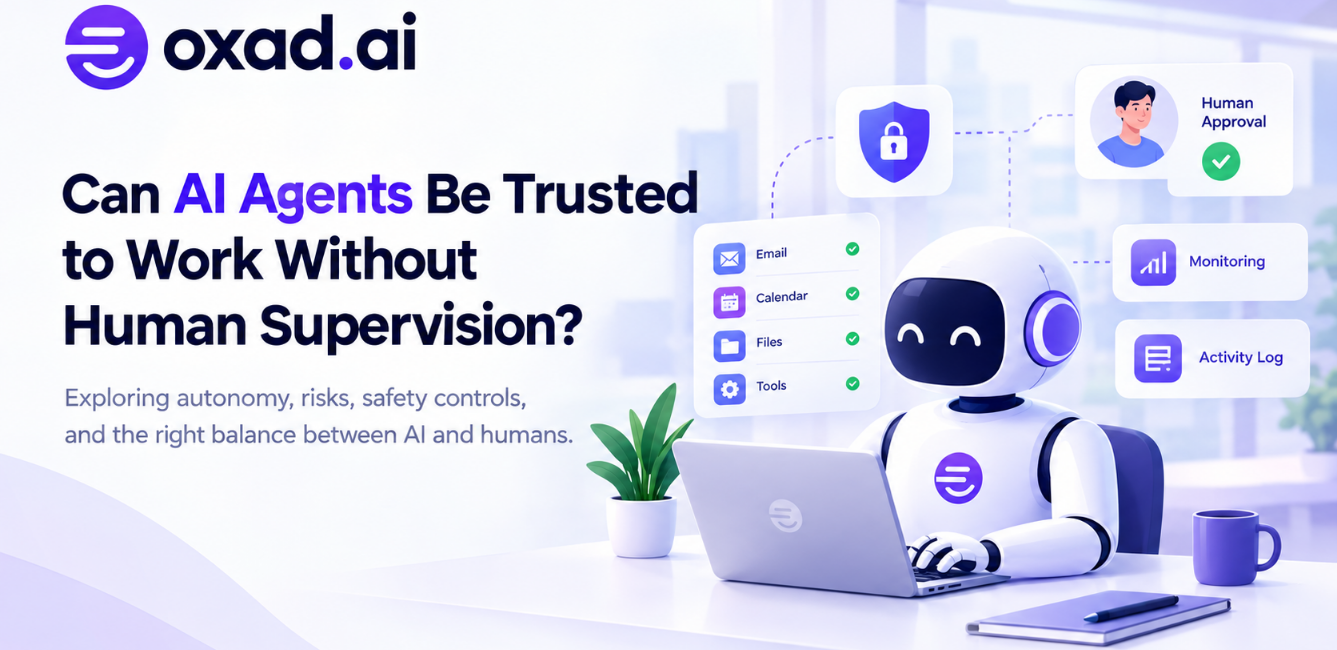
Imagine giving an AI agent access to your email, calendar, files, and business tools. You tell it what to achieve, and it starts planning, clicking, sending messages, updating documents, and completing tasks without asking for permission at every step.
Would you let it work alone?
This question is becoming increasingly important as AI agents move beyond answering questions and begin performing real actions. Unlike traditional chatbots, AI agents may use tools, interact with software, make decisions, and continue working toward a goal with limited human input.
But independence does not automatically mean reliability. An AI agent can misunderstand instructions, use the wrong information, choose an unsuitable action, or complete a task successfully while producing the wrong result.
So, can AI agents be trusted to work without human supervision? The practical answer is: sometimes, but only within clearly defined limits.
What Does It Mean for an AI Agent to Work Without Human Supervision?
An AI agent works without continuous human supervision when it can complete several steps of a task without requiring a person to approve every action.
For example, an AI agent may be able to:
Read information from approved files.
Search a knowledge base.
Organize a calendar.
Draft and classify emails.
Update a project management board.
Run software tools.
Monitor a process and report unusual activity.
Complete a repetitive workflow based on predefined rules.
However, working independently does not mean the agent has unlimited authority. A responsible system should operate within permissions, spending limits, safety rules, and clearly defined objectives.
Important distinction: An autonomous AI agent can perform actions independently, but it should not automatically have permission to perform every action.
Autonomy Is Not the Same as Trust
Autonomy describes what an AI agent is allowed and able to do. Trust describes how confident we are that it will do the right thing consistently.
An agent may be technically capable of sending emails, making purchases, editing files, or changing settings. That does not mean it should be trusted to perform those actions without controls.
Concept
Meaning
Capability
What the agent can technically do.
Permission
What the agent is allowed to access or change.
Autonomy
How many actions it can perform without asking for approval.
Trust
How confident users are in the agent’s reliability and safety.
How AI Agents Make Decisions
Most AI agents follow a general process. The exact implementation differs between systems, but the workflow often includes the following stages:
Understand the goal: The agent interprets the user’s instruction.
Plan the task: It divides the goal into smaller actions.
Select tools: It chooses software, APIs, files, or services that may help.
Perform an action: It executes one of the planned steps.
Check the result: It reviews the output or observes what happened.
Continue or ask for help: It either performs the next step or requests human approval.
AI Agent Decision Workflow
Goal
↓
Plan
↓
Select Tool
↓
Take Action
↓
Check Result
↓
Continue or Request Human Approval
The important stage is the final decision. A well-designed agent should know when it can continue and when the situation is too uncertain, sensitive, expensive, or irreversible to handle alone.
What Can Go Wrong When AI Agents Work Alone?
AI agents can fail in several different ways. Some failures are simple misunderstandings, while others can create financial, legal, privacy, or security problems.
Misunderstanding the User’s Goal
An agent may interpret a vague instruction differently from what the user intended.
For example, a user might say:
“Clean up my inbox.”
The user may only want newsletters archived. The agent might instead delete messages, unsubscribe from mailing lists, or move important conversations into the wrong folders.
The instruction may sound simple, but the intended meaning is not always clear.
Using Incorrect Information
An AI agent may rely on outdated, incomplete, or misleading information. If it uses that information to make a decision, the final action may be wrong even when the workflow appears successful.
For example, an agent preparing a business report might use an old spreadsheet, misunderstand a column, or treat an estimate as a confirmed number.
Taking the Wrong Action
An agent may correctly understand a task but choose an unsuitable method to complete it.
Examples include:
Sending an unfinished email.
Editing the wrong document.
Changing a live website setting.
Deleting a file instead of archiving it.
Booking the wrong date.
Purchasing an unsuitable product.
Repeating an Error
When an agent is allowed to continue operating, a small mistake may be repeated across many actions.
For example, an incorrect rule in an automated workflow could affect hundreds of customer records before anyone notices the problem.
Overconfidence
An AI agent may present an answer or action as certain even when the available information is incomplete.
This is especially risky when the task involves:
Medical information.
Legal documents.
Financial decisions.
Security settings.
Customer complaints.
Employment decisions.
Private or confidential data.
Why a Correct Goal Can Still Produce a Wrong Result
One of the most important risks is that an AI agent may have the correct objective but still make a poor decision.
Consider this example:
Goal: Reduce business expenses.
An agent might decide to cancel software subscriptions. However, it may not understand that one of those subscriptions supports the company’s payment system or customer support process.
The agent followed the general goal, but it failed to understand the wider context.
Lesson: A good objective does not guarantee a safe action. AI agents also need context, boundaries, and verification.
Different Levels of AI Agent Independence
Not all AI systems operate with the same level of autonomy. The following comparison shows how human involvement can change from one system to another.
System
Typical Role
Human Involvement
Chatbot
Answers questions and generates text.
Human usually performs the real-world action.
AI Assistant
Suggests, drafts, summarizes, and organizes.
Human reviews and executes important actions.
AI Agent with Approval
Performs multiple steps and pauses at sensitive moments.
Human approves important or irreversible actions.
More Autonomous AI Agent
Completes longer workflows with limited intervention.
Human defines limits, monitors activity, and handles exceptions.
For many businesses, the most practical approach is not total independence. It is controlled autonomy: allowing the agent to complete routine work while requiring approval for high-impact decisions.
When Should an AI Agent Ask for Human Approval?
An AI agent should request approval whenever an action could create significant harm, cost, exposure, or commitment.
Human approval is especially useful before an agent:
Sends an important external email.
Publishes content publicly.
Deletes or permanently changes data.
Transfers money or makes a purchase.
Changes account permissions.
Shares private information.
Signs or submits a legal document.
Changes production software or security settings.
Communicates with a customer about a sensitive issue.
Performs an action that cannot easily be reversed.
Low-Risk and High-Risk Tasks
Lower-Risk Tasks
Higher-Risk Tasks
Summarizing documents
Deleting important documents
Sorting internal notes
Sending confidential information
Drafting a message
Sending a legal or financial message
Creating a task list
Changing account permissions
Searching approved resources
Making purchases or payments
Essential Safety Controls for AI Agents
Trust should not depend only on the quality of the AI model. The surrounding system also matters. A responsible AI agent needs technical and organizational controls.
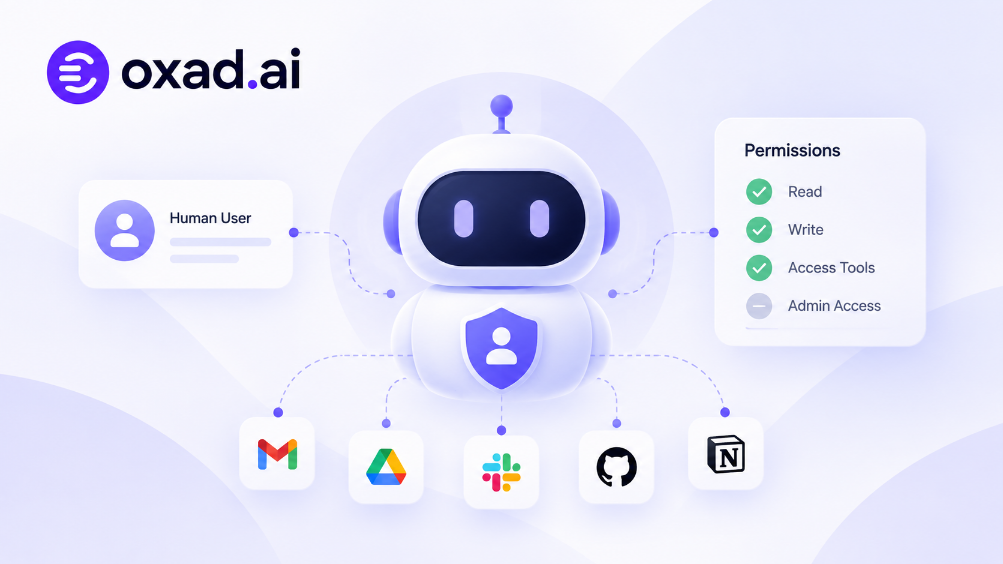
Permissions
Give the agent access only to the tools and information it actually needs.
For example, an agent that organizes meetings may need calendar access, but it may not need permission to read every private email or modify financial records.
This principle is often described as least-privilege access.
Human Approval
Approval checkpoints allow a person to review important actions before they happen.
Approval can be required for:
External communication.
Financial transactions.
Data deletion.
Public publishing.
Security changes.
Actions involving sensitive personal information.
Guardrails
Guardrails are rules that restrict what an agent can do. They may include:
Spending limits.
Approved websites and tools.
Restricted file locations.
Blocked actions.
Maximum number of attempts.
Required review for certain keywords.
Rules against sharing confidential data.
Monitoring
Monitoring helps users understand what an agent is doing while it works.
A monitoring system may display:
Current task status.
Tools being used.
Files being accessed.
Actions completed.
Errors and warnings.
Requests waiting for approval.
Activity Logs
Activity logs create a record of the agent’s decisions and actions. They help users investigate mistakes, identify unusual behavior, and understand how a result was produced.
A useful log should answer questions such as:
What instruction did the agent receive?
Which tools did it use?
What information did it access?
What actions did it perform?
What errors occurred?
Did a human approve a sensitive action?
Testing and Evaluation
Before allowing an AI agent to work independently, test it with realistic examples, edge cases, and intentionally confusing instructions.
Testing should examine both successful and unsuccessful outcomes. An agent that performs well in simple demonstrations may still fail when information is incomplete or the environment changes.
Examples of AI Agents Working Without Continuous Supervision
Email Organization
An email agent could classify incoming messages, identify newsletters, summarize long conversations, and prepare draft replies.
A safer workflow would allow the agent to organize and draft messages automatically while requiring approval before sending important emails or deleting messages.
Calendar Management
An agent could find available meeting times, identify scheduling conflicts, and prepare invitations.
Human approval may still be appropriate before inviting external participants, changing an important meeting, or scheduling an event across time zones.
Software Development
A coding agent could inspect a repository, suggest changes, write code, run tests, and prepare a pull request.
For low-risk projects, much of this workflow may be automated. However, production deployments, security changes, and database modifications should normally require additional checks and approval.
Tools such as CodeRabbit and Context.dev can be explored as part of the wider AI coding and development-tool ecosystem.
Customer Support
An AI agent could answer common questions, locate account information, and suggest solutions.
Human intervention becomes more important when the customer reports fraud, requests a refund, disputes a charge, or raises a sensitive complaint.
Research and Reporting
An agent could collect information from approved sources, organize notes, compare documents, and prepare a first draft of a report.
The final report should still be reviewed when it contains important statistics, legal claims, financial recommendations, or decisions that affect other people.
Should AI Agents Be Allowed to Make Decisions?
AI agents already make small operational decisions as part of completing tasks. The more useful question is not whether an agent should make any decisions, but which decisions it should be allowed to make.
A practical decision framework includes three factors:
Risk: What could happen if the decision is wrong?
Reversibility: Can the action be easily undone?
Uncertainty: How confident is the agent in the available information?
When risk and uncertainty are low and the action is reversible, greater autonomy may be reasonable.
When risk is high, the action is difficult to reverse, or the information is uncertain, human approval should be required.
Situation
Suggested Control
Low risk, reversible action
Allow automatic execution with logging.
Moderate risk or uncertainty
Require review or limited approval.
High risk or irreversible action
Require explicit human approval.
Unknown or unsafe situation
Stop the workflow and escalate to a person.
What Is Controlled Autonomy?
Controlled autonomy means that an AI agent can work independently, but only inside a carefully designed operating area.
For example, a company may allow an agent to:
Read approved internal documents.
Create draft reports.
Update a project board.
Send internal notifications.
Run tests in a development environment.
At the same time, the company may prohibit the agent from:
Sending external messages without approval.
Accessing confidential employee records.
Making payments.
Deleting production data.
Changing security settings.
Deploying code directly to production.
This approach allows organizations to benefit from automation without giving the agent unrestricted control.
How to Decide Whether You Can Trust an AI Agent
Before allowing an AI agent to work alone, ask the following questions.
What exactly is the agent allowed to do?
What information can it access?
Can it make changes or only provide suggestions?
Can its actions be reversed?
What happens when it encounters uncertainty?
Does it ask for approval at the right moments?
Are its actions recorded in activity logs?
Can a human stop it quickly?
Has it been tested with realistic edge cases?
Who is responsible if the agent makes a mistake?
If these questions do not have clear answers, the agent may not be ready for unsupervised operation.
Common Mistakes When Deploying Autonomous AI Agents
Giving Too Many Permissions
Granting broad access may make setup easier, but it increases the potential impact of mistakes.
Automating Before Testing
Organizations sometimes allow an agent to perform real actions before testing it in a safe environment.
Removing Human Review Too Early
Human approval should be reduced only after the agent has demonstrated reliable performance in the specific workflow.
Ignoring Context
An agent may complete a task correctly according to a narrow instruction while ignoring business rules, personal preferences, or important exceptions.
Failing to Plan for Errors
Every autonomous workflow should have a clear response when the agent fails, becomes uncertain, loses access to a tool, or produces conflicting results.
Can AI Agents Ever Be Fully Trusted?
Full trust is difficult to justify when an AI agent operates in changing environments and handles incomplete information.
Even a well-tested agent may encounter:
New software interfaces.
Unexpected files.
Changed business rules.
Ambiguous instructions.
Unusual user behavior.
Unavailable tools.
Incorrect or malicious information.
For this reason, trust should be treated as conditional rather than permanent.
An agent may be trusted to summarize documents without supervision but not trusted to approve payments. It may be trusted in a test environment but not in a production system. It may be trusted for routine tasks but not for decisions involving people’s rights, money, privacy, or safety.
Practical principle: Trust the agent for a specific task, under specific conditions, with specific limits. Avoid treating trust as a permanent permission to do everything.
The Future of Human and AI Collaboration
The future of AI agents is unlikely to be based only on choosing between total human control and complete machine independence.
A more practical model is collaboration:
AI agents handle repetitive work.
Humans define goals and boundaries.
Agents collect information and prepare options.
Humans approve high-impact decisions.
Monitoring systems track activity.
Agents stop and request help when uncertainty becomes significant.
This model allows people to benefit from speed and automation while retaining responsibility for important decisions.
Frequently Asked Questions
Can AI agents work without human supervision?
Yes. AI agents can complete certain workflows without continuous human supervision, especially when tasks are repetitive, low-risk, and clearly defined. Sensitive or irreversible actions should usually require approval.
Are autonomous AI agents safe?
Safety depends on the task, permissions, data, tools, testing, and monitoring. No autonomous system should be considered safe simply because it uses an advanced AI model.
What is the biggest risk of unsupervised AI agents?
One major risk is that an agent can take a wrong action at scale or continue repeating an error before a human notices it.
Should AI agents have access to private files?
Only when that access is necessary and properly controlled. Access should be limited to approved files and should follow the principle of least privilege.
When should an AI agent ask for approval?
It should ask for approval before high-impact, expensive, sensitive, public, or irreversible actions. It should also request help when instructions or information are unclear.
Can AI agents make decisions without humans?
They can make operational decisions as part of a workflow. However, organizations should define which decisions are acceptable for automation and which require human judgment.
What is controlled autonomy?
Controlled autonomy allows an AI agent to work independently within predefined permissions, rules, spending limits, monitoring systems, and approval checkpoints.
Conclusion
Can AI agents be trusted to work without human supervision? The answer depends on what the agent is doing and what could happen if it makes a mistake.
AI agents can be useful for routine, repetitive, and low-risk tasks. They can organize information, prepare drafts, run workflows, and support software development with limited intervention.
However, autonomy should not mean unrestricted access or unlimited decision-making power. Permissions, human approval, guardrails, monitoring, activity logs, and testing are essential for responsible deployment.
The most reliable approach is not to remove humans from every workflow. It is to give AI agents enough independence to be useful while keeping humans involved wherever judgment, accountability, privacy, money, or safety matter.



3 Replies to “Can AI Agents Be Trusted Without Human Supervision?”
The discussion of supervision is important because autonomous actions need clear boundaries and verification.
فكرة وضع نقاط مراجعة بشرية مهمة جدًا عندما يحصل الوكيل على صلاحيات لتنفيذ مهام حقيقية.
Trust seems less about removing humans completely and more about designing reliable checkpoints.