OpenCode: Why Open-Source Coding Agents Could Challenge Claude Code and Cursor
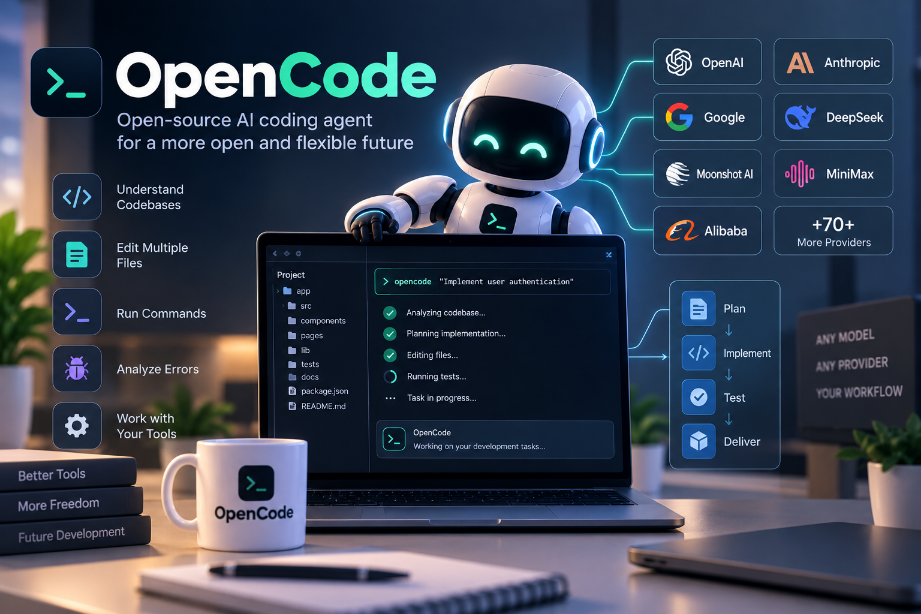
AI coding is entering a new phase. Instead of simply suggesting code or completing a function, modern AI coding agents can understand entire repositories, plan development tasks, edit multiple files, run commands, analyze errors, and iterate toward a working solution.
Among the open-source projects attracting growing attention is OpenCode, an AI coding agent designed to give developers more freedom over the models and providers they use.
This approach could become increasingly important as AI coding models continue to improve and developers gain access to more choices from companies such as OpenAI, Anthropic, Google, DeepSeek, Moonshot AI, MiniMax, Alibaba, and other AI providers.
The bigger question is no longer simply which company has the best coding model. It is whether developers should be able to choose their AI coding agent independently from the model that powers it.
What Is OpenCode?
OpenCode is an open-source AI coding agent built for software development workflows. It can be used from the terminal and integrated into development environments, giving developers an agentic interface for working with codebases.
Unlike traditional AI coding assistants that mainly provide autocomplete suggestions or generate code inside a chat window, coding agents are designed to take a more active role in development.
An agent can inspect project files, understand existing code, modify files, execute commands, investigate errors, and continue working through a task based on the results.
This changes the interaction between developers and AI. Instead of asking an AI assistant to write one function, a developer can describe a broader objective and allow the agent to work through multiple steps.
Why OpenCode Is Getting Attention
The growing interest in OpenCode reflects a broader shift in software development toward agentic coding.
Developers are increasingly looking for tools that can operate across an entire repository rather than tools that only generate individual pieces of code.
OpenCode also benefits from the growing popularity of open-source AI infrastructure. Developers who want more control over their tools, models, privacy, costs, and workflows may prefer an open ecosystem over a tightly integrated platform.
Its support for multiple AI providers is particularly significant because the AI model landscape is changing rapidly. A model that is considered the best option for coding today may be replaced or surpassed by another model tomorrow.
A model-independent coding environment can therefore give developers more flexibility as the market evolves.
Model-Agnostic AI Coding
One of the most interesting ideas behind OpenCode is the separation between the coding agent and the AI model.
These two components do not necessarily need to come from the same company.
The coding agent provides the development workflow, tools, context management, file operations, terminal interaction, and interface. The underlying language model provides the reasoning and code-generation capabilities.
This separation can give developers the ability to select different models for different situations.
A powerful reasoning model could be useful for a complicated architecture problem. A faster and less expensive model could be preferable for routine code changes. A specialized coding model could be useful for particular programming tasks, while a local model could be attractive when privacy or infrastructure control is important.
This flexibility could become one of the most important characteristics of the next generation of AI coding tools.
OpenCode vs Traditional AI Coding Assistants
Traditional AI coding assistants generally focus on helping developers while they write code. They can provide autocomplete suggestions, explain functions, generate snippets, and answer programming questions.
AI coding agents take a more autonomous approach.
Instead of waiting for a developer to request every individual action, an agent can potentially determine the next step, use development tools, inspect the results, and continue working.
This distinction is important because software development is rarely a single-step process.
A seemingly simple request such as adding authentication may require changes to database models, backend logic, API endpoints, frontend components, configuration files, tests, and documentation.
An agentic system is designed to manage more of this workflow as one connected task.
OpenCode vs Cursor
Cursor has helped popularize the idea of AI-native software development by integrating powerful AI capabilities directly into a developer-focused editor.
OpenCode approaches the problem from a different direction.
Rather than making the editor itself the center of the experience, OpenCode places more emphasis on the coding agent and the flexibility of the underlying model infrastructure.
For developers who prefer an integrated AI editor, Cursor can remain an attractive option. For developers who value open-source software, terminal-based workflows, provider flexibility, and greater control over their AI stack, OpenCode presents a different proposition.
The competition therefore is not necessarily about one tool replacing another. It is about different philosophies for how AI should become part of software development.
OpenCode vs Claude Code
Claude Code represents another important development in agentic programming. It allows developers to work with an AI agent capable of interacting with a codebase and performing development tasks from the command line.
The major difference is the ecosystem surrounding each approach.
Claude Code is closely connected to Anthropic’s models and ecosystem, while OpenCode is designed to provide a more provider-independent environment.
This distinction gives developers a meaningful choice. Some may prefer a tightly integrated experience built around a particular model family, while others may want the freedom to change models as new options become available.
Why Open-Source Coding Agents Matter
Open-source AI coding agents could become strategically important for several reasons.
More Model Choice
The number of capable coding models is increasing. Developers do not necessarily want their workflow permanently tied to one provider.
A model-agnostic agent can make it easier to experiment with new models without rebuilding the entire development workflow.
Greater Control
Open-source software gives technical teams more visibility into how the tooling works. This can be especially important for companies that need control over their development infrastructure.
Cost Flexibility
AI coding can become expensive when agents perform long-running tasks and make many model requests.
Being able to choose between different providers and models could allow developers to balance quality, speed, and cost instead of relying on a single pricing model.
Local and Private AI
Some organizations cannot send sensitive source code or proprietary information to external AI services.
Support for alternative and local models could therefore make open coding agents particularly interesting for privacy-conscious developers and organizations.
The Rise of AI Coding Agents
OpenCode is part of a much larger transformation in software development.
AI coding tools are moving from code completion toward task completion.
The difference is substantial.
A code completion system might suggest the next few lines of a function. A coding agent can potentially receive a higher-level instruction such as fixing a bug, adding a feature, updating tests, or refactoring a component and then determine a sequence of actions required to complete the task.
This is why the emerging category of AI coding agents is becoming one of the most important areas in developer AI.
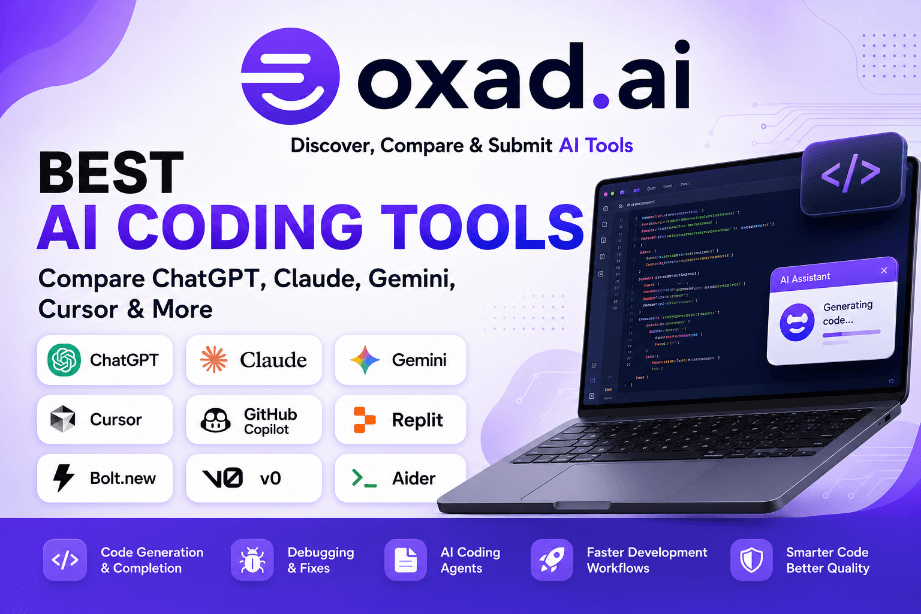
For developers exploring this broader ecosystem, OXAD.AI’s AI Coding Tools Guide provides a useful starting point for discovering different approaches to AI-assisted software development.
AI Agents Are Changing the Developer’s Role
The rise of coding agents does not necessarily mean that developers are becoming less important.
Instead, the role of the developer is gradually shifting.
When AI can handle more implementation work, developers can spend more time defining requirements, designing systems, reviewing changes, testing results, managing architecture, and making technical decisions.
This creates a new challenge: developers must become better at supervising AI-generated work.
Writing code is only part of software engineering. Understanding whether the generated code is correct, secure, maintainable, and compatible with the rest of the system remains critical.
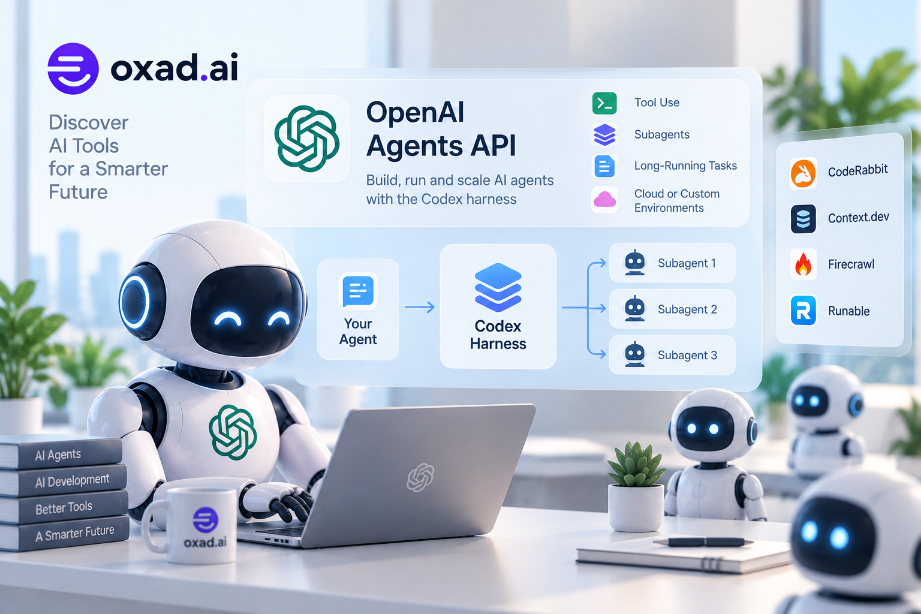
Tools such as CodeRabbit illustrate this complementary direction by focusing on AI-assisted code review rather than simply generating code.
The Importance of Context
One of the biggest limitations of AI coding is context.
A model may generate technically valid code while misunderstanding the architecture, business logic, conventions, or dependencies of a particular project.
AI coding agents attempt to solve this problem by giving models access to more information about the project and by allowing them to interact with development tools.
Context therefore becomes a fundamental part of agentic software development.
Platforms such as Context.dev are part of this emerging ecosystem, helping illustrate how access to relevant information and external context can become an important layer for AI agents.
From Coding Assistants to Autonomous Development
The long-term direction is larger than AI autocomplete.
As models become more capable, coding agents could increasingly handle complete development workflows.
A developer might describe a feature in natural language. The agent could analyze the existing architecture, propose an implementation, modify the required files, run tests, identify failures, make corrections, and prepare the resulting changes for human review.
Human developers would remain responsible for deciding what should be built and whether the result is acceptable, while AI would increasingly handle the repetitive implementation loop.
This represents a move toward AI-assisted software engineering rather than simply AI-assisted coding.
The Challenges OpenCode Still Faces
Despite the potential of open-source coding agents, several challenges remain.
Reliability
An agent that can modify many files can also introduce many errors. More autonomy makes reliable testing and human review increasingly important.
Security
Giving an AI agent access to a terminal, files, repositories, credentials, or external services creates security considerations that do not exist with simple code autocomplete.
Model Quality
The quality of the underlying model still matters enormously. A flexible agent cannot compensate completely for a model that struggles with complex reasoning or software engineering tasks.
Complexity
Model selection, API providers, permissions, context management, tool configuration, and development environments can create additional complexity for users who simply want an AI assistant that works out of the box.
Will OpenCode Replace Cursor or Claude Code?
It is too early to say that OpenCode will replace established AI coding products.
The more interesting possibility is that the market will evolve into several distinct categories.
Some developers will prefer highly integrated AI-native editors. Others will choose terminal-based agents. Enterprise teams may prioritize governance and security, while open-source developers may prioritize model flexibility and local infrastructure.
OpenCode does not need to defeat every competing product to become important. If model-independent coding agents become a standard part of software development, the underlying concept could influence the entire AI coding market.
What OpenCode Could Mean for the Future of AI Coding
The most important development may not be OpenCode itself. It may be the architectural idea behind it.
As AI models become increasingly interchangeable, the interface and agent layer could become just as important as the model.
This could eventually create an ecosystem where developers select an agent based on workflow and capabilities, then choose the most appropriate AI model based on price, performance, privacy, speed, or task requirements.
That would represent a significant change from today’s model-centric AI market.
Instead of asking which AI company provides the best coding experience, developers could increasingly ask which combination of agent, model, tools, context, and infrastructure works best for their project.
Final Thoughts
OpenCode represents an important direction in the evolution of AI-powered software development.
Its significance comes from the combination of open-source development, agentic workflows, and freedom to work with different AI models and providers.
As coding agents become more capable, flexibility may become just as valuable as raw model intelligence.
For developers, this means the future of AI coding may not belong to a single model or platform. It could belong to an ecosystem of specialized agents, models, tools, and context layers that work together.
That makes OpenCode worth watching—not simply as another AI coding tool, but as an example of how the architecture of AI-assisted software development may evolve.
OpenCode is an open-source AI coding agent designed to help developers work with codebases through agentic development workflows.
What makes OpenCode different from traditional AI coding assistants?
OpenCode is designed to perform multi-step development tasks, interact with project files and development tools, and work more autonomously than conventional code-completion assistants.
Is OpenCode model-agnostic?
OpenCode is designed around flexibility between the coding agent and the underlying AI model, allowing developers to work with different supported models and providers.
Is OpenCode an alternative to Cursor?
OpenCode can be considered an alternative approach to AI-assisted development. Cursor focuses heavily on an integrated AI-native editor, while OpenCode emphasizes an open-source, agent-focused and provider-flexible workflow.
Is OpenCode an alternative to Claude Code?
Yes, the two tools can serve similar agentic coding use cases, but they differ in their underlying ecosystems and approach to model and provider flexibility.
Why are open-source AI coding agents important?
They can give developers greater control over their development environment, model selection, privacy, infrastructure, and costs.
Can AI coding agents replace developers?
AI coding agents can automate increasingly large portions of implementation work, but developers remain important for architecture, requirements, security, testing, code review, and technical decision-making.
Why is context important for AI coding agents?
Agents need to understand the architecture, dependencies, conventions, and requirements of a project. Better context can help them produce changes that are more consistent with the existing codebase.
What is agentic coding?
Agentic coding is an approach in which AI systems can perform multi-step software development tasks by inspecting code, planning actions, modifying files, running tools, analyzing results, and iterating toward an objective.