What Are AI NPCs and How Are They Changing Video Games?
AI NPCs could make video game worlds feel less like scripted attractions and more like places inhabited by characters with goals, memories, and changing strategies. Instead of repeating the same dialogue or following a fixed attack pattern, an intelligent non-player character may respond to what you say, remember selected events, cooperate with teammates, or adjust its tactics after a difficult encounter. The challenge is making those reactions believable, fair, safe, and fun—not merely adding a chatbot to a game.
In a nutshell
AI NPCs combine character dialogue, memory, perception, and game-state-aware decisions. The best systems use AI within clear game rules, rather than allowing a language model to control everything.
Interest in this area is growing as game developers explore smaller language models, voice systems, and AI agents. NVIDIA’s ACE technology suite, for example, offers tools for conversational and autonomous characters, including on-device options. Separately, a Sony patent application published in October 2026 describes a possible system for adapting non-player characters to player behavior. A patent is a proposal, not proof that a feature is coming to a commercial game.
This guide explains how AI NPCs work, what “memory” really means, how they differ from traditional game AI, which examples are worth watching, and what developers must solve before these characters become commonplace.
NPC stands for non-player character: any character controlled by the game rather than directly by a human player. Traditional examples include shopkeepers, guards, quest givers, companions, and enemies. Their behavior is commonly driven by dialogue trees, scripts, state machines, behavior trees, navigation systems, and carefully authored triggers.
AI NPCs use one or more AI techniques to make a character’s dialogue or decisions more responsive to context. Depending on the implementation, a character might understand free-form language, retrieve relevant facts from a defined memory, plan a sequence of actions, recognize events in the game world, or adapt to patterns in a player’s behavior.
Not every feature described as “AI NPC” is the same. A character with generated voice lines may still follow a fixed script. A character powered by a language model may speak naturally but have no ability to change the game world. A more complete system connects conversation to the game’s actual state and gives the character a limited set of validated actions.
Four capabilities that can make a character feel intelligent
Context-aware dialogue: replies reflect the current quest, location, relationship, or recent event.
Memory: selected information from earlier interactions can influence later responses.
Planning and action: the character can choose from permitted game actions, such as following, warning, trading, or taking cover.
Adaptation: tactics or assistance can change in response to a player’s repeated choices or performance.
How Do Intelligent NPCs Work?
A useful AI NPC is usually a pipeline of cooperating systems, not a single magical model. The game engine remains responsible for authoritative facts such as health, inventory, position, quest status, collision, and whether an action is legal.
Perceive Game state
→
Retrieve Context + memory
→
Decide Model + rules
→
Act Approved actions
The game checks every proposed action and updates the world state. The next decision uses the new state as context.
1. Perception and game context
The NPC receives a structured summary of relevant events: the player entered a room, an ally is injured, a quest item is missing, or a boss fight has started. The system should not rely on the model guessing facts that the game already knows.
2. Character identity and knowledge
A character profile defines personality, motives, speech style, relationships, and what the character is allowed to know. A village guard should not reveal a secret that only the final boss knows unless the story provides a reason.
3. Language, reasoning, and retrieval
A language model can interpret a player’s request and draft a response or action plan. A retrieval system can supply relevant lore and remembered events. This helps keep responses grounded in the game’s canon, although retrieval does not guarantee accuracy on its own.
4. Action validation
The model might suggest opening a door, sharing a clue, or moving to cover. The game’s rules engine should validate the request, check permissions and resources, and execute only allowed actions. This is essential for reliable gameplay and security.
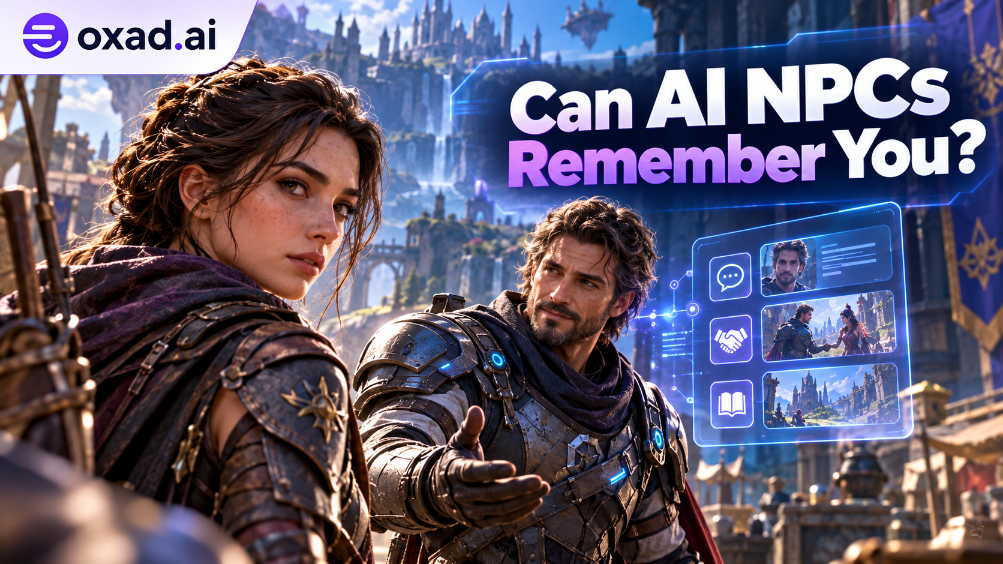
Can AI Characters Remember You Between Sessions?
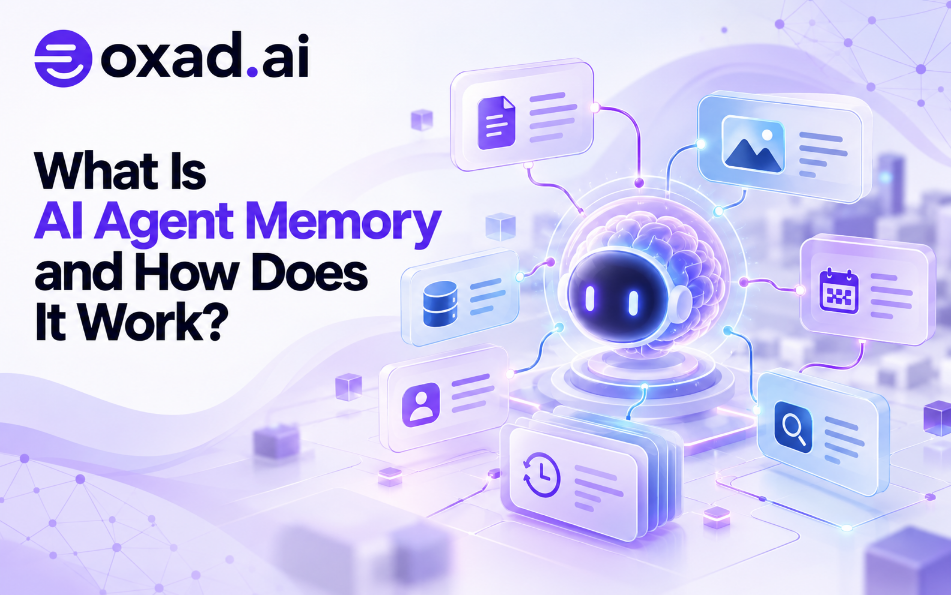
They can, if the game deliberately implements persistent memory. A model does not automatically remember every conversation or every previous session. Memory is a product feature built around storage, retrieval, privacy controls, and rules about what is worth retaining.
Memory type
Example
Design consideration
Working memory
The player just asked for directions.
Usually short-lived and session-based.
Event memory
The player rescued the character earlier.
Store only meaningful events and retrieve them when relevant.
Relationship state
Trust increases after several helpful actions.
Use explicit, testable values rather than vague model guesses.
World knowledge
The character knows which faction controls a region.
Keep lore versioned and consistent with the current story.
Consider a companion who remembers that you prefer stealth. In one encounter, the companion might suggest a quiet route instead of a direct fight. That should be based on recorded gameplay evidence and a designed rule—not an unsupported claim that the AI knows your personality.
Persistent memory also creates responsibilities. Players should understand what is stored, be able to reset or delete relevant data where appropriate, and not have sensitive personal disclosures silently repurposed as permanent character history.
Real-World Projects and Demonstrations to Know
NVIDIA ACE: tools for conversational and autonomous characters
NVIDIA ACE for Games is a suite of developer technologies for speech, character intelligence, and animation. NVIDIA lists partner experiences spanning AI teammates, advisors, citizens, and enemies. Its developer materials also describe local inference options, which can reduce reliance on a remote model for supported workloads. These are technologies and partner projects, not evidence that every listed capability is universally available in every game.
MIR5: an AI boss concept
NVIDIA’s official demonstration of MIR5 presents an AI-powered boss designed to respond to player tactics and recall previous encounters. It illustrates the idea of moving beyond a single fixed boss script. The video is a technology demonstration; players should check the game’s official announcements for current release status and the exact features available to them.
Video: NVIDIA GeForce’s MIR5 AI boss demonstration. Watch on YouTube.
Sony’s October 2026 patent: adapting NPC behavior
A patent application published in the United States on October 1, 2026, describes a possible machine-learning system that uses gameplay data—such as attack patterns, defensive actions, and encounter outcomes—to generate or adjust NPC behavior. The concept could make a boss react differently to different players. However, a published patent does not confirm that Sony will ship the system, when it might appear, or which games might use it.
The official NVIDIA ACE developer page provides further videos and project descriptions for AI teammates, citizens, assistants, and enemies. It is a useful companion to the MIR5 clip because it shows that intelligent characters can serve different gameplay roles—not just combat.
AI NPCs vs. Traditional Game AI
Feature
Traditional NPC
AI-enhanced NPC
Dialogue
Authored lines or dialogue trees
May interpret open-ended language within limits
Behavior
Scripts, state machines, behavior trees
May combine rules with model-generated decisions
Consistency
Highly predictable when well authored
Needs constraints and testing to avoid contradictions
Performance
Often inexpensive and deterministic
Depends on model size, hardware, and inference design
Best fit
Precisely choreographed story beats
Open dialogue, flexible assistance, selected adaptive systems
AI does not make traditional game AI obsolete. Navigation, combat timing, animation, collision, and deterministic quest logic often work better in conventional systems. The most practical approach is hybrid: use authored rules for critical game mechanics and generative AI where flexible language or variation genuinely improves the experience.
Do AI NPCs Need the Internet?
No—not necessarily. The answer depends on where the model runs and which services the game needs.
Cloud-based AI: can use larger models, but requires connectivity and introduces server costs, latency, and service dependency.
On-device AI: runs supported models on the player’s hardware. It can improve responsiveness and reduce the need to send every interaction to a server, but available quality depends on hardware, memory, and optimization.
Hybrid AI: uses local systems for fast or routine decisions and remote services for tasks that justify the extra latency and cost.
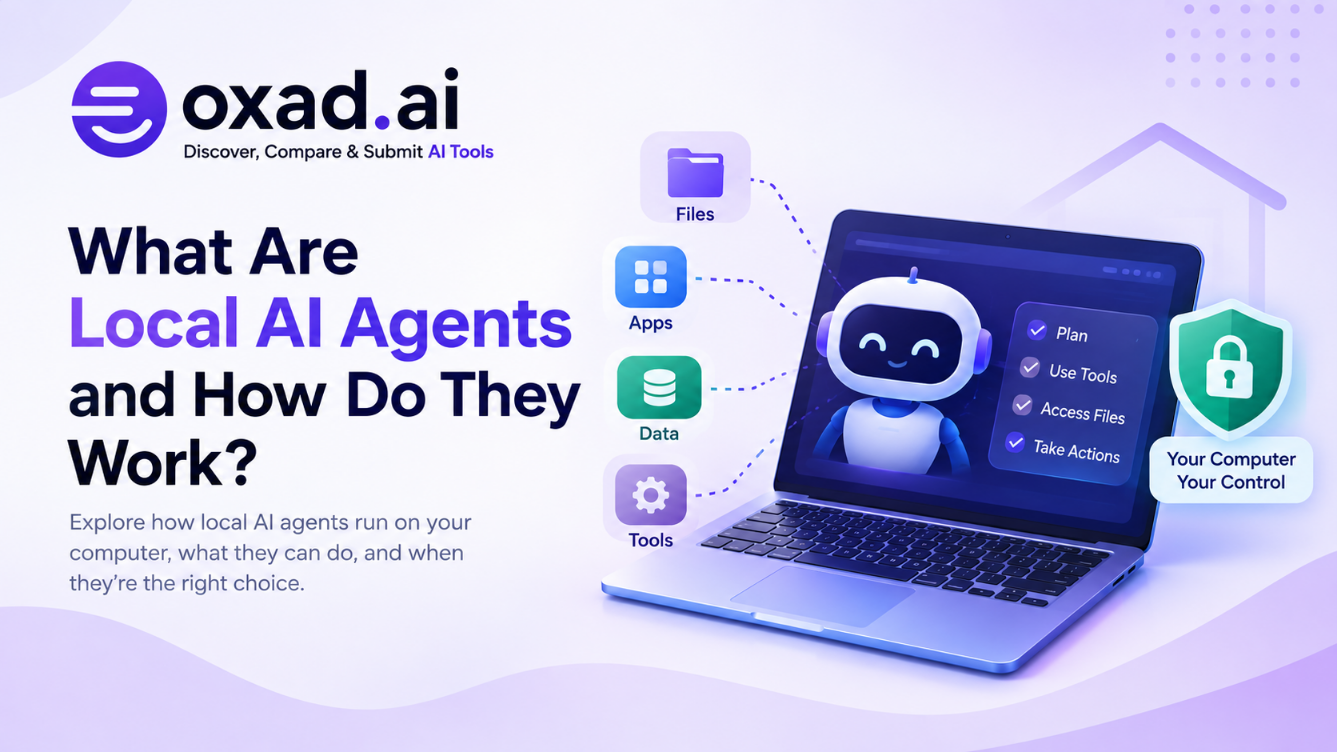
Smaller models can help with local inference. For more background, see our guide to small AI models and our article on local AI agents. These concepts are relevant to game architecture, although a coding model or general local agent is not automatically a ready-made NPC system.
The Biggest Limitations and Design Challenges
1. Latency and pacing
A character that pauses several seconds before every reply can break immersion, especially during combat. Developers can reserve generative calls for dialogue or strategic decisions and keep moment-to-moment reactions in fast, conventional systems.
2. Hallucinations and story continuity
A language model may invent a quest, contradict a previous statement, or claim an item exists when it does not. Retrieval from approved lore, structured character memory, constrained outputs, and engine-side validation help reduce—but do not eliminate—these failures.
3. Cost and scalability
One NPC conversation is manageable; hundreds of active characters generating dialogue and decisions can become expensive. Teams need budgets, rate limits, caching, smaller models, and rules for when an AI call is actually necessary.
4. Fairness and player agency
Adaptive enemies can become more engaging, but they can also feel as though they cheat or punish skilled players. Good design communicates the rules, sets limits on adaptation, and tests whether players perceive the challenge as fair.
5. Safety, moderation, and privacy
Open-ended dialogue can produce inappropriate, abusive, or out-of-character responses. Games need content policies, age-appropriate safeguards, abuse reporting, and privacy-conscious data handling. Voice cloning and likeness use also require careful rights management and consent.
6. Testing a system that can vary
Traditional scripted dialogue can be checked line by line. Generative characters may produce many different outputs, so QA must test classes of scenarios: contradictory lore, invalid actions, prompt injection, offensive requests, network failure, and unexpected player behavior.
How Developers Can Build an AI NPC
A practical prototype should be small enough to measure. Start with one character and one clear role rather than giving every resident of a game world unrestricted generative capabilities.
Define the role: choose a guide, companion, shopkeeper, or boss and write down its goals, personality, and knowledge boundaries.
Expose only necessary game state: send a compact structured summary rather than the entire save file or raw player data.
Ground responses in lore: retrieve relevant approved facts and recent events before generating a reply.
Define permitted actions: create a short list of functions the NPC may request, each with strict parameter validation.
Choose the runtime: compare local and cloud models for latency, hardware needs, privacy, quality, and operating cost.
Test edge cases: check whether the character stays in role, avoids inventing game facts, and recovers when a model or network fails.
Measure player experience: evaluate perceived responsiveness, consistency, fairness, accessibility, and whether the AI makes the game more enjoyable.
Developers working in Unreal Engine can explore the official NVIDIA ACE tools and documentation. For broader AI tooling, browse the gaming tools directory on OXAD.AI. To understand the adjacent workflow of creating game prototypes with prompts, read What Is AI Game Generation?—that topic is related, but it focuses on generating games rather than designing intelligent characters inside them.
What Should Players Expect Next?
The near-term opportunity is not necessarily a world where every NPC behaves like a human. More realistic progress may come from a few well-designed characters: a companion who gives context-aware help, a suspect who responds to questions within a controlled mystery, or a boss whose tactics vary within carefully tuned boundaries.
The strongest experiences will combine authored storytelling with AI flexibility. Developers will still need to decide what a character knows, what it can do, how it changes, and when it should remain predictable. A convincing NPC is not simply one that talks a lot; it is one whose words and actions make sense in the game.
Frequently Asked Questions
What does NPC stand for in gaming?
NPC means non-player character: a character controlled by the game rather than directly by a human player.
Can AI NPCs remember a player’s previous choices?
Yes, if the game stores selected events or relationship state and retrieves them in later interactions. Persistent memory is an engineered feature, not an automatic property of every AI model.
Can AI NPCs change how difficult a game is?
They can be designed to adapt tactics or assistance based on performance. Developers must constrain these changes so that difficulty remains fair and understandable.
Do AI NPCs require a powerful gaming PC?
Not always. Cloud-based models shift much of the computation to remote servers, while local models depend on the device’s CPU, GPU, memory, and optimization. The specific requirements vary by game and model.
Are AI NPCs already used in real games?
Developers and technology providers have announced and demonstrated AI character projects, including NVIDIA ACE partner experiences. Availability and capabilities vary, so check the status of each individual game rather than assuming every demonstration is a released feature.
Will AI NPCs replace traditional game AI?
Unlikely in the foreseeable future. Deterministic systems remain valuable for navigation, combat timing, animation, and critical story logic. Hybrid systems can use generative AI where flexible interaction adds value.
What is the difference between AI NPCs and AI game generation?
AI game generation helps create a game or prototype from prompts and other inputs. AI NPC technology focuses on the behavior, dialogue, memory, and decisions of characters inside a game. Read our AI game generation guide for the related but distinct topic.
Final Verdict
AI NPCs are a promising step toward games that react to players in more personal and dynamic ways. Memory, contextual dialogue, and adaptive behavior can deepen immersion—but only when they are grounded in game state, constrained by design, and thoroughly tested. For players, the key question is whether the character makes the world more engaging. For developers, it is whether AI adds meaningful interaction without sacrificing control, performance, privacy, or trust.