What Are Small AI Coding Models and Why Are They Becoming More Powerful?
AI coding is no longer just a contest to see which model has the most parameters. Developers increasingly care about whether a model can solve a real task, use tools reliably, respond quickly, protect private code, and work at a reasonable cost.
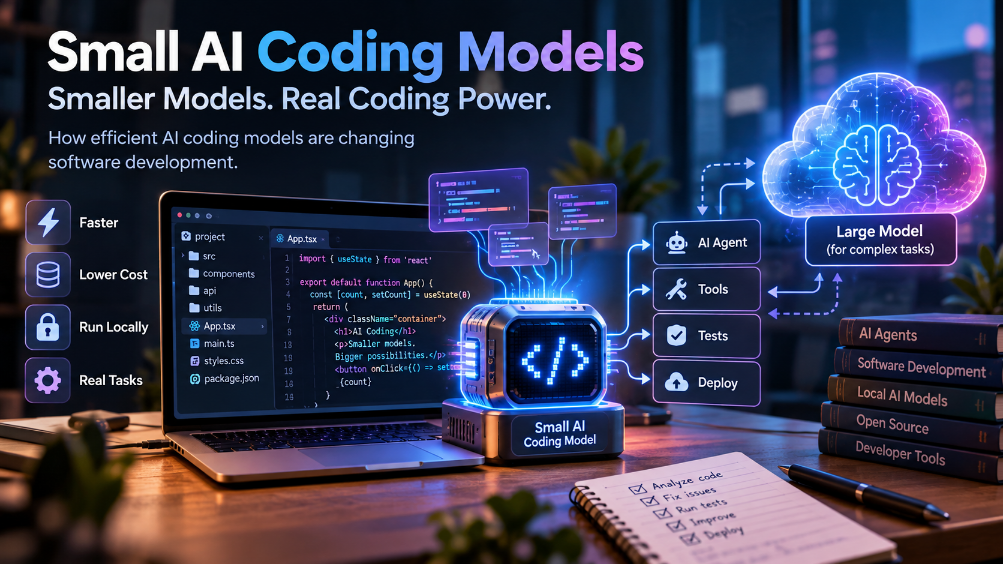
Small AI coding models are becoming important because they can handle focused programming tasks and serve as efficient components inside larger AI coding systems. They do not need to outperform every large model; they need to be good enough for the task they are assigned.
The key idea: a smaller model can be useful when paired with the right context, tools, tests, and task-routing system. Model size matters, but the complete workflow matters more.
What Are Small AI Coding Models?
Small AI coding models are language models designed or adapted for programming that use relatively efficient amounts of compute, memory, or inference resources. They can explain code, complete functions, generate tests, identify likely bugs, suggest fixes, or handle routine steps in a development workflow.
There is no universal parameter count that defines a small model. The term depends on the model family, hardware, precision, and intended task. Some models run on consumer hardware; others are compact compared with frontier models but still need substantial memory.
Some use a mixture-of-experts architecture. Instead of activating every parameter for every token, the model routes each step through selected expert components. This can reduce computation per token, but total parameter count, memory requirements, and runtime speed are not the same thing.
Why Are Small AI Coding Models Becoming More Powerful?
Training for real coding tasks
Real software engineering involves more than generating a snippet. A model may need to inspect a repository, locate a failing test, edit several files, run commands, interpret errors, and revise its changes.
On October 8, 2026, JetBrains announced Mellum2.1, a 12-billion-parameter mixture-of-experts model with 2.5 billion active parameters. JetBrains says it was trained further with reinforcement learning in software and other sandboxed environments, and can explore a codebase, edit files, and check its changes. The company released it under the Apache 2.0 license.
More efficient local inference
Running a model locally can help keep source code on a developer-controlled machine, reduce dependence on network access, and avoid per-request inference charges for local calls. The trade-off is that local models still need enough memory and compute, and may not match a large cloud model on every task.
Microsoft’s October 2026 announcement about MAI-Code-1.1-Flash describes an on-device version using around 3-bit quantization and a 256K context window. Microsoft reports coding benchmark results close to its full-precision counterpart in the evaluations it cites, while recommending more than 120 GB of RAM for the best experience. This shows both the potential and the hardware demands of local coding models.
Better tools and agent workflows
A model becomes more useful when it can work with a file system, terminal, code search, version control, and a test runner. A coding agent can give it a clear task, supply relevant files, execute proposed changes, and return test results for another attempt.
Small Coding Models vs. Large Coding Models
Factor
Small or efficient model
Large or frontier model
Routine edits
Often suitable for bounded changes
Can handle them, but may be more than the task requires
Latency and cost
Can be faster or cheaper, depending on deployment
May require more compute and incur higher costs
Local deployment
More feasible for some models and hardware setups
Usually more demanding, although quantization changes the trade-off
Complex reasoning
May struggle with ambiguous, multi-system problems
Often preferable for difficult architecture or debugging work
Privacy and control
Can keep code local when fully self-hosted
Cloud use sends relevant data to a provider unless privately deployed
Best role
Focused tasks, quick iterations, and sub-agent work
Hard planning and difficult reasoning
These are tendencies, not guarantees. A well-trained small model can outperform a larger one on a narrow task, while a larger model may be more reliable when a problem is unfamiliar or requires deeper reasoning.
What Is the Difference Between a Coding Model and a Coding Agent?
A coding model generates predictions and responses. A coding agent is a system that uses a model to pursue a goal through planning, tool use, observation, and revision.
Component
What it contributes
Model
Interprets the task and proposes a step
Repository context
Supplies relevant files, documentation, and history
Tools
Allow search, file edits, terminal commands, and other operations
Execution environment
Runs commands within defined boundaries
Tests and feedback
Show whether a change works and where it fails
Human developer
Reviews important changes and decides what is ready to ship
A small model can be useful as a sub-agent. It might inspect a file, summarize a module, draft a unit test, or investigate a failed command while a stronger model handles the overall plan. A reliable system assigns tasks based on difficulty rather than expecting one model to do everything.
How Can Coding Agents Use Multiple Models?
Example workflow
Developer request → task planner → small model for code search or routine edits → tools run tests → results are checked → a larger reasoning model handles unresolved failures → developer reviews the final changes.
This is a form of model routing or a hybrid model workflow. It can reduce unnecessary use of expensive models, but routing itself must be evaluated. If the system sends a difficult task to a model that is too weak, repeated failures and retries can waste time.
For a related AI-powered development environment, see Windsurf. For another model ecosystem used in coding and agent workflows, see Z.ai. To explore running agents on your own hardware, read Local AI Agents.
Can You Run Small AI Coding Models Locally?
Yes. Some coding models can run locally through software that manages model downloads and inference. The experience depends on model size, quantization, context length, operating system, available RAM or VRAM, and the coding interface connected to the model.
Local execution can be useful for experimentation, offline work, limiting external data transfer, or controlling inference costs. However, local does not automatically mean private or secure. Check the configuration of your editor, extensions, telemetry, tools, and any remote services used by the workflow.
What Is Quantization?
Quantization represents model weights with lower numerical precision to reduce memory use and sometimes improve speed. A model quantized to around 3 bits can use much less memory than a higher-precision version, although the exact reduction depends on the implementation and runtime overhead.
Lower precision can affect quality, so do not judge a quantized model only by whether it fits in memory. Test it on your own repository and compare the code, tool calls, and test outcomes.
How Should You Evaluate a Small Coding Model?
Benchmarks can help compare models, but no single score predicts performance in every codebase. Results depend on benchmark versions, tools, execution environments, and evaluation methods.
Evaluation
What to check
Task completion
Can it finish a realistic issue rather than just produce a plausible snippet?
Tests
Do existing tests pass, and are useful new tests added?
Regressions
Does the change break unrelated behavior?
Tool reliability
Does it use terminal, search, and file tools correctly?
Latency and cost
How long and how many tokens does a successful task require?
Human rework
How much correction is needed before the code is acceptable?
Security
Does it protect secrets and avoid unsafe commands without approval?
For agentic coding, successful task completion and code quality matter more than an impressive parameter count. Measure complete attempts, including retries and verification, rather than judging only the first answer.
Watch: A Practical Introduction to Local AI Coding
This tutorial demonstrates a local AI coding workflow using Ollama, a coding model, and an editor integration. It is a general practical guide to local coding, not a dedicated walkthrough of Mellum2.1 or MAI-Code-1.1-Flash.
When Should Developers Choose a Small Coding Model?
Test a small or efficient model when the task is narrow, repeated frequently, and easy to verify. Examples include explaining a function, drafting a unit test, summarizing a module, suggesting a small refactor, or handling routine changes under clear constraints.
A larger model or human-led investigation may be better for unfamiliar architecture, subtle security bugs, broad migrations, difficult concurrency issues, or changes with high business impact. Many teams will use a mixture of models and keep tests and human review in the loop.
Limitations and Risks
Incorrect code: models can invent APIs, misunderstand requirements, or miss edge cases.
Weak repository understanding: results may suffer when relevant context is missing.
Hardware constraints: local inference can require substantial memory and careful configuration.
Misleading comparisons: benchmark setups may not be directly comparable.
Agent safety: tool-enabled systems need permission limits, isolated execution, secret protection, and review of risky commands.
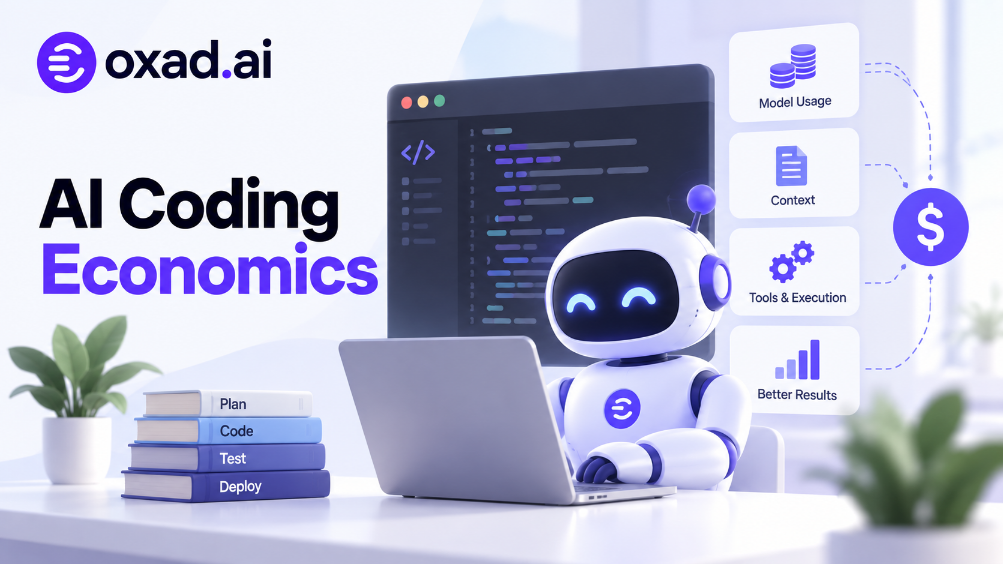
Hidden costs: retries, slow inference, and developer corrections can offset apparent savings.
Will Small AI Coding Models Replace Large Models?
Not across the board. The more likely direction is a mix of models and tools. Smaller models can handle quick, bounded work; larger models can take on complex reasoning; and a coding agent coordinates context, tools, tests, and feedback. The developer remains responsible for reviewing changes and deciding what should be merged or deployed.
Frequently Asked Questions
What is a small AI coding model?
It is a programming-focused AI model designed to perform coding tasks with relatively efficient use of compute, memory, or inference resources.
Are small AI models good at coding?
They can be useful for focused tasks, but quality varies by model, language, repository context, and available tools.
Can small coding models run offline?
Some can run locally without cloud inference, provided the required models and software are already available.
Are local coding models always free?
Local inference may avoid per-request model charges, but hardware, electricity, setup, and maintenance still have costs.
What is the difference between a coding model and an AI coding agent?
The model generates responses; the agent combines a model with tools, context, execution, and feedback to complete tasks.
Does a higher parameter count mean better code?
No. Training, architecture, context, tool use, and task-specific evaluation also affect performance.
What is quantization?
Quantization lowers the numerical precision used for model weights, often reducing memory requirements with possible quality trade-offs.
How should I test a coding model?
Evaluate realistic repository tasks, run tests, track regressions, measure latency and cost, and review the required human correction.
Final Takeaway
Small AI coding models are becoming more useful because developers are improving not only the models themselves, but also training methods, inference efficiency, and the agent systems around them. Mellum2.1 highlights training for agentic software work, while MAI-Code-1.1-Flash illustrates the push toward more efficient local coding.
The goal is not to replace every large model with a small one. It is to use the right model for each task, connect it to reliable tools and tests, and verify the result. That can mean faster iteration, more control over code and data, and a more efficient AI-assisted workflow.