Best Weavy Alternatives: 6 AI Developer & Collaboration Tools Compared
If you are looking for Weavy alternatives, the first thing to understand is that not every alternative solves exactly the same problem. Weavy belongs to a broader category of developer-focused platforms where AI, collaboration, application development, and workflow capabilities increasingly overlap.
That makes choosing an alternative less straightforward than simply comparing feature lists. A developer may want an AI coding assistant, while a product team may need a collaborative development environment. Another user may want to build a complete application with AI, and someone else may be looking for a more flexible platform for creating custom developer workflows.
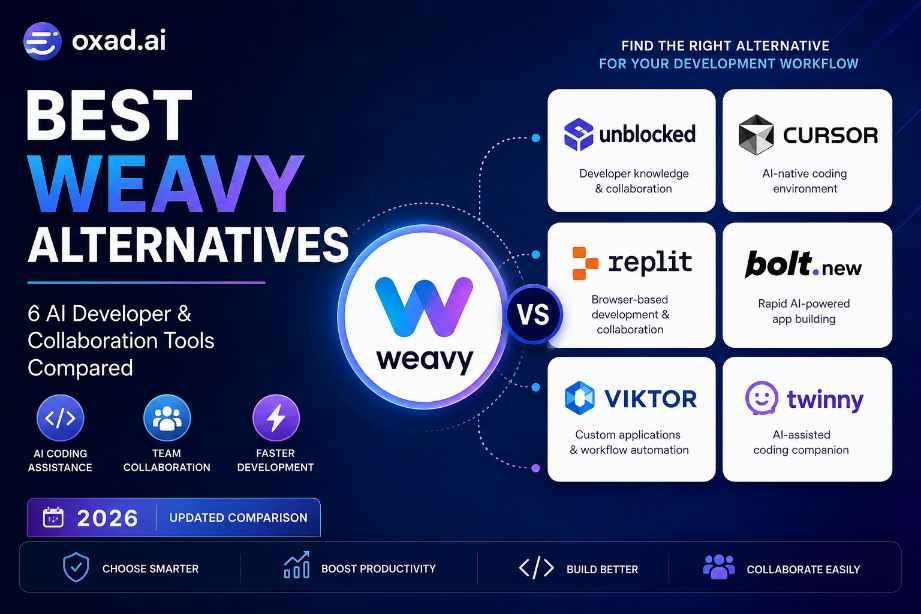
For that reason, this guide compares six tools available on OXAD.AI that can be relevant alternatives depending on what you are trying to accomplish: Unblocked, Cursor, Replit, Bolt.new, VIKTOR, and Twinny.
The goal is not to declare one universal winner. Instead, we look at what makes each platform different, who it is best suited for, and when it may make more sense than Weavy.
Quick takeaway: Weavy alternatives are not interchangeable. Unblocked is particularly relevant to developer knowledge and collaboration, Cursor focuses on AI-assisted coding, Replit combines development and collaboration in the browser, Bolt.new emphasizes rapid AI-powered application building, VIKTOR focuses on custom applications and automation, while Twinny provides another approach to AI-assisted coding.
Weavy Alternatives at a Glance
The following comparison provides a quick way to understand where each alternative fits. Because these products have different purposes, the table should be viewed as a starting point rather than a ranking.
Tool
Best For
Main Strength
Ideal User
Weavy
Developer-focused collaboration and AI experiences
Developer platform
Developers and product teams
Unblocked
Developer knowledge and collaboration
Understanding codebases and team knowledge
Software teams
Cursor
AI-assisted programming
AI-native coding environment
Developers
Replit
Browser-based development
Coding, deployment and collaboration
Developers and creators
Bolt.new
Rapid AI application development
Prompt-to-application workflow
Developers and non-developers
VIKTOR
Custom applications and automation
Building specialized applications
Technical teams
Twinny
AI coding assistance
AI-assisted development
Developers
What Is Weavy?
Weavy is a developer-oriented platform designed around the integration of collaboration and AI capabilities into applications and workflows.
Its positioning makes it particularly interesting for teams that are not simply looking for another standalone chatbot or coding assistant. Instead, Weavy can be considered in the context of products that want to incorporate AI-powered experiences and collaborative functionality into their own applications.
This distinction is important when comparing Weavy with tools such as Cursor or Replit.
Cursor is primarily an AI development environment for programmers. Replit is a browser-based development platform that combines coding, collaboration, and deployment. Weavy belongs to a different part of the ecosystem, where the emphasis is more closely connected to developer platforms and application experiences.
Therefore, someone searching for a Weavy alternative should first identify what they actually want to replace.
Why Are Developers Looking for Weavy Alternatives?
There are several reasons someone might explore alternatives to Weavy.
The first is simply product fit. A platform can be technically capable while still not matching a particular development workflow.
The second is the desired level of control. Some developers prefer an integrated development environment, while others want a browser-based platform or a framework they can customize around their own applications.
Cost can also influence the decision, especially for independent developers and smaller teams. In other cases, the deciding factor may be collaboration, deployment, local development, AI coding capabilities, or automation.
That is why it is more useful to compare Weavy with several different types of tools instead of assuming that one product is a direct replacement.
What Should You Consider Before Choosing a Weavy Alternative?
Define the Main Problem
Start by identifying the problem you are trying to solve. Are you looking for AI coding assistance, team collaboration, application development, automation, or a developer platform that can become part of your own product?
The answer will immediately narrow the list.
Consider Your Development Environment
Some platforms are designed around traditional local development environments, while others allow developers to work primarily in the browser. Your existing workflow can therefore be just as important as the AI capabilities themselves.
Evaluate AI Capabilities
Not every AI development tool approaches AI in the same way. Some focus on code generation and editing, while others emphasize reasoning, application building, documentation, collaboration, or automation.
Think About Collaboration
If several developers or stakeholders need to work together, collaboration features can become a major deciding factor. A tool that is excellent for an individual programmer may not necessarily be the best solution for a larger team.
Consider Scalability
A tool that works well for a prototype may not be suitable for a large production application. Consider how the platform fits into your longer-term architecture before making a decision.
Unblocked: Best for Developer Knowledge and Collaboration
Unblocked is one of the more interesting alternatives to consider if your main requirement is helping developers understand projects and access the knowledge surrounding their codebase.
Rather than functioning primarily as a conventional AI coding editor, Unblocked is designed around the broader context developers need when working on software projects. Its integrations can connect information from development and collaboration systems, allowing developers to work with knowledge that may otherwise be scattered across different tools.
This makes Unblocked particularly relevant for teams where understanding the history and context of a project is as important as generating code.
You can explore the dedicated OXAD.AI page for Unblocked to learn more about the tool and its current positioning.
Best for: Software teams that want AI-assisted access to codebase knowledge, documentation, and development context.
Why Choose Unblocked?
Unblocked can make more sense than Weavy when the primary problem is developer knowledge rather than building a broader application experience.
For teams dealing with large repositories, distributed knowledge, and multiple collaboration systems, having an AI layer that can help connect technical information can be valuable.
Cursor: Best for AI-Native Coding
Cursor is one of the strongest options on this list if your main goal is AI-assisted software development.
Cursor is built around the idea of an AI-native coding environment. Instead of treating AI as a separate chatbot that developers consult occasionally, it integrates AI directly into the programming workflow.
Developers can use AI to understand code, generate changes, refactor files, investigate problems, and work with larger parts of a project.
That makes Cursor particularly relevant for programmers who are looking for an alternative to a platform focused on broader developer functionality but primarily want a powerful coding environment.
Best for: Developers who want AI deeply integrated into their coding workflow.
Why Choose Cursor Instead of Weavy?
Cursor is the more natural choice when coding itself is the center of the workflow.
If you spend most of your time inside an editor and want AI to help you navigate, modify, explain, and improve your code, an AI-native coding environment can be a more direct solution.
Replit: Best for Browser-Based Development and Collaboration
Replit takes a broader approach to application development. Its browser-based environment allows users to write code, work with AI, collaborate, and build applications without relying entirely on a traditional local development setup.
This can make Replit particularly appealing for beginners, educators, rapid prototyping teams, and developers who want a more accessible development environment.
The combination of coding, AI, collaboration, and deployment makes Replit a particularly interesting comparison with Weavy, although the two products have different core approaches.
Best for: Users who want a browser-based environment combining coding, AI, collaboration, and application development.
Why Choose Replit Instead of Weavy?
Replit can be the better fit when you want to go directly from an idea to a working application within a collaborative development environment.
Its browser-first approach also reduces some of the setup normally associated with development environments, making it attractive for people who want to start building quickly.
Bolt.new: Best for Rapid AI-Powered App Building
Bolt.new is particularly interesting for users who want to move quickly from an idea to an application.
Its AI-driven development workflow allows users to describe what they want to build and then work with AI to generate and modify the application.
This makes Bolt.new different from a conventional coding assistant. Rather than beginning with an existing codebase and asking AI to help maintain it, users can start with an idea and use AI as part of the application-building process.
The approach is especially useful for prototypes, experiments, landing pages, internal tools, and early-stage products.
Best for: Rapid prototyping and building web applications with AI assistance.
Why Choose Bolt.new Instead of Weavy?
Bolt.new makes more sense when your priority is speed and application creation rather than integrating a developer platform into a broader product architecture.
For someone who wants to describe an application, generate an initial implementation, and then iterate through natural-language instructions, Bolt.new offers a compelling workflow.
VIKTOR: Best for Custom Applications and Automation
VIKTOR is another alternative worth considering, particularly for technical organizations that need to turn specialized workflows into applications.
Rather than positioning itself simply as another AI coding assistant, VIKTOR focuses on helping technical teams build custom applications and automate workflows.
This makes it particularly relevant to engineering, scientific, industrial, and other specialized environments where software needs to connect with domain-specific processes.
Best for: Technical teams building specialized applications and automating complex workflows.
Why Choose VIKTOR Instead of Weavy?
VIKTOR may be a better fit when the goal is to create specialized applications around technical or business processes rather than focus primarily on AI coding or collaboration.
Its value becomes more apparent when software needs to become part of a larger technical workflow.
Twinny: An Alternative for AI-Assisted Coding
Twinny is another option for developers looking for AI assistance during programming.
Its positioning makes it relevant to users who want AI capabilities integrated into the development process without necessarily moving to a completely different application-building model.
For developers comparing AI coding tools, Twinny can therefore be considered alongside other coding-focused solutions such as Cursor.
You can explore Twinny on OXAD.AI for additional information about the tool.
Best for: Developers looking for an alternative AI-assisted coding workflow.
Weavy vs Unblocked
The comparison between Weavy and Unblocked is most relevant when developer collaboration and access to project knowledge are important.
Unblocked is particularly focused on helping developers work with information surrounding their codebase and development environment. Weavy, meanwhile, is positioned more broadly as a developer platform for incorporating collaboration and AI experiences.
If your biggest challenge is helping developers understand an existing project, Unblocked deserves consideration. If you are building a product that needs embedded collaborative and AI functionality, Weavy may be closer to the original requirement.
Best choice: Unblocked for developer knowledge; Weavy for broader developer-platform use cases.
Weavy vs Cursor
This is a very different comparison.
Cursor is primarily about improving the developer’s coding workflow through an AI-native editor. Weavy addresses a broader developer platform use case.
If you want AI to help you write and understand code every day, Cursor is likely the more direct choice.
If you are interested in building AI and collaboration functionality into a larger application experience, Weavy may be more relevant.
Best choice: Cursor for AI coding; Weavy for developer-platform and embedded experiences.
Weavy vs Replit
Replit is particularly attractive for users who want a complete browser-based development experience. It combines development, AI, collaboration, and deployment-oriented workflows.
Weavy is better considered when you are looking at developer infrastructure and application-level integration rather than simply wanting an online IDE.
Best choice: Replit for browser-based application development; Weavy for broader developer-platform use cases.
Weavy vs Bolt.new
Bolt.new is designed around rapid application creation with AI. It can be particularly appealing when the objective is to go from a natural-language idea to a working prototype quickly.
Weavy is better suited to users whose needs extend beyond rapid prototyping and into developer-oriented platform functionality.
Best choice: Bolt.new for rapid AI app building; Weavy for broader developer-platform requirements.
Weavy vs VIKTOR
VIKTOR becomes particularly interesting when applications need to support specialized technical workflows and automation.
Weavy and VIKTOR therefore serve different needs. The right choice depends heavily on whether the application is primarily a developer-facing platform or a specialized business and technical application.
Best choice: VIKTOR for specialized technical applications; Weavy for developer-platform scenarios.
Weavy vs Twinny
Twinny is more directly connected to AI-assisted coding, making this comparison most relevant to developers evaluating coding assistance rather than application infrastructure.
If your main objective is improving the individual programming experience, Twinny may be worth investigating. If your requirement is broader than coding assistance, Weavy may remain the more relevant option.
Best choice: Twinny for AI-assisted coding; Weavy for broader platform requirements.
Which Weavy Alternative Is Best?
There is no single answer because these tools are designed around different workflows.
Your Main Goal
Recommended Tool
Developer knowledge and collaboration
Unblocked
AI-native coding
Cursor
Browser-based development
Replit
Rapid AI application building
Bolt.new
Specialized applications and automation
VIKTOR
AI-assisted coding
Twinny
Are These Tools Direct Competitors to Weavy?
Not necessarily, and this is an important distinction.
Some of the tools in this comparison overlap with Weavy in specific areas, but they do not all attempt to solve the same problem.
Calling every product a direct competitor would make the comparison less useful and potentially misleading. Instead, these tools should be viewed as alternatives for different parts of the broader developer and AI ecosystem.
This is particularly important when evaluating software for a production environment. A tool that looks similar in a feature list may have a completely different architecture or target user.
How to Choose the Right Weavy Alternative
Start by writing down the exact workflow you want to improve.
If you need an AI assistant inside your programming environment, begin with coding-focused options. If you need a complete environment for building and deploying applications, browser-based platforms may make more sense. If you need specialized business automation, look at platforms designed around custom applications and workflows.
Next, consider how much control you need over your development environment. Some teams value simplicity and managed infrastructure, while others prioritize customization and control.
Finally, evaluate the product using a small real-world project before making a long-term decision. This is often more informative than comparing feature lists alone.
Our Approach to This Comparison
This article compares the tools according to their documented positioning, primary use cases, and the type of developer or team they are designed to serve.
It should not be interpreted as an independent benchmark in which every platform was tested under identical technical conditions. AI development tools can behave differently depending on the programming language, project size, development environment, model configuration, and workflow.
For that reason, developers should evaluate the tools against their own requirements before adopting one for production.
This approach also avoids treating products with different purposes as if they were identical competitors.
Final Verdict
The search for the best Weavy alternative does not lead to one obvious winner. Instead, it reveals a broader ecosystem of AI development and collaboration tools, each approaching the problem from a different direction.
Unblocked is worth considering when developer knowledge and project context are the priority. Cursor is a strong option for AI-native coding. Replit is attractive for browser-based development and collaboration, while Bolt.new focuses on turning ideas into applications quickly with AI.
For technical teams building specialized applications and automating workflows, VIKTOR offers a different approach. Meanwhile, Twinny provides another option for developers looking for AI-assisted coding.
Ultimately, the best choice depends on what you want the software to accomplish.
If your goal is to improve coding, choose a tool optimized for coding. If you need application creation, consider an application-building platform. If collaboration and developer knowledge are the central challenge, look at tools designed specifically for those workflows.
The Best Weavy Alternative Depends on Your Workflow
Compare the tools based on your development environment, AI requirements, collaboration needs, application goals, and long-term workflow before making a decision.
Explore Weavy on OXAD.AI
If you want to learn more about Weavy before choosing an alternative, visit its dedicated page on OXAD.AI for an overview of the tool and its current information.
Frequently Asked Questions About Weavy Alternatives
What are the best Weavy alternatives?
Unblocked, Cursor, Replit, Bolt.new, VIKTOR, and Twinny are relevant alternatives depending on the specific workflow you want to replace.
Is Cursor a Weavy alternative?
Cursor can be considered an alternative when your primary requirement is AI-assisted software development and coding rather than broader platform functionality.
Is Replit a Weavy alternative?
Replit can be an alternative for users seeking browser-based development, AI assistance, collaboration, and application-building capabilities.
What is the best Weavy alternative for coding?
Cursor and Twinny are particularly relevant options when AI-assisted coding is the main requirement.
What is the best Weavy alternative for collaboration?
Unblocked is worth considering when developer knowledge, project context, and collaboration are central to the workflow.
What is the best Weavy alternative for rapid application development?
Bolt.new is particularly relevant for users who want to build and iterate on applications quickly with AI assistance.
What is the best Weavy alternative for specialized applications?
VIKTOR may be a better fit for technical teams building specialized applications and automating domain-specific workflows.
Are all Weavy alternatives direct competitors?
No. These tools overlap with Weavy in different areas and often target different development and business workflows.
How should I choose between Weavy and its alternatives?
Start with your primary requirement, compare the relevant workflows, evaluate pricing and integrations, and test the shortlisted tools on a realistic project.
Where can I compare these AI developer tools?
OXAD.AI provides dedicated pages for Weavy and the alternatives covered in this comparison, making it easier to explore each tool individually.