AI agents are becoming more useful for one simple reason: they can increasingly connect to the systems where real work happens.
Traditional AI assistants mainly generate answers. AI agents are designed to go further by planning tasks, using tools, accessing information, and taking actions on a user’s behalf.
But an agent cannot do much in the real world if it has no way to communicate with the services that contain the data or perform the actions it needs.
This is where AI connectors come in.
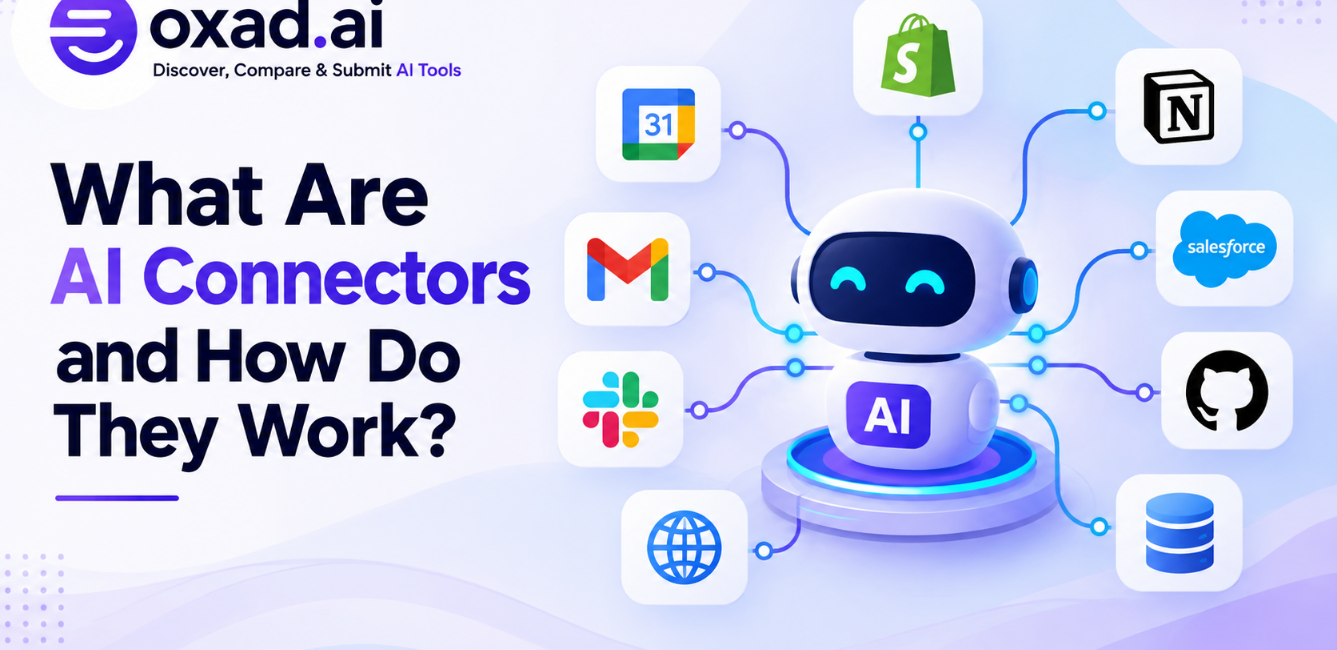
An AI connector can provide a controlled bridge between an AI agent and an external service such as email, calendars, databases, CRMs, coding platforms, shopping systems, business software, or smart-home devices.
The idea is becoming increasingly important as AI moves from answering questions to completing tasks.
What Are AI Connectors and How Do They Work?
AI connectors are integration mechanisms that allow AI applications or agents to access external services, data, or actions through an authorized connection.
In simple terms, a connector helps an AI agent communicate with another system.
For example, imagine asking an AI agent:
“Check my calendar, find a free afternoon, book a meeting with Sarah, and send her an email.”
The language model can understand the request and plan the steps. But understanding the request is not enough.
The agent needs access to a calendar, an email system, and potentially a scheduling service. Connectors provide the practical bridge that allows those systems to participate in the workflow.
Why Do AI Agents Need Connectors?
An AI model can reason about a task without necessarily being able to perform it.
This distinction is important.
A model might know how to book a flight, but that does not mean it has access to an airline or travel platform. An agent might understand how to update a CRM record, but it cannot actually change the record without an authorized connection to the CRM.
Connectors help close this gap between reasoning and action.
The basic idea:
An AI model decides what needs to happen. An agent coordinates the process. A connector gives the agent access to an external capability. The external service performs the operation.
How Do AI Connectors Work?
A typical agent workflow can be understood as a series of layers.
Layer
Role
AI Model
Understands the request and reasons about possible actions.
AI Agent
Plans and coordinates multiple steps.
Connector
Provides a controlled bridge to an external capability.
API or Service
Provides the actual data or performs the requested operation.
Permission Layer
Determines what the agent is allowed to access or change.
Verification
Checks whether the requested action actually succeeded.
For example, an agent receiving the request “Find my next free afternoon and schedule a meeting” could identify the user’s intention, call a calendar connector, inspect available times, create an event, and return the result.
The important point is that the connector does not replace the AI model. It gives the agent access to something the model itself does not possess.
AI Connectors vs APIs: What Is the Difference?
An API is a technical interface that allows software to communicate with another software system.
An AI connector is a broader integration concept designed around giving an AI application or agent practical, often permission-controlled access to that capability.
API
AI Connector
Designed primarily for software-to-software communication.
Designed around connecting AI applications or agents to capabilities.
Defines endpoints, requests, responses, and authentication.
May combine authentication, tool exposure, permissions, policies, and agent-facing interfaces.
Usually requires developers to integrate it.
Can be presented as a ready-to-use connection for an AI agent.
In practice, many AI connectors use APIs underneath. The connector can therefore be thought of as the layer that makes an existing service easier and safer for an AI agent to use.
Are AI Connectors the Same as MCP?
No. AI connectors and MCP are related, but they are not necessarily the same thing.
AI agents and tool use can involve several different technologies for exposing capabilities to an agent, and MCP is one important approach.
MCP, or Model Context Protocol, is a protocol for connecting AI applications with external tools, resources, and data.
The term AI connector is broader. It can describe the complete integration that connects an agent to an external service, including authentication, permissions, APIs, tool definitions, policies, and other integration components.
A useful way to think about the distinction:
MCP can provide a standardized way to expose capabilities to AI applications, while a connector describes the practical connection between an AI agent and an external service.
This means an AI connector can use MCP, an API, a proprietary integration, browser automation, or another technical mechanism depending on the platform.
Where Does an AI Connector Fit Inside an AI Agent?
Consider a modern AI agent architecture as a chain:
AI Model → Agent → Tool Selection → Connector → External Service → Result → Agent
The model provides reasoning.
The agent provides planning and coordination.
The connector provides access.
The external service provides the actual capability.
The result then returns to the agent, which can decide what to do next.
This is one reason AI agent infrastructure is becoming increasingly important. Agents need more than a model. They need an environment where tools, permissions, context, memory, and external services can work together.
What Can AI Connectors Connect To?
The potential range is extremely broad.
Email and Communication
An agent could connect to email and help search messages, summarize conversations, draft responses, or perform approved actions.
Calendars and Scheduling
A calendar connector can allow an agent to find availability, identify conflicts, schedule meetings, or manage appointments according to the permissions granted to it.
Business Applications
Connectors can give agents access to CRM systems, help desks, project-management platforms, accounting software, and other business applications.
Coding and Development Tools
A coding agent can connect to repositories, issue trackers, documentation, testing systems, deployment platforms, and development environments.
Web Data
Some agents need constantly changing information from the web. Tools such as web tools for AI agents can provide capabilities for searching, crawling, and extracting information that a model could not reliably obtain from its training data alone.
Smart Homes and Physical Devices
AI connectors can also reach beyond software.
Google’s Home MCP integration, for example, allows compatible AI applications to discover smart-home resources, inspect device states, retrieve historical information, and execute supported device actions through an authorized connection.
This illustrates an important transition: an AI agent can move from producing text to interacting with a real environment.
Why Permissions Matter So Much
The moment an AI agent can access external services, security becomes much more important.
A chatbot that produces an incorrect answer is frustrating. An agent that sends the wrong email, modifies a database, purchases something, deletes information, or controls a device can create a much more serious problem.
That is why a good connector architecture should consider several layers of control.
Security Layer
Purpose
Authentication
Confirms which account is being connected.
Authorization
Defines what the agent is allowed to access.
Scoped Permissions
Limits access to specific data or actions.
User Approval
Requires confirmation before sensitive actions.
Audit Logs
Records what the agent attempted and what happened.
Revocation
Allows access to be removed when necessary.
Google’s current Home MCP documentation provides a practical example of this principle. Its system uses authorization and safety restrictions because connecting an AI agent to physical devices can result in real-world actions.
AI Connectors and Tool Calling
Tool calling is another important part of this architecture.
When an AI model decides that it needs an external capability, it can select a tool and provide the required arguments.
The connector can then help route that request to the appropriate service.
User: Find my next free meeting slot.
Agent: Determine that calendar access is required.
Tool call: Request available calendar times.
Connector: Authenticate and route the request.
Calendar: Return available times.
Agent: Present the result or continue with the next action.
This is how tool calling becomes useful in a real agent workflow rather than remaining an isolated model capability.
Do AI Connectors Need AI Memory?
Not necessarily, but memory can make connected agents much more useful.
Consider an agent that knows a user’s preferred meeting hours, favorite airlines, usual project repository, or preferred shopping criteria.
Memory can provide the context needed to decide how to use a connector.
However, memory and connectors solve different problems.
Technology
Main Question
Memory
What does the agent know or remember about the user and previous work?
Connector
What external service can the agent access?
Tool
What specific capability can the agent invoke?
AI Connectors Could Change Online Shopping
Shopping provides one of the clearest examples of why connectors matter.
A traditional shopping assistant might recommend several products and provide links. An agent with the right connections could potentially search catalogs, compare products, check availability, manage a cart, and complete an approved purchase.
This changes the role of the AI from recommendation engine to transaction interface.
The recent growth of consumer agents such as Meta’s Muse has made this transition more visible. Muse is designed to perform tasks such as shopping, booking travel, filling forms, sending email, and interacting with services on behalf of users.
For businesses, this creates a new question:
What happens when the next customer is an AI agent acting on behalf of a human?
This is one reason the connector ecosystem could become strategically important for online businesses.
Could AI Connectors Become an “App Store for AI”?
The comparison is useful, although it should be treated as an emerging industry analogy rather than an established fact.
The original smartphone App Store made it easy for users to discover and install capabilities.
An AI connector marketplace could potentially play a similar role for agents by making external capabilities discoverable and easier to authorize.
Instead of asking:
“Which application should I open?”
a user might eventually ask:
“Can you handle this for me?”
The agent would then discover the services it needs and use approved connectors to complete the task.
For this model to work at scale, however, businesses would need to support reliable agent access, identity, permissions, pricing, policies, and verification.
What Happens When a Connector Fails?
Reliable agents need to handle failure rather than assuming every external service will respond correctly.
A connector could fail because an API is unavailable, authentication has expired, a permission has changed, a service rejects the request, or the requested operation is no longer supported.
A robust agent should therefore be able to distinguish between:
Successful actions
Failed actions
Actions requiring user approval
Actions blocked by permissions
Actions that need another tool or service
This is another reason verification matters. An agent should not simply assume that an action succeeded because a connector accepted the request.
What Are the Biggest Challenges for AI Connectors?
Security
Giving agents access to external accounts creates new security risks. Credentials, tokens, permissions, and sensitive data must be protected.
Authorization
An agent should have only the access necessary for the task. A connector that gives an agent unrestricted access to an entire account can create unnecessary risk.
Reliability
External APIs change, services go offline, and integrations can break. Agents need reliable ways to detect and recover from these failures.
Identity
When an agent performs an action, systems need to know whether the action represents the user, an organization, or the agent itself.
Auditability
Organizations will increasingly need to understand what an agent accessed, what it changed, and why an action was performed.
Interoperability
The more fragmented connector systems become, the harder it may be to build agents that work consistently across different platforms.
AI Connectors vs Traditional Automation
Traditional automation usually follows predefined instructions.
For example:
When a new form is submitted → create a CRM record → send an email.
An agent can operate at a different level.
It may receive a goal, decide which systems it needs, determine the sequence of actions, and adapt if something changes.
Connectors can therefore become the infrastructure that allows more flexible agentic workflows to interact with traditional software.
What Do AI Connectors Mean for Developers?
Developers building AI agents increasingly need to think beyond model selection.
The important questions become:
Which tools should the agent have?
Which services should it be able to access?
What permissions should each connection receive?
How should authentication work?
How should actions be verified?
What happens when an external service fails?
How should connector activity be logged?
This moves agent development closer to systems engineering.
An agent is no longer just a prompt wrapped around an LLM. It becomes a system that combines reasoning, context, tools, permissions, external services, and execution.
What Do AI Connectors Mean for Businesses?
Businesses may eventually need to treat AI agents as a new type of software client.
A website has traditionally been designed for humans. An API is designed for software. An AI connector can provide a controlled path for agents to interact with a company’s capabilities.
This could affect areas such as:
Customer support
Sales
E-commerce
Travel
Finance
Marketing
Productivity
Software development
Enterprise operations
Businesses that expose useful, reliable, and well-governed capabilities may become easier for AI agents to work with.
Where Does Context Fit?
Connections are useful only when an agent has enough information to use them correctly.
For example, a web research agent might need live information before deciding which action to take.
Web data for AI agents can therefore complement connectors by providing external information that helps the agent understand the current situation.
This creates another useful distinction:
Context tells the agent what is happening.
Connectors give the agent access to what it can do.
Tools define the specific actions it can perform.
The Bigger Picture: From AI Models to Digital Operators
The development of AI can be viewed as a progression.
AI Model
↓
AI Agent
↓
Tools and Tool Calling
↓
Connectors
↓
External Services and Data
↓
Real-World Actions
The important shift is not simply that models are becoming better at reasoning.
The larger change is that reasoning is increasingly being connected to systems where actions can actually happen.
That is the role the emerging AI connector ecosystem is beginning to explore.
What Is the Future of AI Connectors?
The exact shape of the connector ecosystem is still developing.
Some integrations may be built directly into AI platforms. Others may use open protocols such as MCP. Enterprise platforms may build governed connector marketplaces, while individual services may expose their own agent interfaces.
The technical standards may change, but the underlying requirement is likely to remain:
AI agents need reliable and authorized ways to connect reasoning with external data and actions.
As agents become more autonomous, those connections may become just as important as the models powering them.
Frequently Asked Questions About AI Connectors
What is an AI connector?
An AI connector is an integration that gives an AI application or agent controlled access to an external service, data source, or capability.
How do AI connectors work?
They connect an AI agent to an external system through mechanisms such as APIs, protocols, authentication, permissions, and tool interfaces.
Are AI connectors the same as APIs?
No. APIs provide software interfaces, while AI connectors generally describe a broader agent-facing integration around external capabilities.
Are AI connectors the same as MCP?
No. MCP is a protocol that can be used to expose tools and resources to AI applications, while connector is a broader integration concept.
Why do AI agents need connectors?
Agents need connectors to access external data and services that are not available inside the language model itself.
Can AI connectors perform real-world actions?
Yes. Depending on their permissions, connectors can allow agents to perform actions such as scheduling, purchasing, updating records, or controlling devices.
Are AI connectors secure?
Their security depends on authentication, authorization, permission scopes, approval mechanisms, credential handling, monitoring, and the design of the connected service.
Can AI connectors use APIs?
Yes. APIs are one of the most common technical mechanisms that connectors can use to communicate with external services.
Will every AI agent need connectors?
Not every agent will require external connections, but agents designed to perform useful actions generally need access to tools or services.
Why are AI connectors becoming important now?
AI agents are moving beyond conversation toward workflows that require access to applications, data, transactions, and physical environments.
Conclusion
The next stage of AI agents is not simply better reasoning.
It is the ability to securely connect that reasoning to the services, data, applications, and environments where real-world actions happen.
AI connectors are emerging as an important concept in that transition.
They sit between AI agents and the systems those agents need to use. They can work with APIs, MCP, tool calling, authentication systems, permissions, and other integration technologies.
As AI moves from answering questions to completing tasks, the quality of these connections may become just as important as the intelligence of the underlying model.
That makes AI connectors a concept worth understanding now, before the technology becomes another invisible layer of everyday AI infrastructure.
8 Replies to “What Are AI Connectors and How Do They Work?”
Alex Morgan
I had seen the term AI connectors before, but this explanation made the concept much clearer. The connection between an AI agent and external services is much easier to understand now.
Sophia Lee
The comparison between APIs, connectors, and MCP is especially helpful. It shows why these technologies are related without treating them as exactly the same thing.
Daniel Carter
The permissions and security section is important. Giving an AI agent access to email, calendars, or business systems makes access control a critical part of the architecture.
Emma Wilson
I like the idea of connectors acting as a bridge between an agent and the tools it needs. It makes agentic AI feel much more practical and understandable.
Ryan Miller
The section about tool calling helped connect the different pieces together. An agent needs more than a language model if it is expected to actually perform tasks.
Olivia Bennett
The examples involving services such as Slack, GitHub, databases, and calendars make the topic much easier for beginners to follow.
James Anderson
The distinction between a connector and a simple API integration is useful. The connector has to handle the practical details that allow an agent to use a service.
Mia Thompson
This also explains why AI agents are becoming more useful for real workflows. Connecting models to existing software seems like an important part of the next stage of AI automation.



8 Replies to “What Are AI Connectors and How Do They Work?”
I had seen the term AI connectors before, but this explanation made the concept much clearer. The connection between an AI agent and external services is much easier to understand now.
The comparison between APIs, connectors, and MCP is especially helpful. It shows why these technologies are related without treating them as exactly the same thing.
The permissions and security section is important. Giving an AI agent access to email, calendars, or business systems makes access control a critical part of the architecture.
I like the idea of connectors acting as a bridge between an agent and the tools it needs. It makes agentic AI feel much more practical and understandable.
The section about tool calling helped connect the different pieces together. An agent needs more than a language model if it is expected to actually perform tasks.
The examples involving services such as Slack, GitHub, databases, and calendars make the topic much easier for beginners to follow.
The distinction between a connector and a simple API integration is useful. The connector has to handle the practical details that allow an agent to use a service.
This also explains why AI agents are becoming more useful for real workflows. Connecting models to existing software seems like an important part of the next stage of AI automation.