AI systems are moving beyond answering questions and generating content. They are increasingly being used to investigate problems, write and run code, analyze results, and complete multi-step technical workflows.
This shift is creating a new category of AI systems often described as AI research agents.
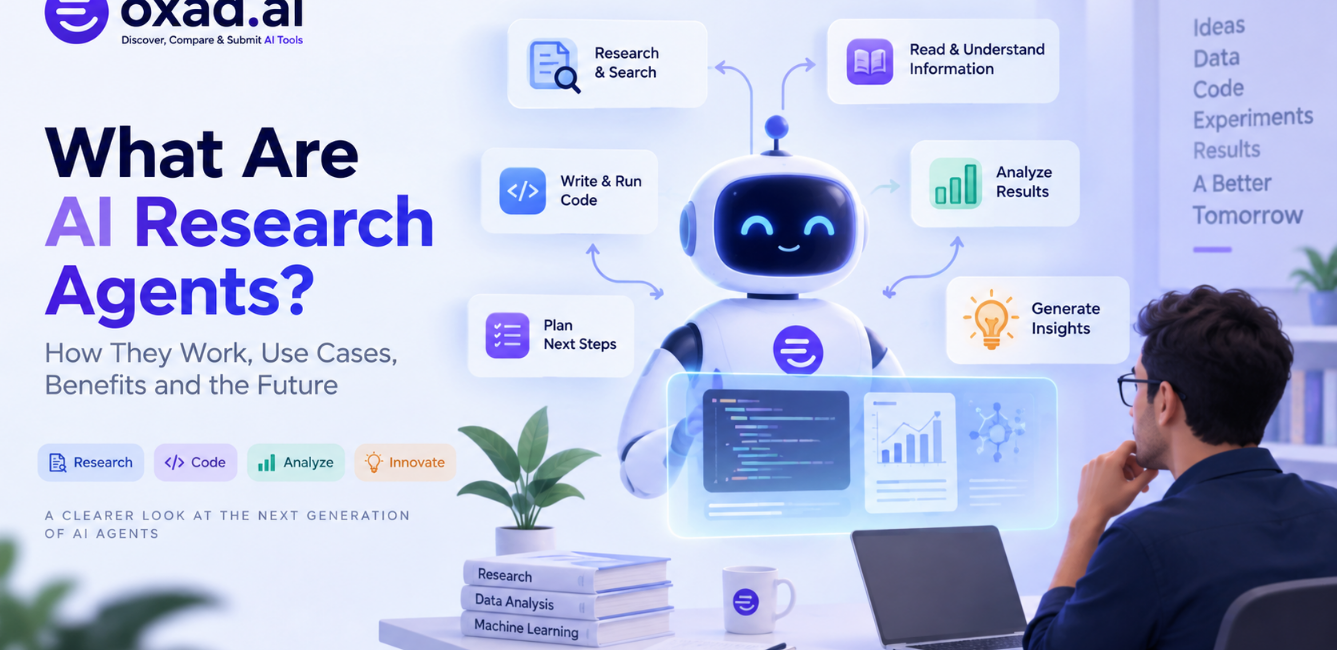
An AI research agent is designed to do more than provide an answer. It can take a research objective, break it into smaller tasks, gather information, use software tools, run experiments, analyze results, and iterate toward a useful outcome.
In simple terms: an AI research agent is an AI system that can help carry out a research process rather than simply answer a research question.
What Is an AI Research Agent?
An AI research agent is an AI-powered system that can perform multiple connected steps toward a research goal.
A traditional chatbot usually works through a relatively simple interaction:
Question → Answer
An AI research agent can work through a much longer process:
Research goal → Planning → Information gathering → Analysis → Experiment → Evaluation → Iteration → Result
The important difference is not simply that the system can generate more text. The difference is that it can participate in the workflow surrounding the research.
Depending on the system, this may include searching information, reading documents, writing code, accessing databases, executing programs, analyzing datasets, generating experiments, checking results, and repeating parts of the process.
Why Are AI Research Agents Becoming Important?
Research is often limited by more than human creativity. Researchers also spend significant amounts of time collecting information, preparing data, writing software, debugging experiments, running tests, analyzing results, and documenting their work.
These activities are increasingly suitable for AI agents because they can be broken into smaller digital tasks.
Research Activity
How an AI Agent Can Help
Literature research
Find, organize, summarize, and compare relevant information.
Data preparation
Transform, clean, classify, and structure datasets.
Programming
Write, modify, debug, and test research software.
Experiments
Run predefined experiments and compare outcomes.
Analysis
Analyze results and identify patterns or unexpected outcomes.
Documentation
Create notes, reports, explanations, and technical documentation.
This does not mean that an AI agent independently becomes a scientist. Human researchers still need to define important questions, judge evidence, validate results, and decide which conclusions are justified.
How Do AI Research Agents Work?
Although implementations differ, many research-agent workflows contain several common components.
1. The Research Goal
Everything begins with a goal.
For example, a researcher might ask an agent to investigate why a machine-learning model performs poorly on a particular dataset.
The agent needs to understand what the researcher is trying to discover before deciding which actions to take.
2. Planning
The agent can break the larger objective into smaller tasks.
For example:
Step
Possible Agent Action
Understand the problem
Inspect the task definition and existing results.
Inspect the data
Load and analyze the relevant dataset.
Inspect the code
Review the existing implementation.
Create a hypothesis
Identify possible explanations for the problem.
Test the hypothesis
Modify the experiment or code and run tests.
Evaluate
Compare the new results with the original results.
3. Tool Use
This is one of the most important differences between a chatbot and a research agent.
An agent can potentially use external tools instead of relying entirely on information contained within the model.
These tools may include:
Web search
Web scraping
Databases
Python or other programming environments
Code repositories
Scientific software
File systems
APIs
Data-analysis tools
Evaluation systems
For AI systems that need current information from the web, infrastructure such as Context.dev can provide web data and structured information that can become part of an agent workflow.
4. Execution
The agent can then perform the tasks it has planned.
For example, it might write a Python script, execute it, inspect the output, identify an error, modify the code, and run the experiment again.
This ability to move between reasoning and execution is what makes agentic research fundamentally different from simply asking an AI model for suggestions.
5. Evaluation and Iteration
A useful research workflow cannot stop after producing the first result.
The system needs some way to evaluate what happened.
If an experiment fails, the agent may investigate the failure. If the results are inconsistent, it may run additional tests. If a hypothesis is not supported, it may explore another approach.
The key idea: an AI research agent creates a loop between planning, action, observation, and revision.
AI Research Agent vs AI Assistant
The distinction can be easier to understand by comparing their workflows.
Capability
AI Assistant
AI Research Agent
Answer questions
Yes
Yes
Use external tools
Sometimes
Core capability
Plan multiple steps
Limited or user-directed
Central to the workflow
Run experiments
Usually requires user action
Can be part of the workflow
Iterate automatically
Usually limited
Important capability
Long-running tasks
Usually limited
Designed for longer workflows
The boundaries are not absolute. Modern AI assistants increasingly include agentic features, while research agents can still operate through conversational interfaces.
The more useful distinction is the workflow, not the product label.
What Can AI Research Agents Be Used For?
Scientific Research
Scientific research involves large amounts of information, data, computation, and experimentation. AI agents can potentially assist with parts of these workflows.
For example, an agent could help researchers analyze a dataset, generate code for an experiment, execute simulations, compare results, and prepare documentation.
Software Engineering Research
Software development itself can become a research environment.
An agent can investigate performance problems, test alternative implementations, analyze benchmark results, and explore different technical approaches.
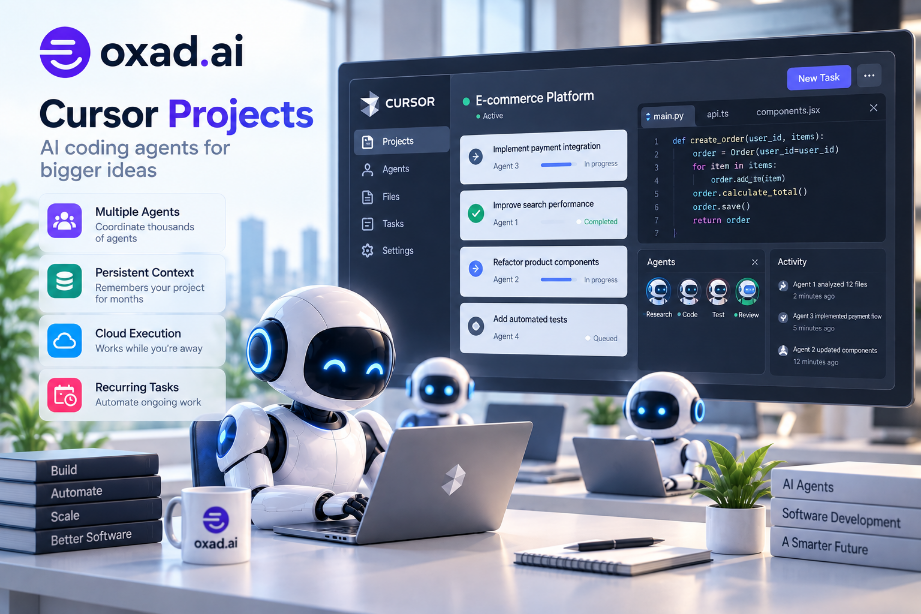
This is one reason the development of AI coding agents is closely connected to AI research agents.
For a broader look at the development environment behind these systems, see the OXAD.AI guide to AI coding tools.
Data Analysis
Research agents can also work with structured datasets.
A workflow might involve importing data, cleaning it, selecting variables, generating statistical analyses, creating visualizations, and checking whether the results support an initial hypothesis.
Technical Research
Engineers can use agentic systems to investigate documentation, compare implementation options, test APIs, inspect repositories, and build prototypes.
This can be particularly useful when a technical problem requires information from several different sources.
Why Coding Is So Important for AI Research Agents
Code is becoming one of the most important tools available to research agents.
Natural-language reasoning can help an AI system formulate an idea, but executable code allows the system to test that idea against real data or a real environment.
That loop explains why coding agents have become such an important component of modern research workflows.
Instead of producing a theoretical answer, an AI system can sometimes test an idea directly.
AI Research Agents and Multi-Agent Systems
A research task does not always need to be handled by one agent.
A more complex system could divide responsibilities between several specialized agents.
Agent Role
Possible Responsibility
Research Agent
Find and organize relevant information.
Coding Agent
Implement experiments and software changes.
Data Agent
Process and analyze datasets.
Evaluation Agent
Check experiments and compare results.
Coordinator
Manage the overall workflow and assign tasks.
This approach can make complex research workflows more modular, but it also introduces additional challenges around coordination, context sharing, cost, and verification.
The goal should not be to use as many agents as possible. The goal is to use the right amount of specialization for the task.
What Does an AI Research Agent Need?
A powerful language model alone is not enough to create a useful research agent.
The surrounding infrastructure can be equally important.
Component
Purpose
Reasoning model
Understand goals and decide what to do next.
Context
Provide the information required for the task.
Tools
Allow the agent to interact with external systems.
Execution environment
Provide a safe place to run code and experiments.
Memory
Preserve useful information across longer workflows.
Evaluation
Determine whether the agent’s actions produced useful results.
Human oversight
Review important decisions, evidence, and conclusions.
Why Context Matters So Much
A research agent cannot investigate a problem effectively if it lacks access to the information surrounding that problem.
Context can include documentation, previous experiments, datasets, scientific papers, source code, external websites, internal knowledge bases, and results from earlier steps.
This is why context engineering is becoming increasingly important for agentic systems.
The model provides reasoning capabilities, but the surrounding context determines what the agent can actually understand and act upon.
In a research workflow, this can mean the difference between an agent making a plausible suggestion and an agent working with the actual evidence required to investigate the problem.
Can AI Research Agents Conduct Research Without Humans?
Not reliably for every research problem.
AI research agents can automate parts of a research workflow, but research involves judgment that is difficult to reduce to a simple sequence of automated actions.
Researchers still need to determine whether a question is meaningful, whether evidence is reliable, whether an experimental design is appropriate, and whether a conclusion is justified.
Human oversight remains important because producing a result is not the same as producing a valid result.
An agent may successfully execute an experiment and still misunderstand the question, use an inappropriate methodology, overlook an important variable, or interpret the result incorrectly.
The most realistic near-term model is therefore human-directed research with increasingly capable AI execution.
What Are the Main Risks of AI Research Agents?
Incorrect Results
An agent can make mistakes at any stage of the workflow. A small error in data processing or code can affect every subsequent result.
False Confidence
A detailed report can appear convincing even when the underlying experiment is flawed.
Tool Errors
External tools can return incomplete, outdated, or incorrect information. Agents need mechanisms for checking the quality of their inputs.
Security Risks
Agents that can execute code, access files, browse the web, or call APIs have more capabilities than ordinary chatbots. Those capabilities also create additional security considerations.
Excessive Autonomy
A system that can continue acting for long periods needs appropriate boundaries. Human approval may be required for sensitive actions or irreversible changes.
Reproducibility
Research needs results that can be inspected and reproduced. Agent-generated workflows therefore need clear records of the data, code, tools, assumptions, and experiments involved.
AI Research Agents vs Traditional Research Workflows
Traditional Workflow
Agent-Assisted Workflow
Human searches for information
Agent can retrieve and organize information.
Human writes most experimental code
Agent can generate and modify experimental code.
Human executes experiments
Agent can execute predefined experiments.
Human checks each result
Agent can perform initial evaluation before human review.
Human repeats failed experiments
Agent can iterate within defined limits.
The purpose is not necessarily to remove humans from the process. Instead, AI can potentially reduce the amount of manual execution required between important research decisions.
How AI Coding Agents Are Becoming Research Infrastructure
The evolution of AI coding tools is closely connected to the emergence of AI research agents.
Modern coding agents can already work with repositories, files, terminals, tests, and development environments. That makes them useful beyond conventional software development.
A researcher can use similar capabilities to build an experiment, run it, inspect the results, change the implementation, and repeat the process.
In this sense, coding agents are becoming more than programming assistants. They can become an execution layer for computational research.
For an example of how open-source coding agents are evolving toward more flexible agentic workflows, see OpenCode on OXAD.AI.
What Could AI Research Agents Change?
The biggest potential change may not be that AI produces more research papers.
It may be that the cost and time required to investigate certain technical questions decreases.
If an AI system can handle parts of information gathering, implementation, experimentation, debugging, and analysis, researchers may be able to investigate more ideas within the same amount of time.
This could also change who is able to perform sophisticated technical experimentation.
Researchers who can describe a problem clearly and supervise AI tools may be able to explore technical ideas without personally implementing every line of code involved.
However, this does not remove the importance of expertise. In fact, as execution becomes easier, the ability to formulate good questions and evaluate results may become even more important.
What Is the Future of AI Research Agents?
The likely direction is not a single autonomous machine that performs all scientific research.
A more practical future is a collection of connected AI capabilities that work under human direction.
A researcher might begin with a question and use AI systems to:
Search and organize relevant information.
Identify potential approaches.
Build an experimental plan.
Write the required software.
Run controlled experiments.
Analyze the resulting data.
Compare alternative approaches.
Document the findings.
Prepare the work for human review.
Some of these capabilities already exist independently. The important development is their increasing integration into longer workflows.
The emerging model is not “AI does research instead of humans.” It is “AI handles more of the execution around human-led research.”
What Should Researchers Look for in an AI Research Agent?
Not every system marketed as an AI agent is suitable for serious research.
When evaluating one, researchers should consider several practical capabilities.
Feature
Why It Matters
Tool access
Research often requires more than text generation.
Long-context handling
Complex projects contain large amounts of information.
Code execution
Experiments often require executable software.
Data access
Agents need reliable information to investigate questions.
Evaluation
Results need to be checked rather than blindly accepted.
Human controls
Important actions should remain reviewable.
Reproducibility
Research workflows should be inspectable and repeatable.
Final Takeaway
AI research agents represent a shift from AI that answers research questions to AI that can participate in the research process itself.
The most important development is not simply better text generation. It is the combination of reasoning, context, tools, code execution, data access, experimentation, evaluation, and iteration.
AI coding agents are an important part of this transition because code gives AI systems a practical way to test ideas against real environments and data.
At the same time, research requires more than execution. Human researchers remain responsible for defining meaningful questions, evaluating evidence, understanding limitations, and deciding whether conclusions are justified.
The future of AI-assisted research will therefore likely depend on the relationship between increasingly capable agents and informed human oversight.
As these systems become better at handling long-running technical workflows, the central question may change from “Can AI answer this research question?” to “How much of the work required to investigate this question can an AI research agent safely perform?”
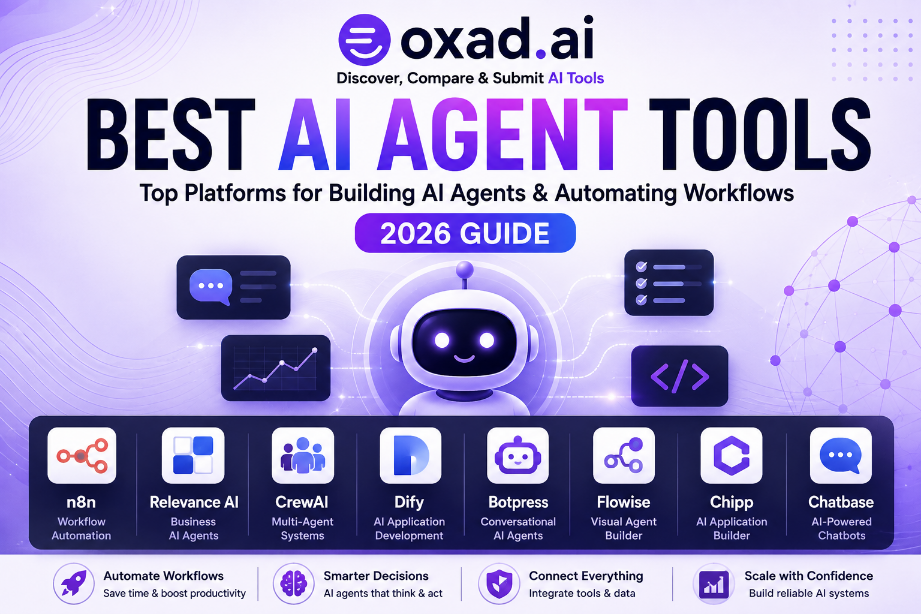
Explore more AI tools: Discover thousands of AI tools for coding, research, agents, productivity, and other workflows in the OXAD.AI directory.


6 Replies to “What Are AI Research Agents and How Do They Work?”
The breakdown of research agents is useful because it shows how planning, searching, and synthesis can work together.
I like the distinction between an agent that retrieves information and one that can organize a full research workflow.
The human review point is important here, especially when an agent combines information from several sources.
The explanation of research agents is clear, especially the way planning, searching, and synthesis fit into one workflow.
L’article explique clairement comment les agents de recherche peuvent combiner plusieurs étapes pour produire une réponse plus structurée.
The section about human review is important because research agents still need ways to verify sources and conclusions.