What Are AI Wearables and How Are They Changing Personal AI?
AI is moving beyond the screen. Instead of waiting for you to open an app, type a prompt, and ask for help, a new generation of devices is being designed to keep AI available around you through voice, cameras, sensors, and context.
That shift is becoming easier to see in September 2026. At Meta Connect 2026, Meta announced that its personal AI agent Muse is coming to its AI glasses, allowing people to interact with an agent hands-free and ask it to act on what they are looking at. Meta also announced a much larger AI-glasses lineup, with more than 100 styles expected across Ray-Ban, Oakley, and Meta Glasses by the end of the year.
At almost the same time, Alibaba introduced Qwen Intelligence, a full-stack platform designed to help smartphone makers build agentic phones that can handle complex tasks across multiple apps. HONOR is the first announced partner.
Together, these developments point to a broader question: what happens when personal AI is no longer an app you open, but an intelligence layer that stays with you?
What Are AI Wearables?
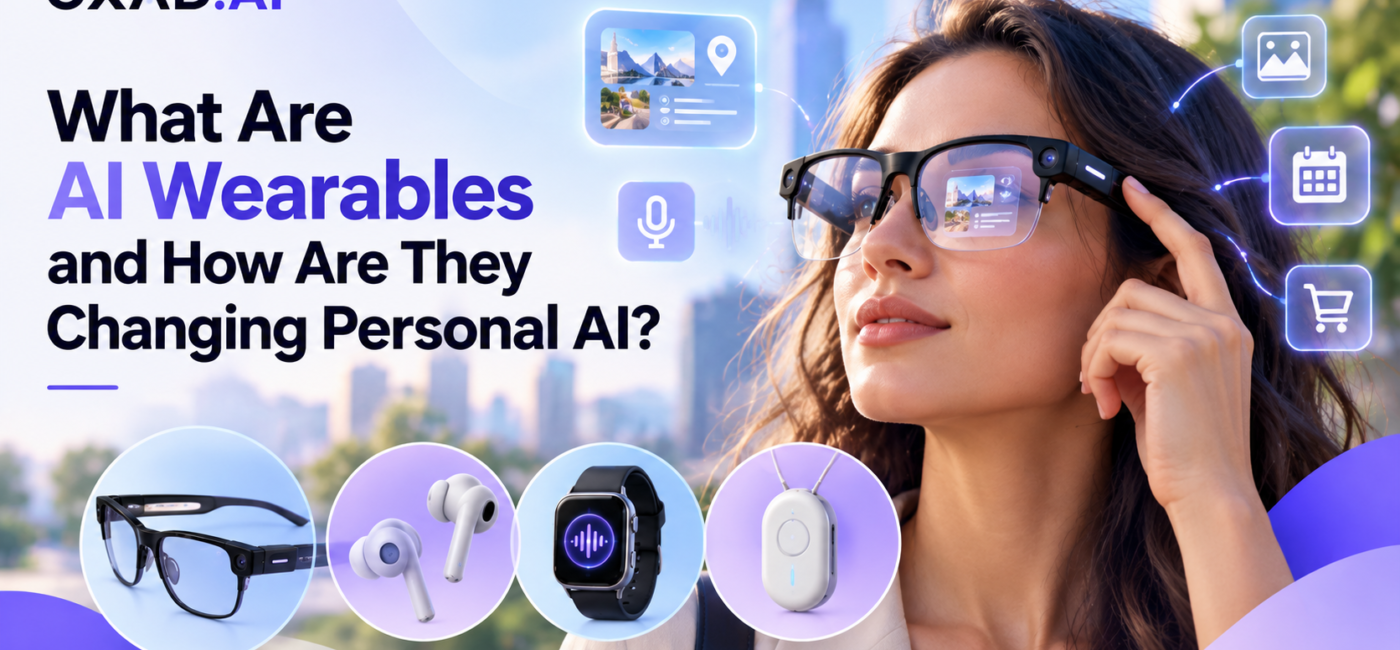
AI wearables are wearable devices that use artificial intelligence to understand information around the user and provide assistance through natural interaction. They can include smart glasses, AI earbuds, watches, pins, cameras, and future devices designed around ambient computing.
A traditional wearable mainly tracks information such as steps, heart rate, location, or notifications. An AI wearable can add another layer: it can understand voice commands, interpret images, use context, answer questions, and in more advanced systems connect to tools or agents that perform tasks.
Hands-free interaction and persistent personal context
How Are AI Wearables Different From Smart Glasses?
Smart glasses are a device category; AI wearables are a broader concept. Smart glasses can provide cameras, speakers, displays, or augmented-reality features. An AI wearable adds an intelligence layer that can understand the user’s request and potentially connect that request to actions.
For example, a conventional smart-glasses experience might display navigation information. An AI-native experience could let the user ask for directions naturally, understand the surroundings, and coordinate the next action without requiring the user to open a separate application.
How Do AI Glasses Work?
AI glasses typically combine several components:
Microphones capture voice commands and conversations when enabled.
Cameras can provide visual information about the user’s surroundings.
Speakers deliver responses without requiring a screen.
Connectivity links the device to a phone, cloud service, or AI platform.
AI models interpret language, images, and other signals.
Agents and tools can turn an instruction into a sequence of actions.
This creates a new interaction loop:
User → Voice → AI Agent → Vision + Context → Tools / Services → Action
The important change is that the user does not necessarily need to describe everything. If an AI system can access visual context, it may be able to reason about what is directly in front of the user.
What Did Meta Announce About AI Wearables?
At Meta Connect 2026, Meta announced that its personal AI agent Muse will come to its AI glasses. According to Meta, users will be able to address Muse hands-free and have the agent act on what they are looking at. Examples described by Meta include asking about a product on a shelf, a flyer on a wall, or a long list of school supplies.
Meta also said that its expanded lineup will exceed 100 AI-glasses styles across Ray-Ban, Oakley, and Meta Glasses by the end of 2026. The company is positioning the glasses as a way to access personal AI throughout the day rather than only inside a phone application.
Meta’s announcement is particularly relevant because Muse is designed as an agent rather than simply a conversational chatbot. Meta describes Muse as able to take tasks, work across connected apps, and turn goals into actions. Bringing that agent to glasses connects vision + voice + context + action in a single user experience.
Agentic smartphones are phones designed to let AI agents perform tasks across the operating system and multiple applications. Instead of asking an assistant for information and then doing the work yourself, the agent can potentially plan the task, interact with apps, and complete multiple steps.
Alibaba’s Qwen Intelligence is a recent example. Alibaba describes it as a full-stack agentic solution for smartphone makers, combining mobile-optimized models, agents, and an engineered platform for complex cross-app tasks.
HONOR is the first announced partner, and Alibaba says the upcoming HONOR Magic9 series and HONOR Robot Phone will be among the first devices incorporating Qwen Intelligence.
Alibaba Cloud’s announcement describes Qwen Intelligence as a platform for building next-generation agentic smartphones.
AI Wearables and Agentic Smartphones Are Part of the Same Shift
At first glance, AI glasses and agentic smartphones look like different product categories. The underlying idea, however, is similar: the AI agent becomes a layer between the user and digital services.
Traditional interaction
Agentic interaction
Open an app
Tell the agent what you want
Find the right feature
Agent plans the task
Move between apps
Agent coordinates tools and services
Describe what you see
Wearable can provide visual context
This can be summarized as:
Chatbot → AI Assistant → AI Agent → AI-Native Device
What Is Ambient AI?
Ambient AI is AI that is available in the user’s environment instead of requiring the user to deliberately open an application first.
The goal is not necessarily to make the AI more visible. In many cases, it is the opposite. The interface can become quieter because the user interacts through voice, vision, sensors, or context.
For example, imagine walking through a store. Instead of taking out your phone, opening an AI app, taking a photo, uploading it, and typing a question, an AI wearable could let you ask naturally while the device provides the visual context.
This is one reason AI context becomes increasingly important. The quality of the response depends not only on the model but also on what information the system knows about the user’s situation.
Why Voice Matters So Much for AI Wearables
Wearables have a major interface constraint: typing on a tiny device is inconvenient. Voice therefore becomes one of the most natural ways to communicate with an AI agent.
AI voice assistants demonstrate the broader movement from keyboard-first interaction toward conversational interfaces. In a wearable, this becomes even more important because the user may be walking, driving, exercising, cooking, or carrying something.
Voice-first interaction can also make AI feel more continuous. Instead of treating every request as a separate prompt, the system can potentially maintain a longer conversation and use context from previous interactions.
What Role Does AI Vision Play?
AI vision gives wearables another important capability: the AI can reason about visual information instead of relying only on what the user says.
That can support tasks such as identifying objects, reading signs, translating visible text, understanding a scene, or answering questions about something the user is looking at.
When vision is combined with an agent, the workflow becomes more powerful:
The user asks a question.
The wearable provides audio and visual context.
The AI interprets the situation.
The agent decides which information or tools are needed.
The agent returns an answer or performs an approved action.
Can AI Wearables Actually Take Actions?
Some current systems are moving in that direction, but the exact capabilities depend on the device, software, connected services, permissions, and rollout status.
The distinction is important. An AI model that can describe an object is not necessarily an agent. An agent can combine reasoning with tools, permissions, and workflows to perform tasks.
This is where wearable AI connects to the wider agent ecosystem. Tools such as AI voice interaction show how natural language can become an interface for computer actions, while agent systems can connect those requests to services and workflows.
What Are the Biggest Challenges?
AI wearables also introduce difficult questions that do not disappear simply because the technology is convenient.
Privacy
Devices with microphones and cameras can collect highly contextual information. Users need clear controls over when information is captured, where it is processed, and who can access it.
Security
If a wearable can access personal accounts or trigger actions, permissions become important. A useful wearable agent needs strong boundaries around sensitive operations.
Battery Life
Continuous audio, cameras, connectivity, and AI processing can consume significant power. Efficient hardware and selective processing are therefore central to the user experience.
Reliability
An agent that misunderstands a simple question is inconvenient. An agent that misunderstands an instruction and performs a real-world action can create a much larger problem. Human confirmation may remain important for sensitive actions.
Social Acceptance
Wearables that can capture audio or images raise questions about bystanders and public spaces. Industry adoption therefore depends not only on technical capability but also on social expectations, product design, and privacy controls.
Are AI Wearables the Future of Personal AI?
It is too early to know which wearable form factor will become dominant. Smart glasses, earbuds, watches, pins, phones, and other ambient devices are all being explored.
What is clearer is the direction of the interface. AI is increasingly being designed around continuous access, context, natural interaction, and action rather than a simple question-and-answer box.
Meta’s integration of Muse with AI glasses and Alibaba’s Qwen Intelligence platform for agentic smartphones are two current examples of this broader movement. They approach the problem from different hardware categories, but both place AI agents closer to the user’s everyday environment.
The bigger idea is not simply “AI glasses.” It is AI becoming an intelligence layer around the user.
AI Wearables FAQ
What are AI wearables?
AI wearables are wearable devices that use AI to understand voice, vision, context, or other signals and provide assistance.
What is an AI wearable?
An AI wearable is a device designed to make artificial intelligence available through natural, often hands-free interaction.
How do AI glasses work?
They combine microphones, cameras, speakers, connectivity, and AI models to understand requests and provide contextual assistance.
Can AI glasses see what you see?
Some AI glasses use cameras to provide visual information to an AI system, subject to device capabilities and permissions.
What are agentic smartphones?
Agentic smartphones use AI agents to plan and perform tasks across applications rather than simply answering questions.
What is ambient AI?
Ambient AI refers to intelligence that remains available in the environment instead of requiring users to open a dedicated app.
Are AI wearables the same as smart glasses?
No. Smart glasses are one type of wearable, while AI wearables include a broader range of intelligent devices.
What can AI agents do on wearable devices?
Depending on the system, they may answer questions, interpret surroundings, provide navigation, retrieve information, and perform connected tasks.
Conclusion
AI wearables represent a shift in how people may interact with artificial intelligence. The important change is not simply putting a language model inside glasses or earbuds. It is connecting AI to voice, vision, context, tools, and real-world actions.
The progression is moving from:
User → App → AI
toward a model in which the user can increasingly interact with an agent directly:
User → AI Agent → Apps, Services, and Devices
As AI glasses, agentic smartphones, and other ambient devices develop, personal AI may become less like an application we visit and more like an intelligence layer that travels with us.
That is the real significance of AI-native wearables.