Context.dev Review: Pricing, Features, API and Best Alternatives
Building an AI application often requires more than a powerful language model. If an AI agent needs current information from the web, developers also need a reliable way to collect, clean, structure, and deliver that information to the application.
Context.dev is a web data platform designed for AI agents, LLM applications, RAG systems, and developer workflows. Instead of building and maintaining your own collection of browsers, proxies, parsers, crawlers, and extraction pipelines, Context.dev provides these capabilities through an API.
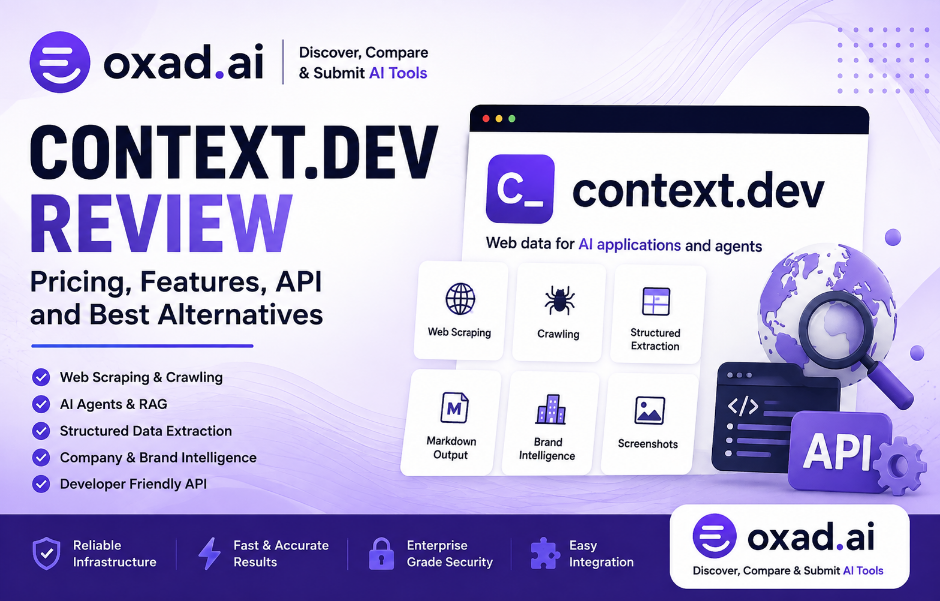
The platform can scrape individual URLs, crawl websites, discover sitemaps, return clean Markdown or HTML, extract structured data, retrieve brand information, capture screenshots, and provide other forms of web and company data.
But is Context.dev actually worth using? How much does it cost? How does its API work? And how does it compare with alternatives such as Firecrawl?
This Context.dev review looks at the platform from a practical perspective, covering its main features, pricing, use cases, advantages, limitations, and alternatives.
Quick verdict: Context.dev is particularly interesting for developers building AI agents, RAG applications, research systems, and products that need live web information. Its strongest differentiator is the combination of web scraping, crawling, structured extraction, and company or brand data through one API.
Context.dev is a developer platform for bringing live web and company information into software applications.
Traditional web scraping usually requires several separate components. A developer may need a headless browser for JavaScript-heavy websites, proxy infrastructure for difficult pages, HTML parsing, content cleaning, retry logic, and custom extraction rules.
Context.dev attempts to simplify that architecture by providing these capabilities behind an API.
According to its official documentation, the platform can return web content as clean Markdown, raw HTML, images, screenshots, or structured JSON. It can also crawl websites, discover sitemaps, and extract information according to a developer-defined schema.
This makes the platform particularly relevant to applications where web information eventually needs to be consumed by an AI model.
Why Context.dev Is Interesting for AI Applications
AI applications frequently suffer from one fundamental limitation: the model may not know what is happening on the web right now.
A language model can be highly capable while still lacking access to the latest pricing page, documentation update, product information, company announcement, or website content.
A web data API can provide the missing layer.
Instead of asking an AI application to rely exclusively on previously learned information, developers can retrieve fresh content and pass it into the model’s context.
That architecture is particularly useful for:
AI agents that need live web information.
Retrieval-augmented generation systems.
Research assistants.
Competitive intelligence applications.
AI search systems.
Company and brand enrichment.
Automated monitoring systems.
Knowledge bases.
Data enrichment pipelines.
Developer tools that need current documentation.
Context.dev specifically positions its web data infrastructure around AI agents and LLM applications, with outputs designed to be usable by downstream AI systems.
Context.dev Features
The platform goes beyond basic webpage scraping. Its functionality can be divided into several major areas.
Web Scraping
Context.dev can retrieve content from individual URLs and return it in formats such as Markdown or HTML.
The Markdown workflow is particularly useful for AI applications because developers often want readable content rather than a large amount of unnecessary HTML markup.
The service also supports JavaScript rendering and automatic handling of different retrieval strategies when a website requires additional processing.
Website Crawling
Sometimes one webpage is not enough.
An AI application may need an entire documentation site, product website, knowledge base, or collection of related pages.
Context.dev provides website crawling capabilities that allow developers to move from individual-page retrieval toward larger website ingestion workflows. The platform also supports sitemap discovery and crawling controls.
Markdown Extraction
One of the most useful features for AI developers is the ability to retrieve clean Markdown.
Instead of passing raw HTML into an LLM, developers can receive content in a more readable format and then use it in prompts, embeddings, RAG pipelines, or agent workflows.
This can reduce the amount of unnecessary markup an application needs to process.
Raw HTML Extraction
Markdown is not always the right output.
Developers building custom parsers, indexing systems, or applications that require access to the underlying DOM may prefer raw HTML.
Context.dev provides an HTML scraping endpoint that returns the retrieved document and resolved URL, with JavaScript rendering available for dynamically generated pages.
Structured Data Extraction
This is one of the more interesting features for developers building AI-powered applications.
Instead of simply receiving a webpage, developers can define a JSON Schema describing the information they want and ask Context.dev to extract that information from a website.
For example, an application could define fields such as company name, pricing tiers, industry, founding year, or product information and receive structured JSON rather than manually parsing the page.
Context.dev states that a successful extraction costs 10 credits and can analyze multiple pages within a crawl for a single extraction request.
Brand Intelligence
Context.dev is not limited to generic webpage content.
The platform also provides company and brand-related data, including logos, colors, fonts, company information, and other brand attributes.
This can be useful for applications that need to enrich company records, automatically populate onboarding forms, or display consistent company information inside a product.
Product Data Extraction
For applications working with commerce or product information, Context.dev also provides product extraction capabilities.
This opens potential use cases around product discovery, competitive research, catalog enrichment, and AI shopping or research applications.
Screenshots and Visual Data
Web content is not always purely textual.
Context.dev also supports webpage screenshots, which can be useful when an application needs visual context in addition to textual information.
Context.dev API
Context.dev is primarily designed as an API-first platform.
The basic workflow is straightforward: obtain an API key, send a request specifying the information you need, and receive machine-readable data that can be incorporated into your application.
The platform provides SDKs and examples for multiple programming environments, including JavaScript and Python, alongside direct API access.
This makes Context.dev particularly attractive for developers who do not want to build an entire scraping infrastructure themselves.
A Simple Development Workflow
URL or website → Context.dev → Clean content or structured data → Your application → LLM, agent, database or RAG system
The main advantage is reducing the amount of scraping infrastructure that your own engineering team needs to maintain.
Context.dev Pricing
Context.dev currently uses a credit-based pricing model.
There is a free option for testing the API, followed by Developer, Pro, Scale, and Enterprise plans.
Plan
Price
Included Credits
Best For
Free
$0
250 personal / 500 work-email one-time credits
Testing and experimentation
Developer
$25/month
10,000
First real workflows
Pro
$149/month
200,000
Production applications
Scale
$499/month
1,000,000
High-volume workloads
Enterprise
Custom
2M+ credits
Large organizations
According to the current official pricing information, annual billing provides two months of savings compared with monthly billing. The Developer plan includes 10,000 credits, Pro includes 200,000, and Scale includes 1 million credits. Enterprise plans provide custom limits and additional security and procurement features.
Context.dev also states that standard scraping costs one credit per successful request or page, while more advanced operations such as structured extraction can consume more credits. Failed or blocked requests are not billed.
Is Context.dev Free?
Yes, Context.dev provides a free option for developers who want to test the API.
The current free allocation is 250 one-time credits for personal-email signups and 500 one-time credits for work-email signups. The free option does not require a credit card according to the official pricing information.
This makes the free tier useful for testing an integration before committing to a paid subscription.
However, developers planning a production application should calculate expected usage rather than assuming that the free allocation will cover ongoing workloads.
Context.dev for AI Agents
AI agents are one of the strongest potential use cases for Context.dev.
An agent may need to perform tasks such as checking a company’s website, finding current product information, reading documentation, researching competitors, or verifying information before producing an answer.
Instead of embedding a large web crawler directly into the agent architecture, developers can use Context.dev as a dedicated web-data layer.
The platform’s combination of scraping, crawling, structured extraction, and company data is particularly relevant when an agent needs more than a simple search result.
Context.dev for RAG Applications
Retrieval-augmented generation depends heavily on the quality and freshness of the information retrieved before the language model generates an answer.
If the underlying knowledge base is outdated, the model may produce answers based on information that is no longer accurate.
Context.dev can be used to retrieve website content, convert it into cleaner formats, and feed that information into a downstream indexing or RAG pipeline.
For example, a documentation assistant could periodically crawl a website, convert its pages into Markdown, process the content into embeddings, and update its knowledge base.
The exact architecture will depend on the application, but the basic principle is simple: fresh web content becomes an input to the AI system rather than something the model has to remember permanently.
Context.dev for Web Scraping
Traditional scraping often becomes difficult when websites use JavaScript, dynamic rendering, changing layouts, or anti-bot systems.
Context.dev aims to abstract much of that complexity.
Its official documentation states that JavaScript rendering, proxy escalation, and bot-detection handling are available through the service rather than requiring developers to configure these components independently.
This can be particularly useful for teams that would rather spend engineering resources on their product than maintaining scraping infrastructure.
Context.dev vs Firecrawl
One of the most relevant comparisons is Context.dev vs Firecrawl.
Both platforms target modern web-data workflows and are particularly relevant to AI developers. Both can help transform web content into formats that are easier for AI applications to consume.
However, their positioning is not identical.
Firecrawl has become well known for AI-oriented crawling, scraping, mapping, search, and content extraction. Context.dev combines similar web extraction capabilities with a broader emphasis on structured company, brand, product, and enrichment data.
Requirement
Context.dev
Firecrawl
AI-ready web content
Yes
Yes
Markdown extraction
Yes
Yes
Website crawling
Yes
Yes
Structured extraction
Yes
Yes
Brand/company enrichment
Strong focus
Less central
AI agent workflows
Strong fit
Strong fit
If you primarily need clean web crawling for an AI application, both are worth evaluating. If your application also needs company, brand, product, or enrichment data, Context.dev becomes particularly interesting.
You can also explore Firecrawl on OXAD.AI for a separate overview and comparison point.
Context.dev vs Other Alternatives
Context.dev is not the only option available to developers.
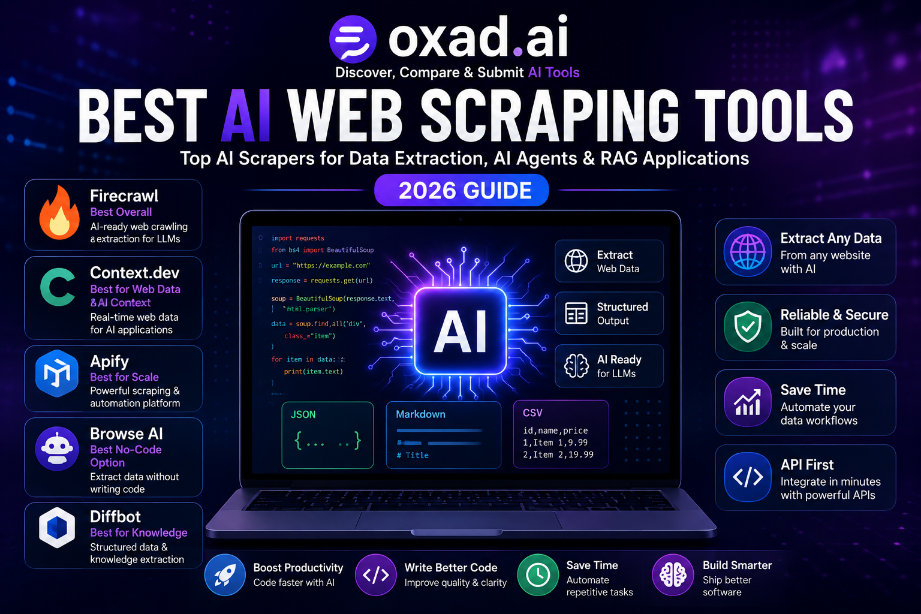
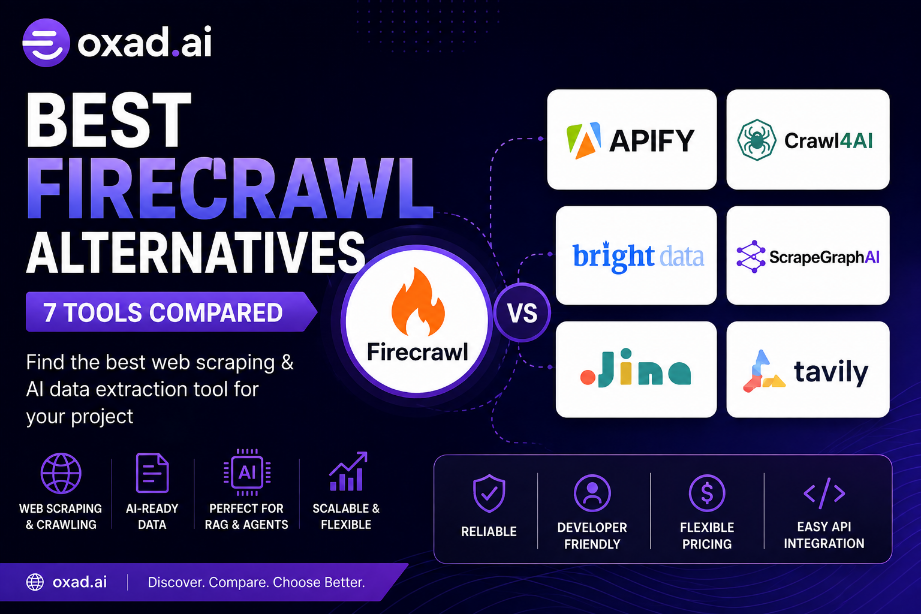
Depending on your architecture, you may also consider platforms such as Apify, Bright Data, Crawl4AI, Jina Reader, or other web-data services.
The important distinction is that these products can solve different problems.
For example, an open-source framework may be preferable if self-hosting and maximum control are priorities. A marketplace-oriented scraping platform may be more useful if you need pre-built scrapers for specific websites. An enterprise proxy provider may be more appropriate for very large-scale data collection.
That means the “best” Context.dev alternative depends on the actual requirements of your application.
Context.dev Pros and Cons
Pros
Cons
Strong fit for AI agents and RAG
Credit-based pricing requires usage planning
Clean Markdown and structured outputs
Advanced extraction consumes more credits
Web crawling and scraping in one platform
Large-scale workloads may require higher plans
Company and brand enrichment capabilities
Some features may be unnecessary for simple scraping
Free testing allocation
Enterprise features require custom plans
Failed requests are not billed
Actual cost depends on endpoint usage
Who Should Use Context.dev?
Context.dev is particularly suitable for developers and organizations that need web information as part of a larger software product.
AI Agent Developers
Agents that need fresh web context can use Context.dev as a retrieval layer.
RAG Developers
Teams building knowledge systems can use the platform to retrieve and process current website content.
SaaS Companies
Companies can use web and company data to enrich onboarding, research, personalization, or internal workflows.
Market Intelligence Teams
Structured extraction and company information can support competitive research and monitoring workflows.
Developers Building Data Pipelines
Teams that do not want to maintain their own browser, proxy, and scraping infrastructure can use the API as an external web-data layer.
Who May Not Need Context.dev?
Context.dev may be unnecessary if your project only requires occasional manual web scraping.
It may also be excessive for a simple one-off data collection task where building a small local script is sufficient.
Similarly, developers who require complete control over every component of their scraping infrastructure may prefer an open-source or self-hosted approach.
The platform makes the most sense when web data is an ongoing part of an application rather than an isolated task.
Is Context.dev Worth It?
For developers building AI-powered products, Context.dev can be worth considering because it addresses several difficult infrastructure problems at once.
The value is not simply in retrieving a webpage. The bigger advantage is having a unified API that can provide web content, structured information, company data, brand information, and other enrichment capabilities.
For a production AI application, reducing the amount of infrastructure that your team needs to build and maintain can be valuable even when a managed API costs more than a basic custom scraper.
However, the economics depend on your workload. Developers should estimate monthly requests, extraction requirements, crawl frequency, and expected growth before selecting a paid plan.
How to Evaluate Context.dev Before Production
The best way to determine whether Context.dev is appropriate for your project is to test it using the websites and workflows that matter to you.
Do not evaluate a scraping API only with simple static pages.
Instead, test a representative selection that includes:
Static websites.
JavaScript-heavy applications.
Documentation websites.
Long-form content.
Product pages.
Pages containing structured information.
Websites requiring more advanced retrieval.
Then measure the quality of the returned content, response time, successful retrieval rate, extraction accuracy, and total cost.
This is more useful than relying exclusively on marketing claims or benchmark comparisons.
Internal OXAD.AI Tools Worth Exploring
Context.dev sits within a broader ecosystem of AI developer, research, and productivity tools. Depending on your project, other tools in the OXAD.AI directory may complement the same workflow.
For web crawling and AI-ready content, explore Firecrawl.
For developer code review workflows, CodeRabbit is a relevant tool to investigate.
For technical application development and automation, VIKTOR offers a different approach.
For AI-assisted development workflows, you can also explore Runable and Weav.
And if your application involves research and competitive intelligence, Littlebird may be worth exploring as well.
This broader ecosystem illustrates an important point: Context.dev does not have to operate in isolation. Depending on your architecture, different AI tools can address different layers of the same workflow.
Our Assessment
Context.dev is an interesting example of how web infrastructure is changing alongside the growth of AI agents.
Traditional scraping was largely about collecting HTML. Modern AI applications need something different: current information that can be retrieved quickly, cleaned, structured, and passed directly into a model or data pipeline.
Context.dev is built around that shift.
Its combination of web scraping, crawling, structured extraction, brand intelligence, and company data makes it more than a simple webpage scraper. The platform is particularly compelling when web information is a core component of the product you are building.
At the same time, developers should not choose it simply because it has a long feature list. The right decision depends on the scale, data sources, extraction requirements, architecture, and budget of the project.
Final Verdict
Context.dev is a strong option for developers who need live web and company data inside AI-powered applications.
Its biggest strengths are the API-first approach, AI-friendly outputs, structured extraction, website crawling, and additional company and brand intelligence capabilities.
The free allocation makes it possible to experiment before committing to a paid plan, while the paid tiers are designed to scale from early development workflows to high-volume production applications. 15
It will not necessarily be the right choice for every scraping project. Simple projects may not need a dedicated platform, while teams that prioritize self-hosting or specialized scraping infrastructure may prefer another solution.
But for developers building AI agents, RAG systems, research assistants, enrichment products, and applications that need fresh web context, Context.dev deserves a serious evaluation.
Looking for Live Web Data for Your AI Application?
Context.dev combines web scraping, crawling, structured extraction, and company intelligence through an API designed for modern AI workflows.
Context.dev is an API platform that provides web scraping, crawling, structured extraction, company data, and brand intelligence for applications and AI agents.
Is Context.dev free?
Yes. Context.dev offers a free allocation for testing, with one-time credits depending on whether you use a personal or work email.
How much does Context.dev cost?
Current paid plans start at $25 per month for Developer, followed by Pro at $149 and Scale at $499, with custom Enterprise plans available.
Does Context.dev support web scraping?
Yes. Context.dev supports scraping webpages into Markdown, HTML, images, and other machine-readable formats.
Can Context.dev crawl entire websites?
Yes. The platform supports website crawling and sitemap discovery for workflows that require content from multiple pages.
Can Context.dev extract structured data?
Yes. Developers can define a JSON Schema and use Context.dev to extract structured information from websites.
Is Context.dev useful for AI agents?
Yes. Live web retrieval and structured extraction make Context.dev particularly relevant to AI agents that need current external information.
Is Context.dev good for RAG?
It can be useful for RAG pipelines because it can retrieve current web content and return it in formats suitable for downstream processing.
Context.dev vs Firecrawl: which is better?
Neither is universally better. Context.dev is particularly interesting when web crawling is combined with structured company and brand data, while Firecrawl is a strong option for AI-focused crawling and web content workflows.
Who should use Context.dev?
Developers building AI agents, RAG systems, research tools, enrichment products, and applications that depend on fresh web data are among the strongest potential users.