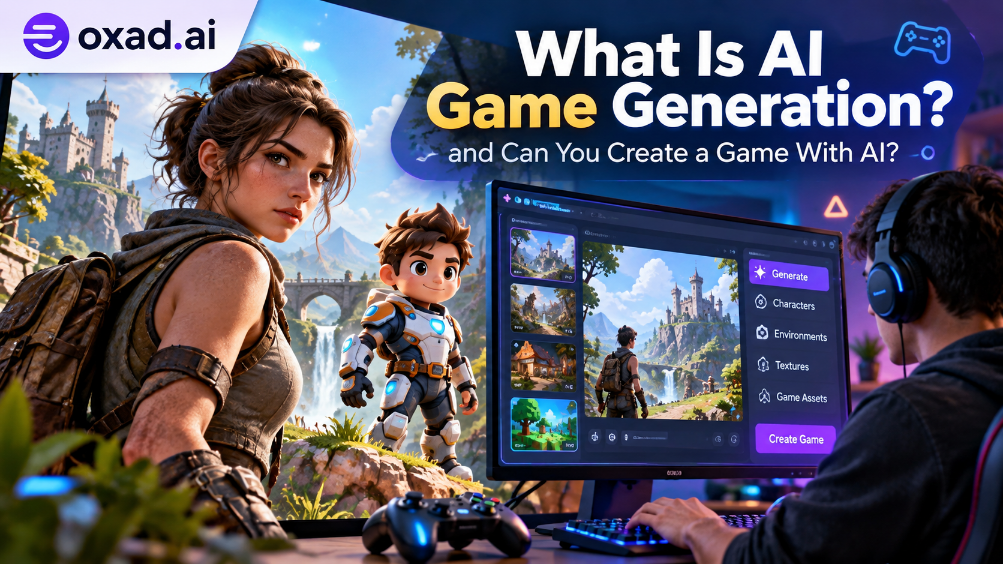
What Is AI Game Generation and Can You Create a Game With AI?
AI game generation is changing who can turn a game idea into something playable. Instead of beginning with a game engine and writing every system by hand, creators can describe a concept in ordinary language, test an AI-generated prototype, and improve it through follow-up instructions. But making a playable experiment is not the same as shipping a polished game.
The key idea
AI can lower the barrier to starting a game. Human direction, testing, and design still determine whether that game is worth playing.
Google’s experimental Playground platform, announced on October 7, 2026, makes this shift especially visible: users can describe a game, play the result in a browser, and refine it conversationally. Google says the initial game-creation experience is available to adults in the United States, with access expanding in phases. Its planned Unity Spark integration is intended to support more advanced mechanics and higher-fidelity 3D experiences.
What Is AI Game Generation?
AI game generation is the use of generative AI to create or modify parts of a video game from instructions, examples, or reference assets. Depending on the tool, it may generate a playable prototype, gameplay logic, environments, characters, dialogue, code, or supporting art and audio.
It is useful to separate three related ideas:
AI-assisted assets
Generate textures, concept art, sound effects, dialogue, or character ideas for a game.
AI-assisted development
Help write code, explain bugs, build levels, or speed up work inside a game engine.
Prompt-to-game
Turn a natural-language description into an interactive game that can be tested and refined.
These approaches can overlap, but they solve different problems. A tool that generates a character image does not necessarily create game rules, collision detection, controls, or a playable level. A related but distinct development is AI NPCs: intelligent characters inside a game that may use contextual dialogue, memory, and adaptive behavior. Game generation creates or modifies the game itself; AI NPC technology focuses on how its characters behave.
How Does Text-to-Game AI Work?
A prompt-to-game tool translates a creator’s description into a structured interactive experience. The exact implementation varies by platform, but a typical workflow looks like this:
1. Describe Idea and rules
→
2. Generate Logic and assets
→
3. Playtest Find problems
→
4. Refine Iterate and improve
The process is iterative: a first generation is a starting point, not proof that the game is complete or reliable.
Example prompt
Create a 2D platform game set on floating islands. The player can jump twice, collect five glowing crystals, and avoid moving obstacles. Add a clear start screen, a restart button, and a final screen when all crystals are collected. Use readable controls and gradually increase the difficulty.
This prompt is more useful than “make a fun game” because it defines the genre, player abilities, objective, obstacles, and completion condition. After the first build, ask for one focused change at a time, then test whether the change actually works.
What Can You Create With an AI Game Generator?
Project type
What AI may help with
What to check
Trivia or quiz
Questions, scoring, rounds, feedback
Answer accuracy and scoring
Arcade prototype
Movement, targets, collision rules
Controls, balance, repeatability
Interactive story
Characters, branching dialogue, choices
Continuity and meaningful choices
Game-jam concept
A quick proof of concept to share
Originality and technical limits
Large commercial game
Drafts, assets, code assistance, prototypes
Performance, security, content, production quality
Small, clearly defined games are generally a better starting point than a large open-world project. Complexity grows quickly when a game needs persistent progression, sophisticated enemies, networking, save systems, accessibility options, or performance across many devices.
Google Playground and Unity Spark: What Is the Difference?
The October 7 announcement from Google and Unity is a useful example of two stages in AI-assisted game creation. Playground is the experimental, browser-based starting point. Unity Spark is the planned extension aimed at creators who want to develop more advanced experiences using Unity technology.
Area
Google Playground
Unity Spark
Status
Experimental platform launched October 7
In testing; closed beta announced as coming soon
Main goal
Create, play, refine, and share custom browser games
Support more advanced mechanics and higher-fidelity 3D
Typical user
Beginners, hobbyists, idea testers
Creators looking to develop a concept further
Availability
Initially adults aged 18+ in the United States; creation access rolls out in phases
Not generally available at announcement
Availability and features can change as these experimental products evolve. Check the official product pages before planning a project around them.
Watch the Official Playground Overview
This official overview introduces Google’s prompt-based game creation experience and shows the idea behind making a game through natural-language instructions.
AI Game Generation vs. Traditional Game Development
Dimension
Prompt-based creation
Traditional engine workflow
Getting started
Fast for simple concepts
Requires learning tools and workflows
Control
Convenient, but output can be unpredictable
Detailed control over systems and implementation
Debugging
May require repeated prompts and manual checks
Developer can inspect code, tools, and logs
Best fit
Experiments, prototypes, simple games
Complex, scalable, production-ready projects
Professional use
Can accelerate early work
Often remains important for shipping and maintenance
The two approaches are not mutually exclusive. AI can help a developer explore mechanics or create a prototype, after which a conventional engine and a human team can refine, optimize, and maintain the result. If you want to continue from a prototype into code, see our guide to AI coding tools.
Can AI Create a Complete Commercial Game?
AI can generate playable experiences, but “playable” and “commercially ready” are different standards. A commercial release may need reliable controls, balanced difficulty, original art direction, stable performance, accessibility, localization, platform compliance, privacy protections, and extensive testing.
AI output may also contain bugs, repetitive level design, inconsistent art, shallow progression, or mechanics that seem plausible in a description but fail during play. Human creators still need to decide what makes the game distinctive and whether its systems work together.
Reality check
Treat an AI-generated game as a draft until you have tested it. Check every objective, restart path, collision, score update, save function, and user-facing instruction. Do not assume a successful generation means the experience is bug-free.
How to Create Your First AI Game
Choose one small idea. Start with a quiz, a short platformer, a simple racing game, or a single-screen arcade challenge.
Define the rules. Specify the player’s goal, controls, obstacles, scoring, and what counts as winning or losing.
Generate a first prototype. Use a prompt-based tool such as Playground if it is available to you, or an AI-assisted game-development workflow.
Play it yourself. Try the obvious path and the unusual path. Look for broken controls, impossible levels, and unclear instructions.
Request focused changes. Ask to fix one problem or adjust one mechanic at a time.
Check originality and rights. Avoid asking the system to copy protected characters, art, music, or a specific game’s distinctive assets.
Decide what comes next. Share a small experiment, or move the concept into a full game engine if it needs deeper control.
What About Copyright, Ownership, and Commercial Use?
Rules differ by tool, jurisdiction, and asset source. Before publishing or monetizing a game, review the platform’s terms for ownership, commercial use, generated assets, user-uploaded references, and attribution. Keep records of assets you created yourself or have permission to use.
Do not assume that a prompt makes a near-copy of a famous game safe to publish. Build a distinct setting, visual identity, characters, sounds, and mechanics, and seek qualified legal advice if rights are central to a commercial release.
Where AI Game Creation Fits in the Wider Creator Toolkit
AI game generation is part of a broader change in creative software: people can describe an outcome, generate a first version, and then refine it through conversation. The same general pattern appears in coding and visual production, though the requirements for interactive software are more demanding because the result must respond correctly to player input.
For related workflows, explore our guides to AI graphic design tools and AI video co-directors. These cover adjacent creative tasks without implying that an image or video generator can replace a game engine.
Frequently Asked Questions
What is an AI game generator?
An AI game generator is a tool that uses prompts or other inputs to create or modify a playable game, its mechanics, or supporting assets.
Can I create a game with AI without coding?
Yes, some tools let beginners generate simple browser games using natural-language prompts. More complex projects may still require coding, testing, and engine knowledge.
What is Google Playground?
Playground is Google’s experimental browser-based platform for creating, playing, refining, and sharing custom games with text prompts. At launch, availability was limited to adults in the United States, and creation access was rolling out in phases.
What is Unity Spark?
Unity Spark is a planned AI-assisted game-creation experience announced by Unity and Google. The companies said it is intended to add advanced mechanics, higher-fidelity 3D capabilities, and Unity runtime flexibility.
Can AI make a 3D game?
Some AI-assisted workflows can help create or prototype 3D experiences, but results depend on the tool and project scope. Advanced 3D games still need careful design, optimization, and testing.
Are AI-generated games original?
They can combine ideas in new ways, but originality is not guaranteed. Creators should review the result, avoid copying protected material, and make deliberate creative choices.
Can I sell a game made with AI?
Possibly, but check the platform terms, asset licenses, and applicable laws before monetizing it. Commercial readiness also requires quality assurance and a clear user experience.
Will AI replace game developers?
AI may automate parts of prototyping and production, but game development also involves creative direction, systems design, testing, collaboration, and ongoing support. It is better viewed as a changing toolset than a complete replacement.
Final Takeaway
AI game generation makes it easier to move from an idea to a playable first version. Google’s Playground launch and the planned Unity Spark integration show how prompt-based creation is moving toward a more accessible entry point for interactive entertainment.
The opportunity is real, but so are the limits. Use AI to explore ideas, test mechanics, and accelerate early work; then apply human judgment to make the game original, stable, fair, and genuinely enjoyable. The strongest results are likely to come from creators who treat AI as a collaborator—not as a substitute for design and playtesting.