What Is an AI Video Co-Director and How Does It Work?
AI video is moving from generation to direction. Instead of asking an AI model to create one clip from one prompt, a new class of systems can plan a sequence, break it into shots, maintain characters and environments, generate multiple clips, inspect the results, and revise weak shots.
This emerging approach is often described as an AI video co-director. The idea is not that AI replaces a human filmmaker. Instead, AI becomes a production partner that handles the repetitive orchestration between a creative idea and a coherent finished video.
Recent research from Google describes an AI video co-director as a hierarchical multi-agent framework that treats long-form video generation as a planning and optimization problem. The system sits above video models such as Gemini and Veo and coordinates tasks such as multi-shot prompting, shot chaining, visual continuity, and closed-loop refinement.
What Is an AI Video Co-Director?
An AI video co-director is an AI system that helps plan, generate, evaluate, and refine a video across multiple shots rather than simply producing a single clip from a text prompt.
The key difference is orchestration. A traditional text-to-video workflow might look like:
Prompt → Video Clip
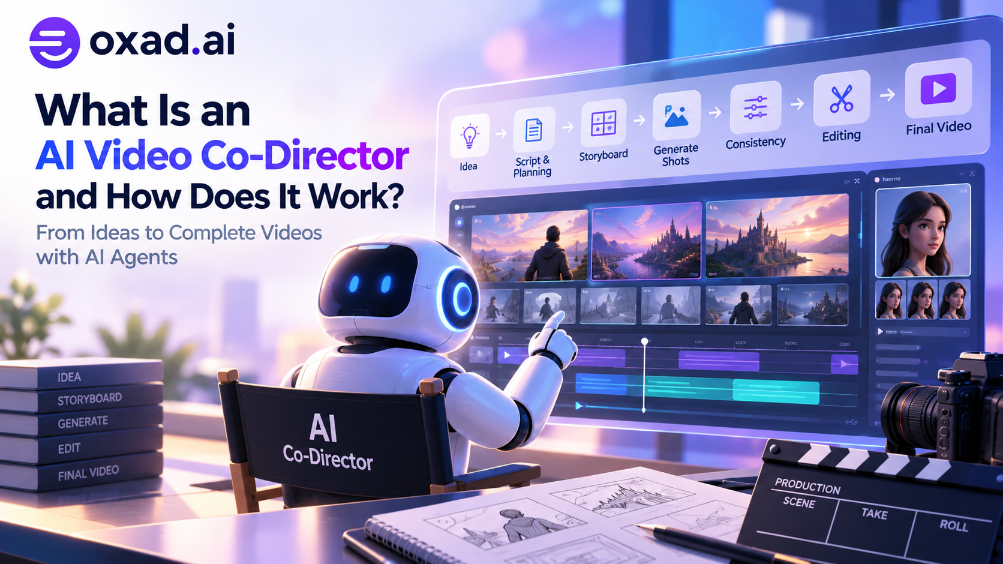
An agentic video workflow looks more like:
Idea
↓
Story Planning
↓
Storyboard + Shot List
↓
References + Continuity Constraints
↓
Generate Multiple Shots
↓
Visual Review
↓
Regenerate Weak Shots
Final Edit
This makes the co-director concept closer to an agentic production system than a simple video generator.
Why Is AI Video Moving Beyond One Prompt?
Generating an attractive five- or ten-second clip is different from creating a coherent story that lasts several minutes.
Longer videos introduce problems that are difficult to solve with independent prompts. A character can change appearance between shots. A room can change layout. Lighting can drift. Props can disappear. Camera logic can become inconsistent. A scene may look impressive by itself but make little narrative sense when placed next to the previous shot.
Google’s recent research describes these problems as visual drift, feature drift, content collapse, and error propagation. The research argues that long-form generation needs global planning and world-state tracking rather than treating every shot as an isolated generation task.
How Does an AI Video Co-Director Work?
An AI video co-director can be understood as a group of specialized agents or stages working around one or more video generation models.
Stage
What the AI Does
Creative brief
Understands the goal, audience, style, duration, and narrative idea.
Planning
Builds a story structure and determines what must happen in each scene.
Storyboard
Converts the story into shots, camera directions, actions, and visual references.
Continuity
Tracks characters, locations, objects, lighting, style, and other persistent elements.
Generation
Sends optimized instructions and references to video or image models.
Evaluation
Checks visual quality, narrative alignment, continuity, and technical problems.
Refinement
Regenerates or edits problematic shots and repeats the review loop.
What Is the Role of Storyboard Planning?
Storyboarding becomes much more important when AI has to generate a sequence instead of one isolated clip.
A storyboard gives the system an intermediate representation between the human idea and the video model. Each shot can contain information about framing, camera movement, characters, environment, action, duration, dialogue, sound, and continuity constraints.
Runway’s recent guide to AI storyboarding similarly describes a storyboard as a shot-by-shot visual plan containing framing, action, camera movement, dialogue, timing, and sound notes. This planning layer moves important creative decisions earlier in the workflow, before generation costs accumulate.
How Does an AI Video Co-Director Maintain Character Consistency?
Character consistency is one of the central problems in multi-shot AI video.
A co-director can maintain a structured representation of important visual entities. Instead of giving each shot a completely independent prompt, the system can carry forward a character sheet, reference image, appearance description, wardrobe, environment details, and other visual anchors.
For example, a character record might contain:
Character: Maya
Appearance: short dark hair, green jacket, brown boots
Age: adult
Visual style: cinematic documentary
Continuity rules: same clothing and facial identity across scenes
Reference: approved character image
The system can then inject the relevant constraints into every shot involving Maya. This does not guarantee perfect consistency, but it gives the generation pipeline explicit information to preserve.
What Is Agentic Video Generation?
Agentic video generation describes video workflows in which AI agents perform multiple connected production tasks instead of generating a clip from a single instruction.
The important word is agentic. An agent can observe the current state, choose an action, use a tool, inspect the result, and decide what should happen next.
For video, this can create a loop such as:
Plan → Generate → Inspect → Correct → Generate Again
This is fundamentally different from simply clicking “generate” repeatedly until a good clip appears.
How Is an AI Video Co-Director Different From an AI Video Generator?
Capability
AI Video Generator
AI Video Co-Director
Text-to-video generation
Core
Core
Shot planning
Limited or separate
Core
Storyboard
May be available
Central planning layer
Cross-shot memory
Often limited
Explicitly managed
Automatic evaluation
Usually limited
Part of the workflow
Regeneration decisions
Usually human-driven
Can be agent-driven
Long-form orchestration
Limited
Primary objective
The two categories overlap. A modern video platform can contain both generation and agentic orchestration. The distinction is about where the intelligence sits: inside a single generation request or across the entire production workflow.
Can AI Create an Entire Video Automatically?
Increasingly, AI systems can automate substantial portions of video production, but “entirely automatically” needs qualification.
A complete production may involve writing, visual planning, asset creation, video generation, voice, music, editing, captions, quality control, and publishing. Agentic systems can coordinate many of these steps, but creative approval, factual review, brand requirements, and final quality decisions can still benefit from human oversight.
The most useful model is therefore often human-directed automation: the human defines the creative objective and boundaries while the AI handles repetitive orchestration.
What Does the Visual Review Agent Do?
A major difference between agentic video generation and simple prompting is the ability to evaluate the output.
A review agent can inspect generated frames or clips and look for problems such as:
Character appearance changing between shots.
Objects disappearing or changing shape.
Unexpected camera movement.
Incorrect scene composition.
Visual artifacts.
Broken narrative continuity.
Incorrect timing or pacing.
Mismatch between the shot and the storyboard.
If the result fails a defined check, the workflow can send feedback to the generation stage and request a targeted revision rather than regenerating the entire project.
Why Is Closed-Loop Video Generation Important?
Traditional prompting is often open-loop: the user provides an instruction and receives an output.
This architecture is useful because video generation is probabilistic. A strong prompt does not guarantee that every shot will be correct. The ability to detect and repair failures can therefore be as important as the ability to generate the first version.
Watch an Example of Long-Form Agentic Video Generation
Google Research provides a useful visual example of this direction: a long-form video generated with the A²RD agentic architecture, designed to maintain narrative and visual consistency across a continuous ten-minute sequence.
Watch the example below:
The video is hosted on YouTube and published as part of Google’s research on coherent long-form video generation.
What Are Current Examples of This Approach?
Creators exploring the broader AI video ecosystem can also compare the AI video tools available through OXAD.AI.
Google’s September 2026 research is one of the clearest examples. Its AI video co-director uses a hierarchical multi-agent architecture to coordinate creative intent and visual continuity across multi-shot narratives. Google reports improvements in multi-shot narrative consistency and character persistence, including minutes-long video generation.
Research is also moving in the same direction beyond Google’s system. Recent academic work has explored multi-agent planning, consistency checking, long-video editing, and structured orchestration layers between scripts and video models. For example, CineCrew uses a film-oriented structured representation for planning, generation, critique, and repair, while other agentic systems explicitly separate storyboard planning, synthesis, verification, and cross-shot consistency.
What Tools Are Needed to Build an AI Video Co-Director?
Component
Purpose
Reasoning model
Plans the narrative and makes production decisions.
Video model
Generates the actual video clips.
Image model
Creates references, characters, locations, and keyframes.
Assembles clips, audio, transitions, captions, and final timing.
How Could This Change AI Video Creation?
The biggest change may be the unit of creation.
Today, many workflows are organized around individual clips. The creator generates a clip, evaluates it, changes the prompt, and tries again.
A co-director changes the unit from clip to production. The system understands that ten or fifty shots belong to the same project and should share a visual and narrative state.
This could make AI video more useful for advertisements, explainers, product demonstrations, education, documentaries, short films, social campaigns, and serialized content.
What Are the Limitations of AI Video Co-Directors?
Consistency is still imperfect
Reference tracking and automated review can reduce drift, but generated media can still contain visual inconsistencies.
Planning can amplify mistakes
If the initial story plan is wrong, downstream generation can efficiently produce the wrong video. Planning therefore needs review as well.
Generation costs can increase
Creating several candidates and regenerating weak shots can require more compute and model calls than a single generation.
Creative judgment remains difficult
Visual quality is not only a measurable technical property. Tone, humor, emotion, pacing, cultural context, and artistic intent can require human judgment.
Tool orchestration adds complexity
A system coordinating multiple models, APIs, editors, storage systems, and evaluators introduces its own engineering and reliability challenges.
AI Video Generator vs AI Video Agent vs AI Video Co-Director
These terms describe increasingly broader layers of automation.
Generator → Agent → Co-Director
An AI video generator focuses primarily on creating media. An AI video agent can perform connected video tasks using tools. An AI video co-director emphasizes the orchestration of the entire creative production process, including planning, continuity, generation, review, and refinement.
The boundaries are not standardized across the industry, so these terms can overlap. The useful distinction is architectural rather than branding-based.
Could AI Video Co-Directors Replace Human Directors?
Not necessarily. The co-director model is better understood as a division of labor.
Humans can define the story, creative intent, emotional direction, audience, visual language, and acceptable boundaries. AI can then manage large amounts of repetitive execution: converting ideas into shot plans, generating alternatives, checking continuity, and coordinating production tools.
That relationship is similar to other agentic systems: the AI handles more execution while the human remains responsible for the goals and important creative decisions.
What Is the Future of Agentic Video Generation?
The likely direction is not simply bigger text-to-video models. It is a layered production system in which models specialize in different parts of filmmaking.
A future workflow could contain:
Creative Director Agent → defines the concept and visual language
Script Agent → develops the narrative
Storyboard Agent → creates the shot plan
Continuity Agent → tracks characters, locations, and objects
Generation Agents → produce video and image assets
Review Agent → evaluates the results
Editing Agent → assembles the final timeline
Human Director → approves creative decisions and final output
This architecture turns AI video from a sequence of disconnected generations into a coordinated production pipeline.
Frequently Asked Questions
What is an AI video co-director?
An AI video co-director is an agentic system that plans, generates, evaluates, and refines multiple video shots as one coherent production.
How does an AI video co-director work?
It combines planning, storyboarding, continuity tracking, video generation, visual evaluation, and iterative refinement.
What is agentic video generation?
Agentic video generation uses AI agents to coordinate multiple production steps instead of relying on one video-generation prompt.
Can AI create an entire video?
AI can automate many stages of production, but human creative direction and quality control can remain important for professional work.
How does AI maintain character consistency?
Systems can use character references, structured descriptions, persistent state, visual anchors, and automated checks across shots.
What is the difference between an AI video generator and an AI video agent?
A generator primarily creates media, while an AI video agent can coordinate tools and perform multiple connected video tasks.
Can AI video agents edit videos automatically?
Yes. Agentic systems can coordinate trimming, sequencing, transitions, captions, audio, and other editing operations when the required tools are available.
Will AI video co-directors make long-form AI video easier?
They are designed to address long-form challenges such as planning, continuity, visual drift, and iterative correction.
Conclusion
The next stage of AI video is not only better generation. It is better orchestration. An AI video co-director can connect creative planning, storyboards, multiple shots, character consistency, generation, visual review, editing, and refinement into one workflow.
The shift can be summarized as Prompt → Video becoming Idea → Plan → Storyboard → Generate → Review → Refine → Final Video. That is the core idea behind agentic video generation and one reason AI video is becoming increasingly connected to the broader agentic AI ecosystem.
The idea of treating video creation as a full production workflow is interesting. Planning and continuity could be just as important as the generation model itself.
Could an AI video co-director keep the same character across many scenes? Answer: It can use references and continuity tracking, although perfect consistency is still difficult.
The closed-loop approach makes sense. Having an AI review each shot before moving forward seems much more practical than generating dozens of clips manually.
I like the distinction between a video generator and a co-director. The latter is really about coordinating planning, generation, review, and editing rather than just making a clip.



4 Replies to “What Is an AI Video Co-Director and How Does It Work?”
The idea of treating video creation as a full production workflow is interesting. Planning and continuity could be just as important as the generation model itself.
Could an AI video co-director keep the same character across many scenes? Answer: It can use references and continuity tracking, although perfect consistency is still difficult.
The closed-loop approach makes sense. Having an AI review each shot before moving forward seems much more practical than generating dozens of clips manually.
I like the distinction between a video generator and a co-director. The latter is really about coordinating planning, generation, review, and editing rather than just making a clip.