AI agents are moving beyond simple prompts and individual tool calls. Increasingly, developers are giving agents reusable skills: structured instructions, resources, scripts, and procedures that help an agent perform specialized tasks more consistently.
That shift is changing how we think about AI coding agents. The important question is no longer only which model is smarter. It is also how an agent combines skills, tools, context, subagents, and workflows to complete real work.
What Are AI Agent Skills?
An AI agent skill is a reusable package that teaches an AI agent how to perform a particular type of task. A skill can contain instructions, reference material, scripts, examples, and other resources the agent can use when that capability is needed.
Instead of repeatedly explaining a process in a prompt, a developer can package that process as a skill and make it available to an agent.
Simple definition: A skill gives an AI agent reusable knowledge and procedures for completing a specialized task.
Why Are Agent Skills Becoming Important?
Modern coding agents increasingly work on tasks that require more than generating a few lines of code. They may need to inspect a repository, follow project conventions, run tests, use command-line tools, review documentation, modify files, and verify the result.
Skills provide a way to package this expertise so an agent can reuse it across tasks and projects.
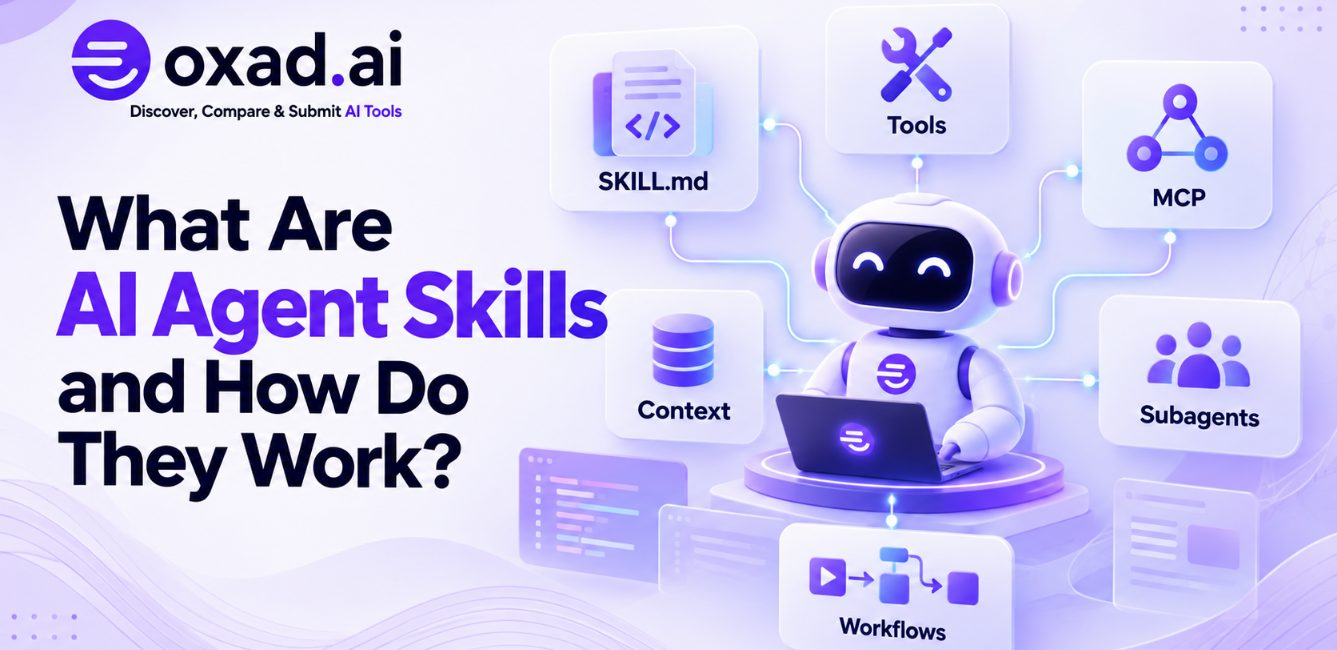
The prompt describes the user’s goal. The agent decides what needs to happen. A relevant skill supplies specialized procedures and knowledge. Tools provide capabilities such as file access, APIs, browsers, or command execution. Subagents can handle specialized parts of a larger task, while the workflow connects the actions into a repeatable process.
Prompt vs Tool vs Skill vs Agent
Concept
What it does
Prompt
Tells the AI what the user wants.
Tool
Gives the agent an external capability.
Skill
Teaches the agent how to perform a recurring specialized task.
Agent
Coordinates reasoning, tools, skills, and actions.
Subagent
Handles a specialized part of a larger task.
Workflow
Connects multiple actions into a repeatable process.
What Is SKILL.md?
SKILL.md is a commonly used convention for describing an agent skill. It can provide the instructions an agent should follow when a particular capability is invoked. Depending on the environment, a skill can also be accompanied by scripts, references, examples, or other supporting resources.
The important idea is not the filename itself. The important idea is that agent expertise can be packaged as a reusable, discoverable unit.
AI Agent Skills vs MCP
Agent Skills and MCP solve different parts of the agent architecture.
Technology
Main question
MCP
How can an AI system connect to external tools and data sources?
Skill
How should an agent perform a particular task using its available capabilities?
Tool
What capability can the agent invoke?
Agent
How should the system coordinate reasoning and actions?
A useful mental model is: MCP is connection, a skill is expertise or procedure, a tool is capability, and an agent is the orchestrator. They can therefore work together rather than being direct replacements for one another.
Are Agent Skills the App Store of AI Agents?
As reusable skills become easier to share, a new ecosystem is emerging around skill libraries and repositories. This is conceptually similar to how mobile applications created reusable software ecosystems, although an agent skill is different from a traditional app because it can package instructions, procedures, references, and executable resources for an agent.
The result could be a future in which developers assemble agents from reusable skills instead of building every workflow from scratch.
How Coding Agents Use Skills
Coding agents are a natural environment for skills because software development contains many recurring procedures. A skill could teach an agent how to review pull requests, migrate a database, follow a repository’s testing process, generate documentation, or troubleshoot a specific framework.
Tools such as AI coding agents can benefit from this model because reusable expertise can sit above the underlying model and make workflows more consistent.
Skills, Context, and Tools
A useful way to understand modern agent architecture is to separate three layers. Skills provide procedural knowledge, context provides the information needed for the current task, and tools allow the agent to take action.
For example, a documentation skill may define how documentation should be written, AI agent context may provide relevant project information, and a tool may create or update the documentation file.
Can AI Agent Skills Work With Workflows?
Yes. Skills become especially useful when an agent is expected to complete multi-step workflows. A skill can describe the process, while tools execute individual actions and the agent coordinates the overall task.
This is part of the broader move from chatbots toward AI agent workflows that can plan, act, verify, and continue through several steps.
Are AI Agent Skills Safe?
Skills should be treated as executable or operational dependencies rather than harmless text. Depending on their design, they may include scripts, shell commands, references, external dependencies, or instructions that influence what an agent does.
That means developers should review the source of a skill, understand what permissions it expects, inspect scripts and dependencies, and avoid giving agents more access than the task requires.
Security principle: Reusable agent capabilities should be trusted, reviewed, versioned, and permissioned like other software dependencies.
Why Agent Skills Matter for AI Development
Skills create a layer between a general-purpose model and a specialized workflow. This can make agents easier to extend without retraining the underlying model for every new task.
It also changes how developers may evaluate AI agents. Model quality still matters, but the practical capability of an agent can increasingly depend on the quality of its skills, tools, context, permissions, and workflows.
What Is the Future of AI Agent Skills?
The direction is toward increasingly modular agents. Instead of treating every agent as a closed product, developers can combine reusable skills with tools, context systems, MCP connections, and subagents.
This could make agent ecosystems more composable: a developer selects the agent, adds the required capabilities, supplies the relevant context, and lets the system coordinate the workflow.
Frequently Asked Questions
What are AI agent skills?
They are reusable packages of instructions and resources for specialized agent tasks.
What is an agent skill?
An agent skill teaches an AI system how to perform a recurring task.
What is SKILL.md?
SKILL.md is a common convention for describing an agent skill and its instructions.
How do AI agent skills work?
The agent loads relevant skill guidance and applies it with available tools and context.
Are agent skills the same as MCP?
No. MCP focuses on connecting AI systems with tools and external data sources.
What is the difference between a skill and a tool?
A tool provides a capability while a skill explains how to use capabilities for a task.
Can coding agents use skills?
Yes. Skills can encode repeatable software development and repository workflows.
Can AI agent skills contain code?
Some skill packages can include scripts or other executable supporting resources.
Are AI agent skills safe?
They can introduce risk, so their instructions, scripts, dependencies, and permissions should be reviewed.
Why are agent skills useful?
They make specialized agent behavior reusable instead of requiring repeated prompts.
Conclusion
AI Agent Skills represent an important shift from simply prompting AI toward programming AI agents with reusable expertise. Skills can complement tools, MCP, context systems, subagents, and workflows, giving agents a more modular way to perform specialized work.
For developers, the emerging skill ecosystem is worth watching because it could become an important layer in how AI coding agents and autonomous workflows are built, shared, secured, and maintained.
5 Replies to “What Are AI Agent Skills and How Do They Work?”
Alex Morgan
The distinction between skills, tools, and MCP makes the whole agent architecture much easier to understand. SKILL.md seems especially useful for packaging repeatable workflows.
OXAD.AI Editorial Team
Absolutely. SKILL.md is especially interesting because it gives developers a practical way to package repeatable expertise without changing the underlying model. The combination of skills and tools could make agent workflows much more modular.
Sophia Lee
I like the idea of treating AI agent skills as reusable expertise rather than simply another type of plugin. The connection between skills, context, and tools is particularly interesting.
Daniel Carter
The security section is important. If skills can include scripts and instructions that influence an agent, reviewing permissions and dependencies before installing them should become standard practice.
OXAD.AI Editorial Team
That is an important point. As skills become easier to share, provenance and permission boundaries will matter just as much as the instructions themselves. Treating a skill like a software dependency is a useful mindset.



5 Replies to “What Are AI Agent Skills and How Do They Work?”
The distinction between skills, tools, and MCP makes the whole agent architecture much easier to understand. SKILL.md seems especially useful for packaging repeatable workflows.
Absolutely. SKILL.md is especially interesting because it gives developers a practical way to package repeatable expertise without changing the underlying model. The combination of skills and tools could make agent workflows much more modular.
I like the idea of treating AI agent skills as reusable expertise rather than simply another type of plugin. The connection between skills, context, and tools is particularly interesting.
The security section is important. If skills can include scripts and instructions that influence an agent, reviewing permissions and dependencies before installing them should become standard practice.
That is an important point. As skills become easier to share, provenance and permission boundaries will matter just as much as the instructions themselves. Treating a skill like a software dependency is a useful mindset.