What Is AI Model Routing and How Does It Make AI Agents Smarter and Cheaper?
AI systems are increasingly moving beyond the idea of using one model for every task. A simple request may only need a fast, inexpensive model, while complex reasoning, coding, debugging, or long-context work may require a much more capable model. AI model routing is the infrastructure layer that helps decide which model should handle each task.
Quick answer: AI model routing is the process of dynamically selecting an AI model for a specific task, based on factors such as capability, cost, latency, context requirements, reliability, and the current state of an AI workflow.
What Is AI Model Routing?
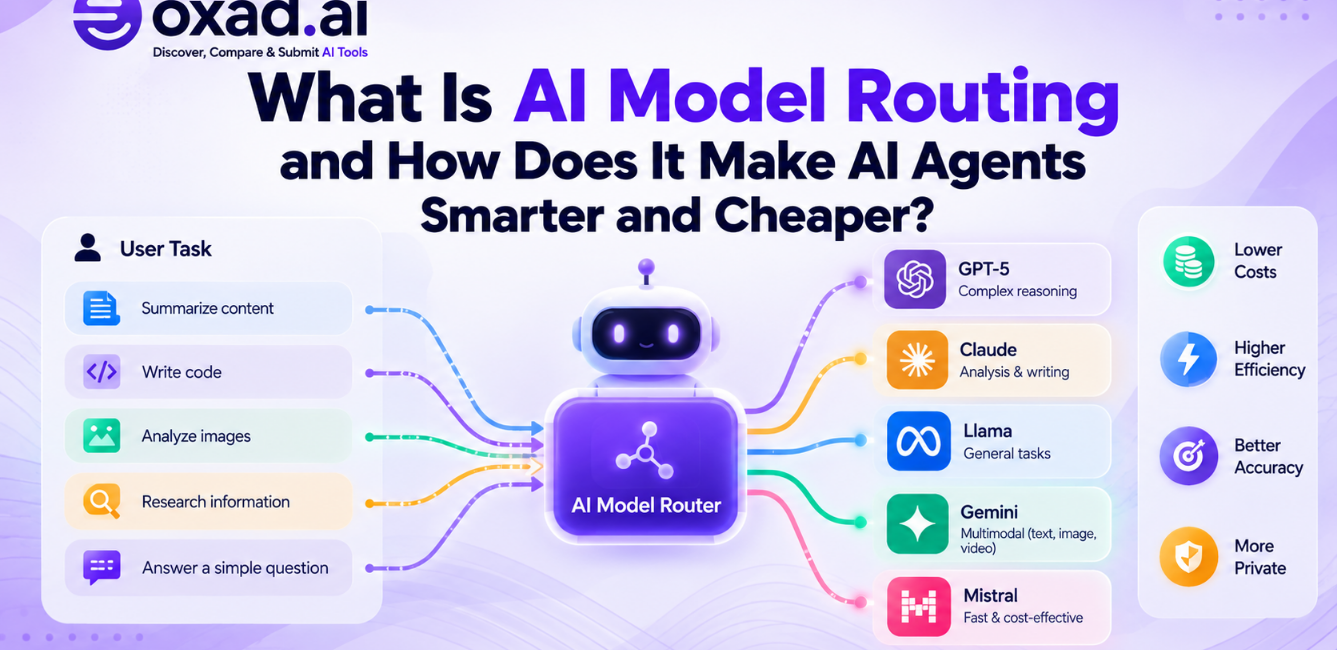
AI model routing is a system-level approach in which software evaluates a task and sends it to the model that best fits the requirements. Instead of permanently choosing one large language model, an AI application can use several models and route different requests to different models.
The basic idea can be represented as:
Traditional approach
Model routing approach
User → One model → Answer
User → AI system → Router → Suitable model → Result
Same model for most tasks
Different models for different tasks
Simple cost and performance trade-off
Dynamic quality, cost, latency, and capability trade-offs
Why Do AI Systems Need More Than One Model?
Not every AI task has the same requirements. A small classification task does not necessarily need the same reasoning capability as a difficult software debugging problem. Likewise, a real-time voice interaction may prioritize latency, while a research task may prioritize reasoning depth and context handling.
This creates a practical problem: which model should handle this specific task?
A routing layer can evaluate the request before execution and select a model according to the application’s objectives.
Task
Potential model preference
Main reason
Simple classification
Small or efficient model
Low cost and fast response
Summarization
Efficient language model
Good quality without unnecessary reasoning
Coding
Coding-capable model
Code generation and tool use
Complex reasoning
Frontier reasoning model
More demanding inference
Vision task
Vision-capable model
Image or multimodal understanding
How Does AI Model Routing Work?
A typical routing system can be divided into several steps. The exact architecture varies, but the basic process is straightforward.
1. Understand the task
The system first examines the incoming request. It may classify the task as coding, summarization, reasoning, extraction, conversation, research, tool use, or another category.
2. Inspect the context
The router can consider the available context, including conversation history, required tools, input size, previous agent steps, and whether the task belongs to a longer-running workflow. This is where AI agent context becomes important.
3. Evaluate candidate models
The system can compare available models according to capability, price, latency, context window, reliability, availability, and application policies.
4. Select an execution path
The router may select one model, use a sequence of models, or construct a more complex workflow. In some systems, a smaller model can produce an initial answer and a stronger model can review or improve it.
5. Execute and evaluate
The result can be evaluated using quality checks, tool outcomes, validation rules, or other signals. If the first model does not meet the required quality level, the system can escalate the task.
What Is the Difference Between Model Selection and Model Routing?
The terms are related, but they are not always used in exactly the same way.
Concept
Meaning
Model selection
Choosing a suitable model for a request or workload.
Model routing
Dynamically directing requests or workflow steps to suitable models.
Multi-model orchestration
Coordinating multiple models as part of one larger execution workflow.
In a simple application, model selection might happen once before a request starts. In an agentic system, routing can happen repeatedly as the workflow changes.
What Is Dynamic Model Routing?
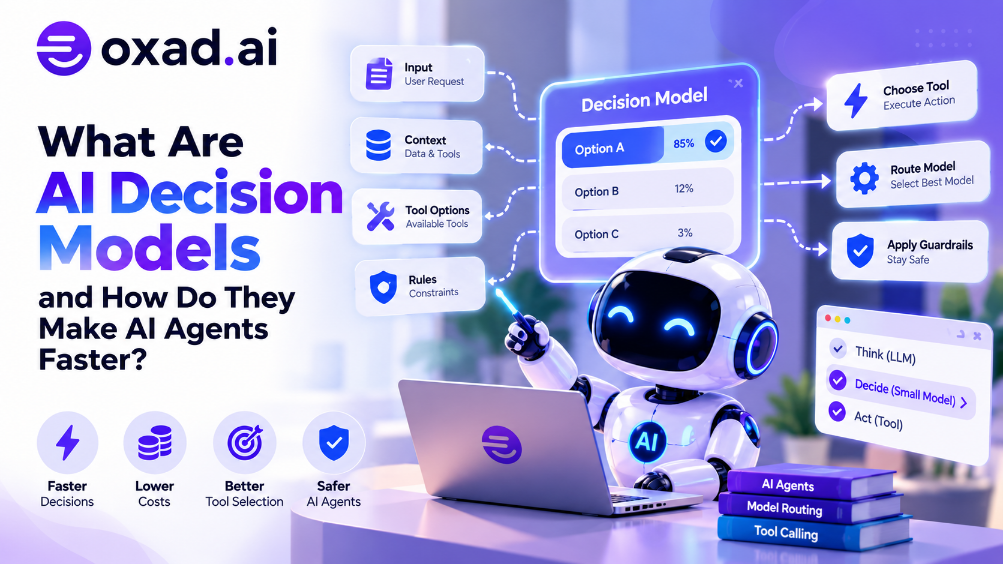
Dynamic model routing means that the decision is made at runtime rather than being permanently configured. The router can use information about the current task, context, model availability, cost, latency, and previous execution results.
For example, an AI agent could begin with an efficient model for a straightforward request. If the task becomes more complex after tool calls or code analysis, the agent could route a later step to a stronger model.
The important shift: routing changes the question from “Which model should we use?” to “Which model should handle this step of this task right now?”
How Does AI Model Routing Reduce AI Costs?
Using the most expensive or compute-intensive model for every request can be inefficient when many tasks do not require its full capabilities. Routing can instead match model capability to task difficulty.
For example, a system could send routine classification and short transformations to an efficient model while reserving a more expensive model for complex reasoning, difficult coding, or tasks where quality requirements justify the additional cost.
However, routing does not automatically reduce costs. A router introduces its own computation and complexity, and a poorly designed policy can make unnecessary model calls or reduce quality. The financial effect therefore depends on the workload, model pricing, routing policy, cache behavior, and evaluation method.
What Is AI Model Routing in AI Agents?
AI agents make routing more interesting because an agent does not simply generate one answer. It can plan, read context, call tools, inspect results, retry failed actions, delegate work, and continue across multiple steps.
This means model routing can happen at different points in an agent workflow:
At the beginning of a task.
When the agent creates a plan.
When a coding step requires deeper reasoning.
When a tool result changes the task.
When a subagent is launched.
When a quality check indicates that the current result is insufficient.
This is closely connected to AI agent infrastructure, because the harness can coordinate models, tools, context, state, and execution decisions.
What Is the Connection Between Model Routing and AI Coding Agents?
AI coding is one of the clearest examples of why routing matters. A coding agent may perform many different operations during one session: understand a repository, search files, write code, run tests, debug an error, review a change, and explain the result.
Those operations do not necessarily have identical model requirements. A routing system can therefore treat the coding session as a sequence of tasks instead of assuming that one model must handle everything.
GitHub’s Project HydraFusion is a recent example of this direction. GitHub describes it as a research preview that can select between single-model execution, cascade workflows, and draft-and-critique workflows, with the goal of balancing quality, cost, and latency.
GitHub also introduced configurable cost-and-quality priorities for Copilot Auto model selection, allowing users to emphasize efficiency, balance, or intelligence when the system chooses a model for a prompt.
These developments illustrate a broader idea: AI coding agents can increasingly be designed around model choice as part of the runtime rather than treating the model as a fixed component.
What Is Multi-Model Orchestration?
Multi-model orchestration goes one step beyond selecting a single model. Several models can participate in the same workflow, with each model performing a different role.
A simple example might look like this:
Stage
Possible role
Understand
Classify the request and identify requirements
Draft
Generate an initial solution efficiently
Critique
Check the result for errors or weaknesses
Escalate
Use a stronger model when the task requires it
This does not mean that every AI application needs multiple models. The added orchestration can introduce latency, complexity, and additional failure points. The value comes when the workload benefits from specialization or differentiated cost and capability.
Why Is AI Model Routing Becoming More Important Now?
The number of capable AI models is increasing, while models are becoming more specialized across reasoning, coding, multimodal understanding, speed, context length, and cost. As a result, choosing one universal model becomes less attractive for some AI systems.
Recent research also treats routing as an agent infrastructure problem rather than only a traditional model-serving optimization. A September 24, 2026 study describes an agent harness as a layer that can decide which model answers, what information the model reads, how prompt caching is used, and which subagents run. The authors report a routing experiment focused on reducing model spend in enterprise coding workloads.
Other 2026 research similarly describes agentic routing as a step-level decision made using the state of the execution harness, rather than simply selecting a model for an isolated prompt.
What Are the Main Challenges of AI Model Routing?
Routing quality
The router must make good decisions. Sending a difficult task to an inexpensive but unsuitable model can reduce quality.
Latency
A routing layer should not add more delay than the optimization is worth, especially in real-time applications.
Context and caching
Switching models during a long workflow can have implications for context handling and prompt-cache efficiency.
Evaluation
A routing policy needs meaningful measurements. A lower API bill is not useful if the resulting quality drops below the application’s requirements.
Reliability
Models can have different availability, rate limits, failure patterns, and tool-use behavior. A production router needs to account for these operational differences.
Is AI Model Routing the Same as Using a Model Router API?
Not necessarily. A model router can be a dedicated service or API that exposes several models behind one interface. AI model routing is the broader concept: any system that dynamically decides which model should perform a task can implement routing.
A simple application may use a rules-based router. A more advanced system may use a classifier, benchmark data, historical execution results, real-time model signals, or an agent harness to make the decision.
What Could AI Model Routing Mean for the Future of AI Agents?
The long-term implication is that an AI agent may increasingly be defined by more than its underlying model. The runtime can decide which model to use, what context to provide, which tools to call, whether to delegate a task, and when to verify the result.
This suggests a broader progression:
Single model → model selection → model routing → multi-model orchestration → adaptive agent systems
The most capable model may still matter enormously, but the overall system can gain additional flexibility by deciding when that capability is actually necessary.
AI Model Routing vs. Always Using the Best Model
It is tempting to assume that the strongest available model should handle every task. In practice, “best” depends on what the application is optimizing for.
If the priority is…
Routing may prioritize…
Lowest cost
Efficient models where quality remains acceptable
Lowest latency
Fast and available models
Highest quality
More capable models or multi-model verification
Balanced performance
A mixture based on task difficulty
Frequently Asked Questions
What is AI model routing?
AI model routing dynamically sends tasks to models selected according to capability, cost, latency, context, or other requirements.
What is LLM routing?
LLM routing is the practice of directing language-model requests to different LLMs based on the needs of each request or workflow step.
How does AI model routing reduce costs?
It can reserve expensive models for demanding tasks while using efficient models for simpler work, although actual savings depend on workload and routing quality.
How do AI agents choose the right model?
An agent system can use task type, context, tools, model capabilities, latency, cost, availability, and previous execution signals.
Is model routing useful outside coding?
Yes. Routing can be used for customer support, research, document processing, multimodal applications, automation, and other AI workflows.
Does model routing always improve AI performance?
No. Poor routing can increase latency, cost, or errors, so routing policies need testing and continuous evaluation.
Conclusion
AI model routing changes how we think about AI systems. Instead of asking which single model is the best for everything, developers can build systems that decide which model is appropriate for each task, step, or workflow.
That distinction becomes particularly important as AI agents become more capable and workflows become longer and more complex. The future of AI may not depend only on building stronger models. It may also depend on building better systems for deciding when, where, and how each model should be used.